Facts
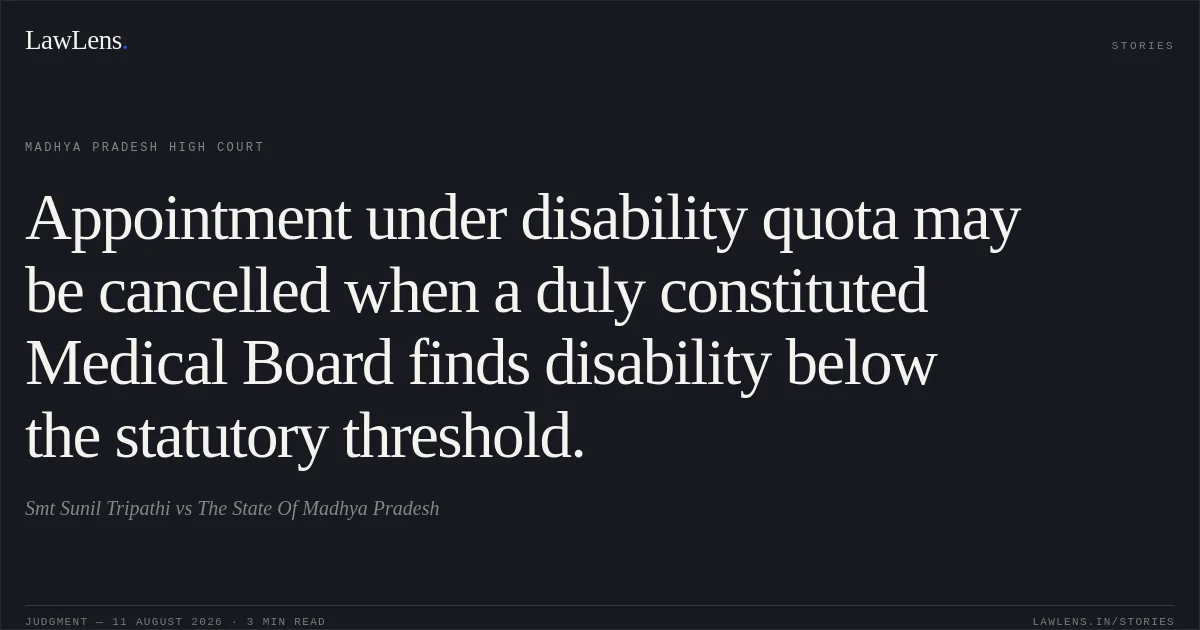
The petitioner participated in the 2019 recruitment process for Higher Secondary Teachers and was appointed as a Higher Secondary Teacher (Sanskrit) under the visually impaired (VH) disability category on 6 October 2021, based on a disability certificate recording 40% disability.
Source reference: para. 2Following complaints concerning allegedly forged disability certificates, the Directorate directed verification of disability certificates through Medical Boards.
Source reference: para. 3Upon medical re-examination, the petitioner’s disability was assessed at 20%, instead of 40%, and a recommendation was made to cancel the appointment.
Source reference: paras. 2–3.1, 5The petitioner sought re-examination by another Medical Board, but that request had already been rejected by the Commissioner, Public Instructions, on 13 February 2025.
Source reference: para. 3.1Thereafter, the respondents passed the impugned order dated 16 June 2026 cancelling the petitioner’s appointment.
Source reference: paras. 1–2The petitioner challenged the order under Article 226 of the Constitution, contending, inter alia, that the 20% disability certificate had not been supplied and that re-examination was pending.
Source reference: paras. 1–2Issues
Whether the impugned order cancelling the petitioner’s appointment, on the basis of a duly constituted Medical Board’s assessment that the petitioner had only 20% disability, violated the principles of natural justice.
Source reference: paras. 3.1, 5Whether the Court should direct a fresh medical examination or reassessment of the petitioner’s disability by another Medical Board.
Source reference: paras. 2, 5–6Whether non-supply of the 20% disability certificate warranted interference with the impugned order.
Source reference: para. 8Law Applied
The Court exercised judicial review under Article 226 of the Constitution, applying the principles of natural justice to determine whether the petitioner had been afforded a meaningful opportunity of hearing.
Source reference: paras. 1, 5It relied on the administrative finding that a duly constituted Medical Board had assessed the petitioner’s disability at 20% and noted that no provision for reassessment had been shown.
Source reference: paras. 3.1, 5The Court further applied the principle that expert medical assessments by an independent Government Medical College or its associated hospital should not ordinarily be interfered with absent allegations or proof of mala fides, malpractice, or improper assessment.
Source reference: para. 6It also recognised the petitioner’s statutory remedy under the Right to Information Act, 2005, for obtaining the disability certificate and the availability of an appeal in accordance with law against the medical assessment.
Source reference: para. 8No judicial precedent was cited in the judgment.
Source reference: no citationReasoning
The Court found that the impugned order had been passed after the petitioner was given an opportunity of hearing and therefore did not violate natural justice.
Source reference: paras. 3.1, 5The assessment of 20% disability was made by a duly constituted Medical Board, and the petitioner’s request for examination by another Board had already been rejected by the competent higher authority.
Source reference: para. 5Since the petitioner neither pleaded nor demonstrated malpractice, improper assessment, or lack of independence on the part of the Medical Board associated with the Government Medical College, the Court declined to substitute its view for that of the medical experts or order reassessment.
Source reference: para. 6The petitioner’s grievance regarding non-supply of the certificate did not justify quashing the appointment-cancellation order, as the certificate could be sought under the RTI Act and the medical finding could be challenged through the appropriate appellate remedy.
Source reference: para. 8Holding
The Court held that the cancellation order dated 16 June 2026 was not vitiated by breach of natural justice and that no case was made out for interference under Article 226 or for a fresh medical examination.
The writ petition was accordingly dismissed as devoid of merit.
Source reference: para. 7The petitioner was granted liberty to obtain the 20% disability certificate under the Right to Information Act, 2005, and, if dissatisfied with the re-examination report, to pursue the appellate remedy available in law.
Source reference: para. 8Original Court PDF
Smt Sunil TripathivsThe State Of Madhya Pradesh
Click to open original judgment
Original judgment, available to read, download and summarize on LawLens.in