Facts
Sat Jinda Kalyana College, affiliated with Maharshi Dayanand University (“MDU”), advertised a post of Assistant Professor of Physical Education on 14 February 2018. The sixth respondent was selected and appointed, while the appellants were not included in the merit list.
Source reference: para. 4After the appointment, information obtained under the Right to Information Act indicated that Bundelkhand University had not conducted a Ph.D. programme during 2011–2014 and that the sixth respondent had not attended any such programme.
Source reference: para. 5Further material, including an affidavit of Bundelkhand University’s Registrar or Controller of Examinations, prima facie indicated that the claimed Ph.D. degree, a letter allegedly issued by Bundelkhand University, and a certificate were forged or fabricated.
Source reference: para. 6The appellants filed a writ petition under Article 226 seeking quo warranto, but the Single Judge dismissed it, holding that the sixth respondent’s UGC-NET qualification independently satisfied the eligibility requirement and that the appellants had not controverted MDU’s stand.
Source reference: para. 8The Division Bench dismissed the intra-court appeal on the grounds that the appellants lacked locus standi and could not use quo warranto to vindicate personal grievances arising from an unsuccessful selection process.
Source reference: para. 9The appellants thereafter approached the Supreme Court through special leave petitions.
Source reference: paras. 1–2Issues
1. Whether the appellants could maintain a writ of quo warranto challenging the sixth respondent’s appointment on the allegation that his Ph.D. degree was forged.
Source reference: paras. 8–9, 13–142. Whether the sixth respondent lacked an essential qualification for appointment as Assistant Professor of Physical Education because of the alleged invalidity of his Ph.D. degree.
Source reference: paras. 10–153. Whether, notwithstanding dismissal of the appellants’ challenge and continuation of the appointment, the Supreme Court should direct an independent inquiry into the authenticity of the sixth respondent’s Ph.D. degree.
Source reference: paras. 18–20Law Applied
A writ of quo warranto lies where a person occupies a public office without the requisite qualification or despite a legal disqualification; the petitioner may be a stranger, but must establish the disqualification through unimpeachable evidence, after which the burden shifts to the appointee and appointing authority to rebut it.
Source reference: para. 14The Court considered the UGC Regulations on minimum qualifications, particularly the 2010 Regulations applicable to the 2018 advertisement, under which qualifying the UGC-NET/SLET/SET was ordinarily mandatory, while a Ph.D. awarded in accordance with the UGC Ph.D. Regulations, 2009 could exempt a candidate from that requirement.
Source reference: paras. 11–12The Court also considered the principles governing quo warranto stated in A.N. Shastri v. State of Punjab, R.K. Jain v. Union of India, Dr B. Singh v. Union of India and B. Srinivasa Reddy v. Karnataka Urban Water Supply & Drainage Board Employees Association.
Source reference: para. 9Article 142 permits the Supreme Court to pass orders necessary to do complete justice, subject to observance of natural justice.
Source reference: paras. 18–20Reasoning
The Court held that the Ph.D. was not an essential qualification for the post. Under the applicable recruitment criteria, NET/SLET/SET was mandatory, whereas a Ph.D. was relevant either as an exemption from that requirement or as a basis for additional marks.
Source reference: paras. 11–12, 15Since the sixth respondent had admittedly qualified the UGC-NET examination, the alleged falsity of his Ph.D. did not render him ineligible for appointment or establish usurpation of public office for purposes of quo warranto.
Source reference: para. 15The appellants therefore could not succeed in invalidating the appointment, particularly when they were unsuccessful candidates and had not shown that they themselves were entitled to appointment.
Source reference: para. 9However, the material subsequently placed before the Supreme Court—including Bundelkhand University’s assertion that the degree and related documents were fabricated—required verification.
Source reference: paras. 6, 18–19The Court accordingly distinguished between the absence of a ground to quash the appointment through quo warranto and the need to investigate possible deceit in securing additional marks or appointment-related benefits.
Source reference: paras. 6, 18–19Holding
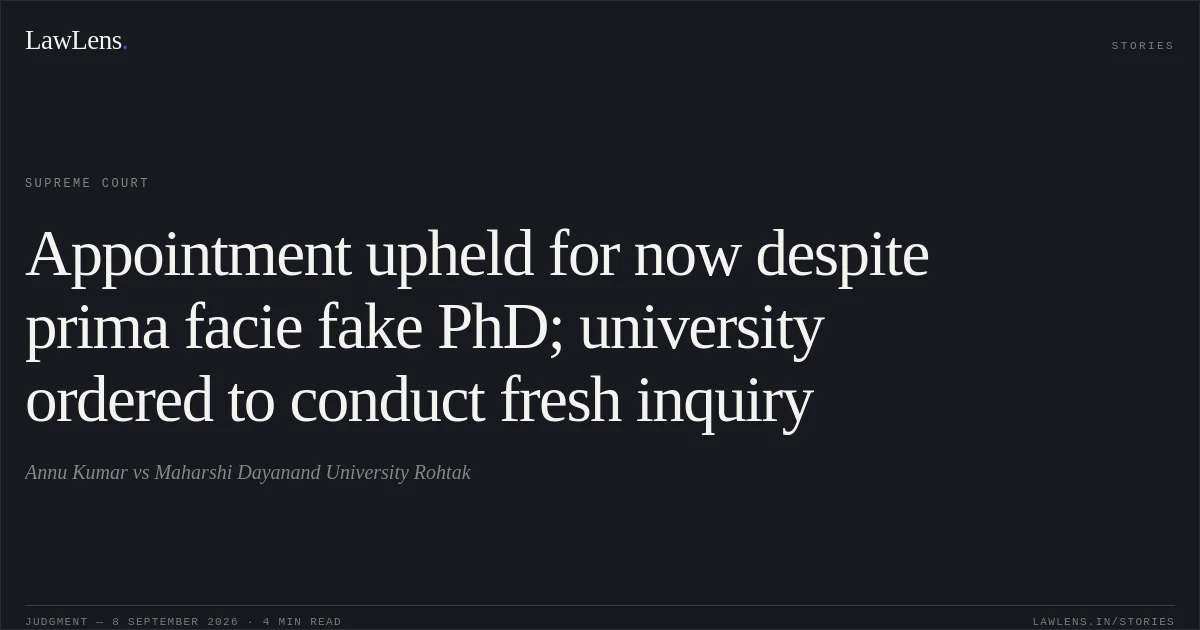
The appeals were disposed of without disturbing the sixth respondent’s appointment, as his UGC-NET qualification independently fulfilled the mandatory eligibility requirement and the appellants had not established a case for quo warranto.
Exercising power under Article 142, the Court granted MDU liberty to conduct a fresh inquiry into the authenticity of the Ph.D. degree.
Source reference: para. 19The sixth respondent must produce the original degree before MDU officials, while Bundelkhand University officials must produce the supporting records relied upon in their affidavit.
Source reference: para. 19The sixth respondent must be afforded an effective opportunity of defence and cross-examination, and the inquiry must comply with natural justice.
Source reference: para. 19If the degree is found to be forged, MDU, the College, Bundelkhand University, or any other person may provide information to the police for criminal prosecution in accordance with law.
Source reference: para. 20Parties were directed to bear their own costs.
Source reference: para. 23Original Court PDF
Annu KumarvsMaharshi Dayanand University Rohtak
Click to open original judgment
Original judgment, available to read, download and summarize on LawLens.in