Facts
The petitioners, claiming to be TET-qualified candidates residing in various districts of Assam, challenged the engagement of Assistant Teachers under the Assam scheme titled “Strengthening Elementary Education of Assam.”
Source reference: p. 23The State authorities had issued an advertisement dated 30 June 2017 inviting applications for 7,042 contractual Assistant Teacher posts, while stipulating that the category-wise vacancies might increase or decrease after departmental approval.
Source reference: pp. 23–24, para. 4; p. 27, para. 5The petitioners did not participate in the recruitment process, asserting that the limited district-wise vacancies made their chances of selection remote.
Source reference: pp. 24–26, para. 4The result was declared on 1 September 2017. Thereafter, by Notification dated 6 September 2017, the authorities notified the engagement of 11,319 TET-qualified candidates, including candidates appointed against the increased vacancy and placed in the State Pool of Teachers.
Source reference: pp. 25–28, para. 4; pp. 40–41, paras. 14–14.1The petitioners approached the Court between May 2019 and February 2024, with delays ranging from approximately 19 months to 76 months.
Source reference: p. 49, para. 18Issues
Whether the petitioners, who did not participate in the recruitment process, had the locus standi to challenge the selection and engagement of the candidates.
Source reference: pp. 41–44, paras. 15–16.4Whether the engagement of candidates in excess of the 7,042 vacancies originally indicated in the advertisement violated the petitioners’ rights under Articles 14 and 16 of the Constitution.
Source reference: pp. 45–48, paras. 17–17.6Whether the writ petitions were liable to be rejected on the ground of delay and laches.
Source reference: pp. 48–55, paras. 18–18.12Whether the Notification dated 6 September 2017 could be challenged without challenging the foundational advertisement dated 30 June 2017, particularly its clause permitting an increase or decrease in vacancies.
Source reference: pp. 56–57, paras. 19–19.3Whether the State’s justification for engaging 11,319 teachers through the existing recruitment process and creating a State Pool of Teachers was legally sustainable.
Source reference: pp. 57–60, paras. 20–20.5Law Applied
The Court applied the constitutional guarantee of equality of opportunity in public employment under Article 16, holding that appointments to State posts ordinarily require a properly issued advertisement and a fair selection process, relying on Union Public Service Commission v. Girish Jayanti Lal Vaghela, (2006) 2 SCC 482.
Source reference: pp. 45–46, para. 17.2It also relied on State of U.P. v. Neeraj Awasthi, (2006) 1 SCC 667, for the principle that illegal appointments made contrary to statutory rules cannot ordinarily be regularised.
Source reference: pp. 46–47, para. 17.3However, where an advertisement expressly provides that vacancies may increase or decrease, additional appointments from the same selection process may be permissible, as recognised in Sanjay Kumar Mishra v. District Judge, Ambedkar Nagar, Civil Appeal No. ___ of 2025 arising from SLP (C) No. 14980 of 2024.
Source reference: pp. 47–48, paras. 17.4–17.5On locus, the Court relied on Jasbhai Motibhai Desai v. Roshan Kumar, (1976) 1 SCC 671, and Madan Lal v. High Court of J&K, (2014) 15 SCC 308, holding that strangers generally cannot challenge service-selection matters through public-interest litigation, except in appropriate quo warranto proceedings.
Source reference: pp. 42–44, paras. 16.1–16.2The Court further applied the doctrine of delay and laches under Article 226, relying on P.S. Sadasivaswamy v. State of T.N., (1975) 1 SCC 152; Mrinmoy Maity v. Chhanda Koley, (2024) 15 SCC 215; Tridip Kumar Dingal v. State of W.B., (2009) 1 SCC 768; Union of India v. Tarsem Singh, (2008) 8 SCC 648; and Shiv Dass v. Union of India, (2007) 9 SCC 274.
Source reference: pp. 49–55, paras. 18.1–18.7Finally, the Court applied the limited scope of judicial review over governmental policy decisions, permitting interference only for illegality, unconstitutionality, arbitrariness, discrimination or mala fides.
Source reference: pp. 59–60, paras. 20.3–20.4Reasoning
The Court held that the petitioners were strangers to the selection process because they neither applied nor participated in the recruitment, and their challenge was effectively a public-interest challenge to the number of appointments rather than a person-specific grievance.
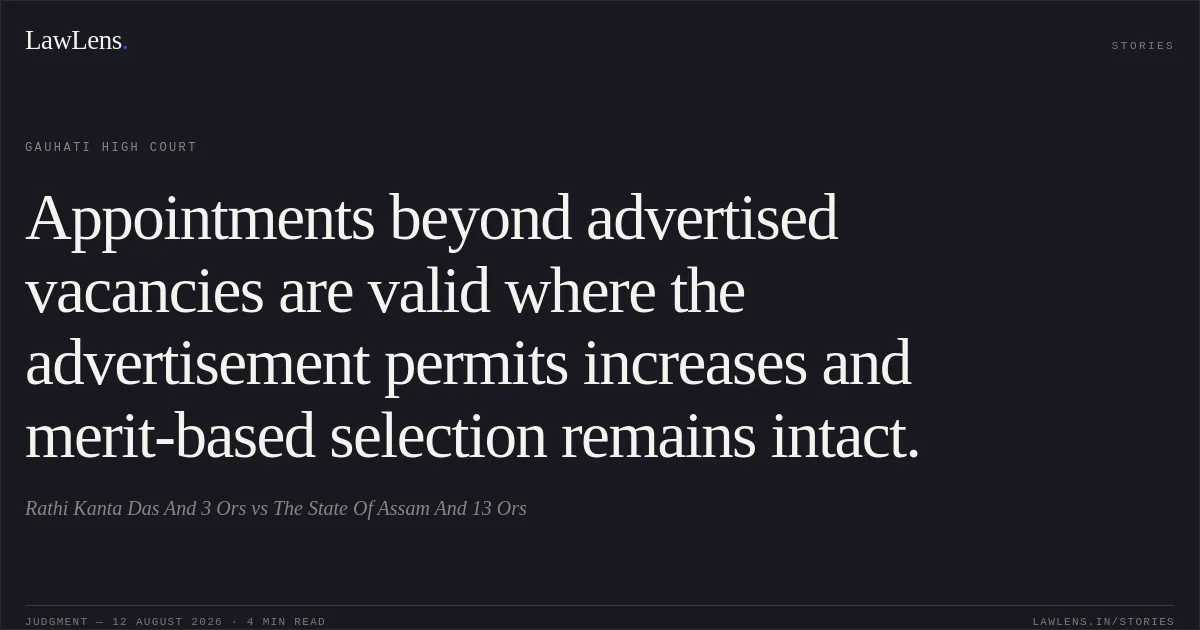
Source reference: pp. 42–44, paras. 16.1–16.4Although appointments ordinarily cannot exceed advertised vacancies, the advertisement expressly authorised an increase or decrease in vacancies. The additional candidates were selected from the same recruitment exercise and the petitioners did not establish that the selection criteria had been altered, that the appointments were not merit-based, or that the process was mala fide or discriminatory.
Source reference: pp. 47–48, paras. 17.4–17.6; pp. 56–57, paras. 19.1–19.3The Court also found the petitions grossly delayed: the first petition was filed after approximately 19 months and the later petitions after delays extending to 76 months. The explanations of financial hardship and personal reasons were considered insufficient, particularly because the challenged engagement had created settled third-party rights and the status of many appointees had subsequently changed, including through later policy measures and regularisation-related developments.
Source reference: pp. 48–55, paras. 18–18.10Since the vacancy-increase clause was the foundation of the impugned Notification, failure to challenge the advertisement itself further weakened the petitions.
Source reference: p. 57, para. 19.3The State’s reliance on the 3 August 2017 Government of India communication and the imminent 15 September 2017 NIOS registration deadline was accepted as a rational administrative basis for filling the State Pool from the existing merit process rather than commencing an impracticable fresh recruitment exercise.
Source reference: pp. 57–60, paras. 20–20.2The Court therefore declined to substitute its view for the State’s policy decision in the absence of proven illegality, arbitrariness or mala fides.
Source reference: pp. 59–60, paras. 20.3–20.5Holding
The Court answered the locus issue against the petitioners, holding that non-participants in the recruitment process could not maintain the challenge.
It held that the additional appointments did not, in the circumstances, violate Articles 14 and 16 because the advertisement permitted an increase in vacancies and the appointments were made from the same selection process.
Source reference: p. 48, para. 17.6The petitions were also barred by delay and laches, and the petitioners could not successfully challenge the Notification dated 6 September 2017 without challenging the advertisement dated 30 June 2017.
Source reference: pp. 55, 57, paras. 18.12, 19.3The State’s justification for creating the State Pool and engaging 11,319 teachers was found legally sustainable.
Source reference: p. 60, para. 20.5Accordingly, all five writ petitions were dismissed as not maintainable, with the parties directed to bear their own costs.
Source reference: pp. 61–62, paras. 21–23Acts & Sections Cited
1 provisions across 1 statute referred to in this judgment. Linked provisions open on LawLens.
Right of Children to Free and Compulsory Education Act, 20091
Original Court PDF
Rathi Kanta Das And 3 OrsvsThe State Of Assam And 13 Ors
Click to open original judgment
Original judgment, available to read, download and summarize on LawLens.in