01Facts
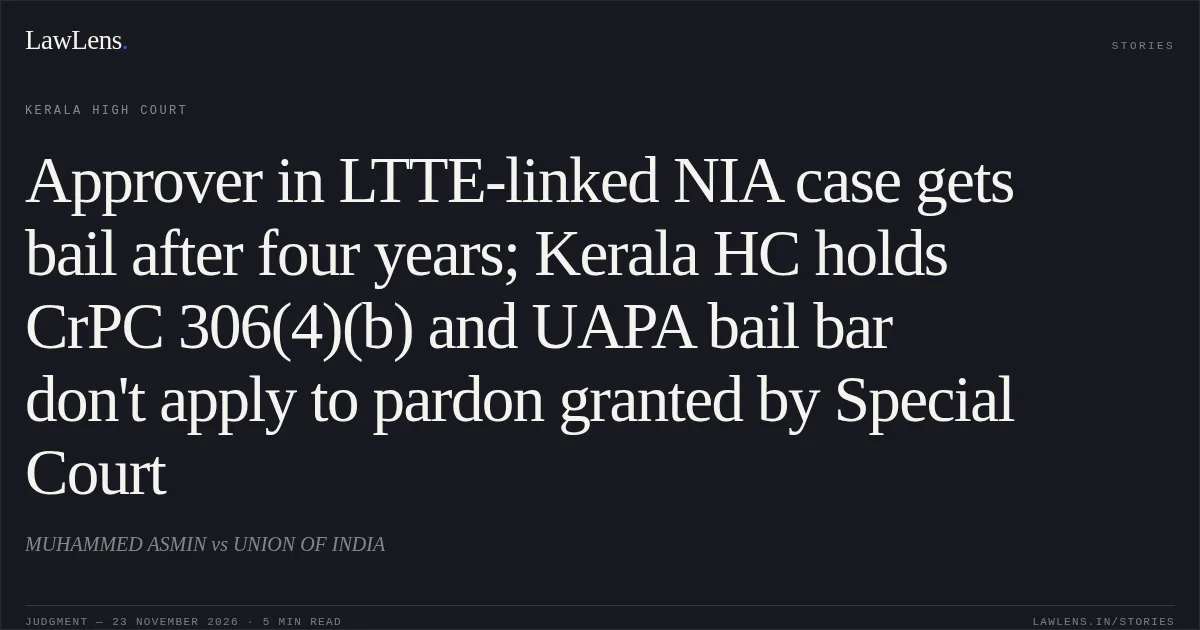
The appellant, a Sri Lankan national, is an accused in a transnational conspiracy case involving alleged LTTE-linked financing, more than 300 kg of heroin, AK-56 rifles and ammunition.
¶ 1He is charged under Section 120B IPC, UAPA Sections 17, 18, 20, 38–40, and NDPS Sections 20(b)(ii)A, 21(c), 23(c), 27A, 28 and 29.
¶ 2(a)–(d)He was arrested on 19.12.2022.
¶ 3He gave a Section 164 CrPC statement, and on 19.12.2023 the Special Court for NIA Cases, Chennai, granted him pardon in Crl.M.P. No. 1610/2023, which he accepted and became an approver.
¶ 3The Madras High Court, by order dated 31.07.2025, disposed of his bail plea and directed expeditious framing of charges and his examination.
¶ 4The case was then transferred to Ernakulam under Supreme Court directions.
¶ 4He had been in custody for nearly four years, while accused Nos. 8 and 14, who had also turned approvers in a connected case, were granted bail.
¶ 5The Special Judge rejected his bail application under Section 483 BNSS on 18.09.2026, relying on Section 306(4)(b) CrPC, Section 43D(7) UAPA, foreign-national status and flight risk.
¶ 6The appeal under Section 21 NIA Act challenges that order.
¶ 1The parties' undisputed facts are his pardon, acceptance and continuous custody since 19.12.2022.
¶ 1002Issues
i.1. Whether the restriction in Section 306(4)(b) CrPC, mandating detention of an approver until termination of trial, applies to a person pardoned by the Special Court under Section 307 CrPC.
¶ 11 · ¶ 22 · ¶ 27ii.2. Whether the embargo on bail under Section 43D(7) UAPA and Section 37 NDPS Act applies to an approver whose pardon remains operative.
¶ 28 · ¶ 30 · ¶ 32iii.3. Whether prolonged incarceration is a relevant consideration in deciding bail for an approver accused of serious offences.
¶ 32 · ¶ 33 · ¶ 3803Law Applied
Section 306 CrPC permits a Magistrate to tender pardon at any stage, and sub-section (4)(b) requires an approver to be detained until the termination of trial unless already on bail.
¶ 13 · ¶ 14Section 307 CrPC empowers a Court to tender pardon after commitment and does not contain an equivalent of Section 306(4)(b).
¶ 15 · ¶ 16Under Section 16(1) of the NIA Act, a Special Court may take cognizance without committal, making it a Court of Session for these purposes.
¶ 20 · ¶ 21Section 308 CrPC governs the consequences of non-compliance with pardon conditions.
¶ 24–26Section 43D(7) UAPA bars bail to non-citizens who entered or remain in India illegally, save in very exceptional circumstances, and Section 37 NDPS is analogous.
¶ 29 · ¶ 30A. Devendran v. State of T.N. (1997) 11 SCC 720; Shammi Firoz v. NIA (2010) 4 KHC 319; and Saidevan Thampi v. State of Kerala (2013 KHC 694) were relied upon on the scope of pardon and the Special Court's powers.
¶ 16 · ¶ 23State of Maharashtra v. Abu Salem (2010) 10 SCC 179 was relied upon in the bail analysis.
¶ 31A.J. Peiris v. State of Madras, AIR 1954 SC 616 was relied upon in the bail analysis.
¶ 32Union of India v. K.A. Najeeb (2021) 3 SCC 713 holds that statutory bail restrictions yield to Part III rights where trial is unlikely to conclude within a reasonable time and substantial incarceration has occurred.
¶ 34 · ¶ 35Javed Iqbal (2024) 8 SCC 293; Javed Gulam Nabi Shaikh (2024) 9 SCC 813; Rabi Prakash (2023 SCC OnLine SC 1109); and Athar Parwez (2024) 20 SCC 57 were relied upon on bail under statutory restrictions.
¶ 36 · ¶ 37Prasanta Kumar Sarkar v. Ashis Chatterjee (2010) 14 SCC 496 lists the factors relevant to bail.
¶ 33Mohd. Muslim v. State (NCT of Delhi) (2023) 18 SCC 166 addresses the harms of prolonged incarceration.
¶ 39Mahender Chawla v. Union of India (2019) 14 SCC 615 addresses witness protection.
¶ 41Provisions in the judgment · 25 · Linked ones open on LawLens
National Investigation Agency Act, 2008 Section 21Section 2Section 11Section 22Section 16
Bharatiya Nagarik Suraksha Sanhita, 2023 Section 483Section 398
Unlawful Activities (Prevention) Act, 1967 Section 17Section 18Section 20Section 38Section 39Section 40
Narcotic Drugs and Psychotropic Substances Act, 1985 Section 20Section 21Section 23Section 28Section 29Section 37
Code of Criminal Procedure, 1973 Section 164Section 306Section 307Section 308Section 195Section 340
04Reasoning
Section 306(4)(b) applies only to pardons tendered by a Magistrate under Section 306(1). The Special Court, being a Court of Session competent to take cognizance under Section 16(1) of the NIA Act, tendered pardon under Section 307 in this case. The restriction therefore could not be extended to the appellant, and the Special Judge erred in rejecting release solely on that basis.
¶ 23 · ¶ 27Section 43D(7) targets an accused who is a non-citizen and has entered or remains in India illegally. An approver whose pardon is operative ceases to occupy the position of an accused and is a prosecution witness, subject to the withdrawal of protection under Section 308. The same reasoning applies to Section 37 NDPS.
¶ 30 · ¶ 32The grant of pardon is conditional, and the appellant remains bound by the disclosure obligation.
¶ 26The gravity of the offences is not a bar where custody has become disproportionate. The Court relied on the four-year custody, the pardon, the bail granted to co-approvers in a connected case and the unlikelihood of early conclusion of trial.
¶ 33 · ¶ 38 · ¶ 40The Court reconciled this with Najeeb and Javed Iqbal, which permit constitutional courts to grant bail on Article 21 grounds notwithstanding statutory restrictions. The continued detention cannot be justified under either provision.
¶ 35 · ¶ 36 · ¶ 38Recognising that the approver's risk of reprisal is real, the Court directed that he be considered for protection under the Witness Protection Scheme.
¶ 41 · ¶ 4205Holding
Section 306(4)(b) CrPC does not apply to a pardon tendered by the Special Court under Section 307 CrPC.
¶ 27Section 43D(7) UAPA and Section 37 NDPS do not bar bail to an approver whose pardon remains in force, as he is a witness and not an accused.
¶ 30 · ¶ 32Prolonged incarceration of nearly four years, coupled with the grant of pardon and bail to co-approvers, entitles the appellant to release.
¶ 38 · ¶ 40The appeal is allowed, subject to conditions: (i) a bond of ₹1,00,000 with two solvent sureties to the satisfaction of the Special Court; (ii) surrender of any passport and no fresh travel document without permission; (iii) disclosure of address and contact details to the IO, with residence confined to Ernakulam District and availability for investigation; (iv) no right to remain in India conferred, with FRRO and immigration authorities free to act; (v) reporting to the NIA every Saturday (10–11 a.m.) if not admitted to an immigration facility; (vi) no contact with co-accused or witnesses; (vii) no media or social-media commentary on the case; (viii) no offence and good conduct; (ix) out-of-state sureties permitted subject to verification; (x) appearance as required; and (xi) liberty for the NIA to seek cancellation.
¶ 44(i)–(xi)The State Home Secretary is directed to bring the appellant within the Kerala Witness Protection Scheme and assess his safety, and the Registry is to forward the order to the Home Department.
¶ 42 · ¶ 43Original Court PDF
MUHAMMED ASMINvsUNION OF INDIA
Click to open original judgment
Original judgment, available to read, download and summarize on LawLens.in