01Facts
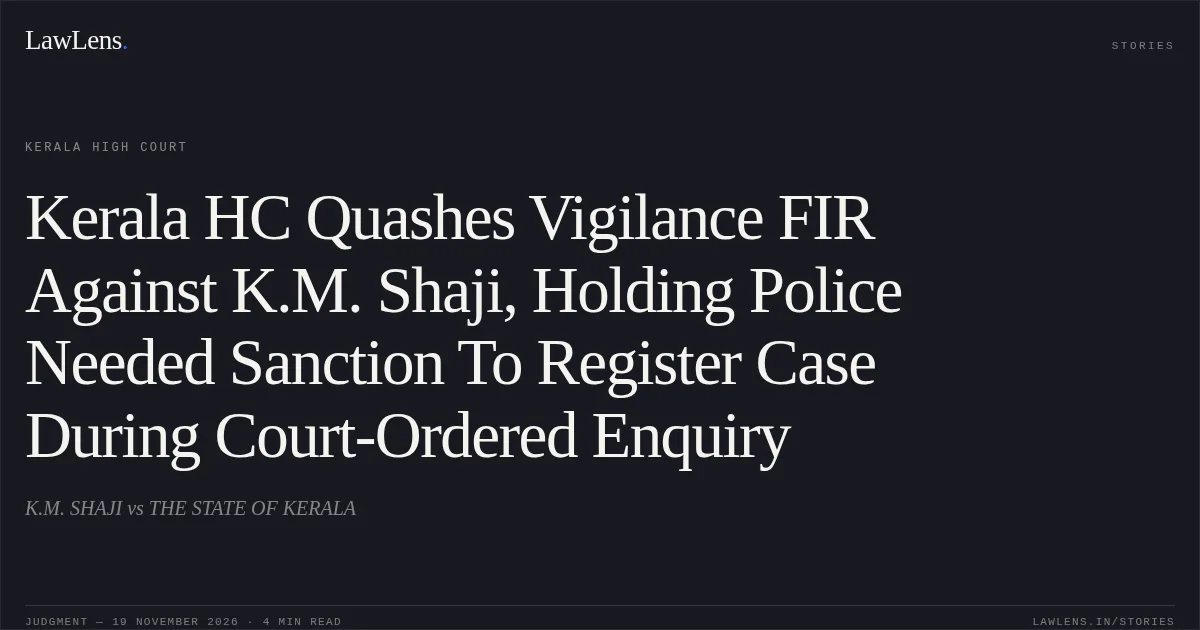
The petitioner, K.M. Shaji, challenged Ext. P4 FIR in Crime No. 2/2021 of the Vigilance and Anti-Corruption Bureau, Kozhikode, registered on 11 April 2021 under Section 13(2) r/w 13(1)(e) and 13(2) r/w 13(1)(b) of the Prevention of Corruption Act, 1988 ("P.C Act").
¶ 1 · Appendix, Ex. P4The FIR was registered pursuant to Ext. P2, an order dated 9 November 2020 of the Enquiry Commissioner and Special Judge, Kozhikode, in C.M.P. No. 132/2020, on a private complaint filed by the third respondent under Sections 190 and 200 CrPC.
¶ 1 · ¶ 10 · Appendix, Exs. P1–P2Ext. P2 directed a preliminary enquiry and a report to the Special Court, and referred to Section 17A of the P.C Act.
¶ 4, 7The petitioner contended that registration without sanction under Section 19 P.C Act is illegal, relying on Anil Kumar v. M.K. Aiyappa [2013 KHC 4790 (SC)].
¶ 3The petitioner contended that a preliminary enquiry to test the genuineness of allegations contravenes Lalita Kumari v. Government of U.P. [2013 (4) KLJ 686].
¶ 4The petitioner contended that the reference to Section 17A in Ext. P2 was erroneous, since the Special Judge found the allegations unrelated to any official decision.
¶ 4The prosecution relied on Reghuthaman P. v. State of Kerala [2016 (4) KHC 166] for the proposition that an FIR may be registered if a cognizable offence emerges during a preliminary enquiry.
¶ 502Issues
i.1. Whether Ext. P2 (the Special Judge's order directing preliminary enquiry) is liable to be quashed, including on account of the erroneous reference to Section 17A and the alleged testing of the veracity of allegations contrary to Lalita Kumari.
¶ 7 · ¶ 8ii.2. Whether a preliminary enquiry ordered under Section 156(3) CrPC, without prior sanction under Section 19 P.C Act, is permissible.
¶ 11iii.3. Whether an FIR (Ext. P4) may be registered by the Investigating Officer, without Section 19 sanction, during a preliminary enquiry ordered under Section 156(3) CrPC.
¶ 10 · ¶ 12 · ¶ 1303Law Applied
The power to register an FIR under Section 156(1) CrPC is the general source of police power, but where proceedings originate from a Magistrate's or Special Judge's order under Section 156(3), that power is traceable only to Section 156(3).
¶ 10An investigation under Section 156(3) in respect of P.C Act offences requires sanction under Section 19, as laid down in Anil Kumar v. M.K. Aiyappa [2013 KHC 4790 (SC)] and as followed by two Division Benches of the Kerala High Court in Mohammed V.A v. State of Kerala [2019 (1) KHC 239 (Ker.)] and A.K. Sreekumar v. State of Kerala (Crl.M.C. No. 4677/2022).
¶ 3 · ¶ 11 · ¶ 12A "preliminary enquiry" is confined to ascertaining whether a cognizable offence is disclosed, and does not extend to testing the truth of allegations; an FIR must be registered where a cognizable offence is disclosed, as held in Lalita Kumari v. Government of U.P. [2013 (4) KLJ 686].
¶ 4 · ¶ 8 · ¶ 10 · ¶ 12Reghuthaman P. v. State of Kerala [2016 (4) KHC 166], particularly para. 15, was considered and distinguished on the sanction requirement.
¶ 5 · ¶ 12The pendency of the reference in Manju Surana v. Sunil Arora [2018 KHC 6224 (SC)] does not diminish the binding effect of Anil Kumar.
¶ 3Provisions in the judgment · 5 · Linked ones open on LawLens
Prevention of Corruption Act, 1988 Section 13Section 19
Code of Criminal Procedure, 1973 Section 156Section 190Section 200
04Reasoning
Ext. P2 was not under challenge, as no prayer to quash it was made. The Court declined to examine the petitioner's objections to Ext. P2 as a ground for quashing, though it recorded that the reference to Section 17A was erroneous and that this error, by itself, did not vitiate the order.
¶ 7On the Lalita Kumari objection, the Court read Ext. P2 as a whole. The reference to the "genuineness and truth" of allegations was beyond the scope of a preliminary enquiry. However, because Ext. P2 directed a preliminary enquiry only to determine whether cognizable offences under the P.C Act were made out, and required a report to the Special Court, it was not vitiated.
¶ 8 · ¶ 9Directing a preliminary enquiry without Section 19 sanction does not offend Anil Kumar, because no investigation is ordered at that stage.
¶ 11Registering an FIR during such an enquiry is different. Since the source of power is Section 156(3), not Section 156(1), and Anil Kumar requires sanction for an investigation under Section 156(3), the police could not register an FIR without sanction. The Court found it "incomprehensible" that a police officer could do without sanction what the Magistrate or Special Judge could not order without it.
¶ 10 · ¶ 11Reliance on Reghuthaman was rejected, as that decision had not accounted for the sanction requirement of Anil Kumar in P.C Act cases.
¶ 12Because Ext. P4 was registered without Section 19 sanction, the FIR was held unsustainable. The Investigating Officer should instead have filed a report before the Special Judge, who would then decide whether to order investigation under Section 156(3), with sanction obtained as required.
¶ 1305Holding
(i) Ext. P2 is not quashed. Directing a preliminary enquiry without Section 19 sanction does not contravene Anil Kumar, and the erroneous reference to Section 17A does not vitiate the order.
¶ 7–9(ii) An FIR registered by the Investigating Officer during a preliminary enquiry ordered under Section 156(3) requires prior sanction under Section 19 P.C Act, since the power is traceable only to Section 156(3). (iii) Ext. P4 FIR, registered without such sanction, cannot be sustained. The Original Petition is allowed, and Ext. P4 FIR and all consequential proceedings are quashed.
¶ 10–13Original Court PDF
K.M. SHAJIvsTHE STATE OF KERALA
Click to open original judgment
Original judgment, available to read, download and summarize on LawLens.in