01Facts
The petitioner (plaintiff) filed OS No. 367/2013 before the Munsiff's Court, Parappanangadi, seeking a declaration that he is not the biological father of defendants 2 and 3, who were born to defendant 1 on 11.06.2012.
¶ 1–2Defendant 1 had lodged a criminal complaint alleging sexual assault under Sections 376, 450, 506 r/w 34 IPC, leading to the plaintiff's 36-day judicial custody before bail.
¶ 2On defendant 1's contention and the plaintiff's application (IA No. 2652/2015), the parties were referred for DNA profiling to the Rajiv Gandhi Centre for Biotechnology (RGCB), Thiruvananthapuram, which reported on 07.11.2016 that the plaintiff is not the biological father.
¶ 2The defendants did not object to the referral or seek to set aside the report, but filed IA No. 31/2017 seeking a second test at the Centre for DNA Fingerprinting and Diagnostics, Hyderabad; the trial court dismissed it on 28.03.2017.
¶ 2In OP(C) No. 2010/2017, this Court (Ext. P8, 09.10.2024) held that a second test was impermissible absent an application to set aside the report, but remitted IA No. 31/2017 for reconsideration.
¶ 2On reconsideration, after the RGCB scientist (PW2) was examined and cross-examined, the trial court held that the report was not shown to be inadmissible, yet allowed IA No. 31/2017 and directed a fresh test at Hyderabad on the ground that paternity was in dispute (Ext. P12, 31.01.2026).
¶ 2The plaintiff challenged Ext. P12.
¶ 202Issues
i.1. Whether a second DNA test may be ordered merely because the opposing party suffers no prejudice.
¶ 1, 19ii.2. Whether the respondents were entitled, as of right, to a second DNA test in view of the directions in Ext. P8 judgment.
¶ 7, 11iii.3. Whether the respondents established grounds to set aside or discredit the RGCB report, including the alleged lack of qualification of the scientist who conducted the test.
¶ 10, 12–18iv.4. Whether the absence of prejudice to the plaintiff justifies the impugned order, or whether specific, verifiable defects in the original process must be shown before a retest is ordered.
¶ 20, 23v.5. Whether the court may order a second DNA test merely because it is expedient to satisfy the opposing party.
¶ 21–2203Law Applied
Order XXVI Rule 10A CPC applies the procedure in Rule 10 mutatis mutandis to scientific examinations.
¶ 8Under Order XXVI Rule 10(2)–(3) CPC, the report forms part of the record and becomes evidence upon examination of its author, and a party cannot routinely set it aside; sufficient grounds must exist.
¶ 9Section 112 of the Evidence Act, 1872 presumes paternity in matrimonial relationships, and under Aparna Ajinkya Firodia v. Ajinkya Arun Firodia (2023) parties should not routinely be referred for DNA testing where that presumption applies; it is not attracted where paternity is contested in a case of alleged sexual assault.
¶ 14Akhtar Ali v. State of Uttarakhand (2025 SCC OnLine SC 1949) holds that a person with an M.Sc. in Botany and a doctorate may qualify to conduct DNA testing, but does not establish disqualification as the sole ground for discarding a test.
¶ 15Section 45 of the Indian Evidence Act, 1872 and Section 39 of the Bharatiya Sakshya Adhiniyam, 2023 do not require a specific degree; a specially skilled person officially appointed at a premier institute qualifies as an expert.
¶ 17Compelled DNA testing infringes bodily autonomy and privacy under Article 21 of the Constitution, and courts must require concrete justification before ordering a retest.
¶ 19A retest requires specific, verifiable defects such as sample mix-up, improper sealing, unguarded transit, fraud, impersonation, collusion, degradation, contamination, inconclusive results, or breach of forensic standards.
¶ 20S. Veeralakshmi v. Superintendent of Police [2015 (2) MLJ (Crl.) 39] (Madras HC) holds that a party seeking a second test must point to defects in the earlier test, and the Court found it persuasive.
¶ 22Provisions in the judgment · 5 · Linked ones open on LawLens
Indian Penal Code, 1860 Section 376Section 450Section 506Section 34
Bharatiya Sakshya Adhiniyam, 2023 Section 39
04Reasoning
The respondents' failure to apply to set aside the RGCB report was a significant omission. They did not object to the Hyderabad/RGCB referral at the outset, participated in the process, and raised no grounds to set aside the report.
¶ 10Ext. P8 did not confer a right to a second test; it directed reconsideration only because the respondents pressed the request, and it did not create an entitlement.
¶ 11The objection to the report's admissibility was not pursued with diligence, as the trial court itself found no ground to interfere, and RGCB is a premier government institution.
¶ 12Even on merits, lengthy cross-examination of PW2 revealed no discrepancy and no violation of established norms.
¶ 13On qualifications, PW2 deposed to a PhD in Botany with a biotechnology specialisation and long-standing charge of the Genome unit; the respondents offered no evidence beyond a bare assertion and did not seek information under the RTI Act, 2005.
¶ 16–17The Court refused to presume that a government institution would assign DNA testing to an unqualified person.
¶ 18Ordering a repeat test merely because one party dislikes the result would undermine the finality of expert evidence and infringe privacy rights.
¶ 19Because no specific, verifiable defect, fraud, sample irregularity, degradation, or inconclusiveness was shown, the prejudice-based rationale of the trial court was insufficient.
¶ 20, 23The Court rejected the argument that expediency in satisfying a party justifies retesting, adopting the reasoning in S. Veeralakshmi that the Madras decision in which a second test was permitted was a concession in special circumstances and not a general rule.
¶ 21–22The approach must not favour bastardy but must respect procedural law.
¶ 23The respondents' reliance on Aparna Ajinkya Firodia and Akhtar Ali was found inapposite.
¶ 14–1505Holding
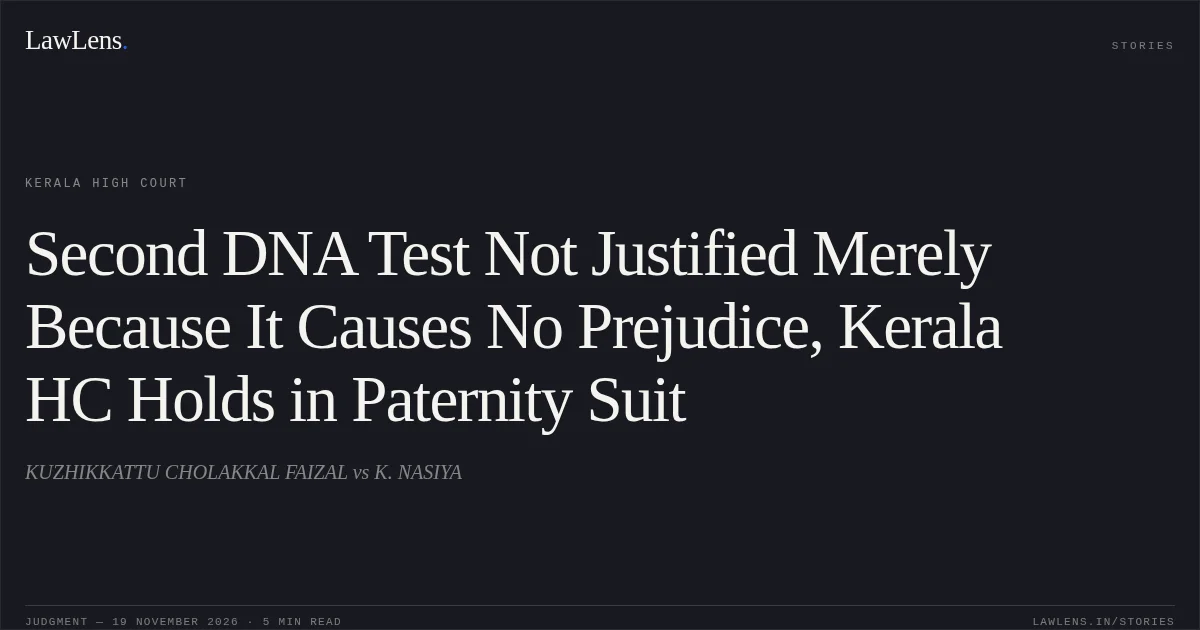
A second DNA test cannot be ordered as a matter of course merely because the opposing party finds the first report unacceptable or because no prejudice would result; the party challenging the report must establish specific, material defects.
¶ 23–24The respondents failed to show grounds to reject the RGCB report, and the trial court erred in ordering fresh testing at Hyderabad.
¶ 24The Original Petition is allowed. Ext. P12 order dated 31.01.2026 in IA No. 31/2017 in OS No. 367/2013 is set aside, and IA No. 31/2017 stands dismissed, with no order as to costs.
¶ 24Original Court PDF
KUZHIKKATTU CHOLAKKAL FAIZALvsK. NASIYA
Click to open original judgment
Original judgment, available to read, download and summarize on LawLens.in