01Facts
The dispute arose from a claimed business loan between a father-in-law and son-in-law.
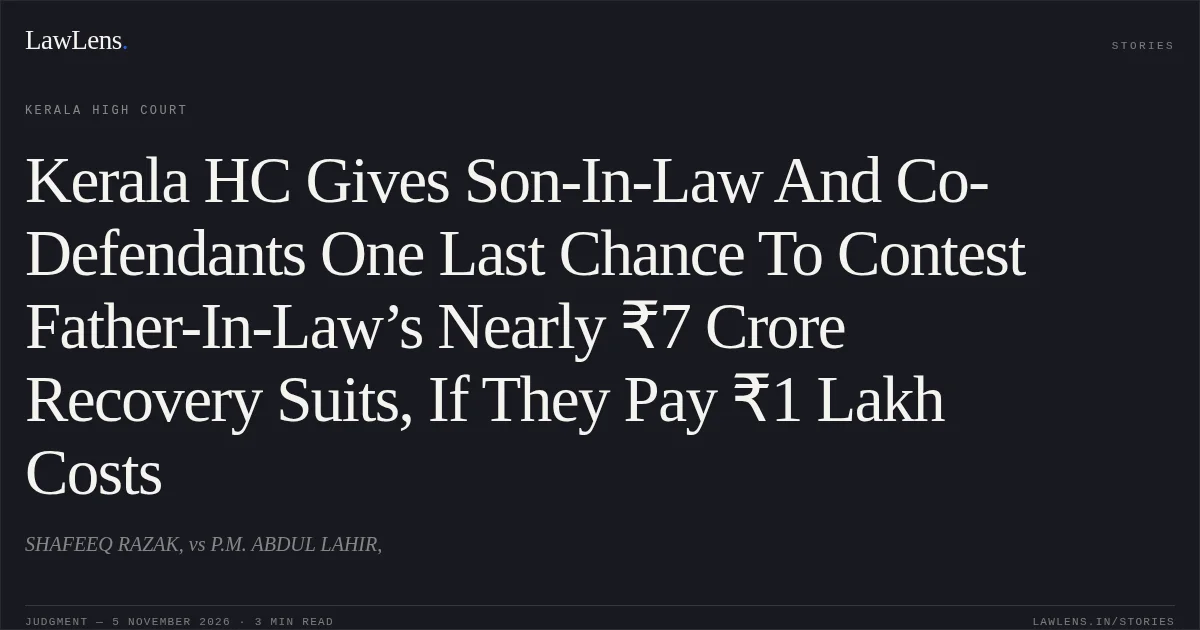
The plaintiff instituted two suits seeking recovery of nearly ₹7 crore.
¶ 1 · p. 7 · ¶ 3 · p. 7After the plaintiff’s evidence was closed, the suits were posted for the defendants’ evidence; the defendants did not adduce evidence, and judgment followed.
¶ 4 · p. 8The defendants had also declined to cross-examine the plaintiff/PW1, and their counsel later filed a memo stating that instructions to cross-examine had not been received.
¶ 4 · p. 8The defendants applied under Order IX Rule 13 CPC to recall or set aside the decrees.
The appeals arose from the trial court’s orders dated 12 March 2026 in those proceedings.
¶ 6–8 · pp. 9–1002Issues
i.Whether an application under Order IX Rule 13 CPC was maintainable where the defendants were absent when the suit was concluded after they failed to adduce evidence.
¶ 8, 11–12 · pp. 9, 12–13ii.Whether the defendants should be permitted to participate in the proceedings and, if so, on what terms.
¶ 13–14 · pp. 13–1403Law Applied
Order XVII Rule 2 CPC provides that where a party fails to appear on an adjourned hearing date, the court may proceed in a manner directed by Order IX; its Explanation permits the court, in its discretion, to proceed as if a party were present where that party’s evidence or a substantial portion of it has already been recorded.
¶ 9 · pp. 10–11Under Order XVII Rule 3, where a party fails to produce evidence or perform an act necessary for the suit’s progress, the court may decide the suit forthwith if the parties are present under Rule 3(a), or proceed under Rule 2 if a party is absent under Rule 3(b).
¶ 10 · p. 11In Prakash Chander Manchanda v. Janki Manchanda, (1986) 4 SCC 699, the Supreme Court held, as applied here, that where the defendant is absent and the court proceeds under Order XVII Rule 3(b) read with Rule 2, disposal is under Order IX, leaving an aggrieved party able to apply under Order IX Rule 13.
¶ 8, 11 · pp. 9–10, 12The Court also considered Fathima M.K. v. Kunhipathu, 2018 (3) KHC 402; 2018 (3) KLT 491, which addressed a different situation where parties were present and the suit was decided under Rule 3(a).
¶ 5 · p. 8 · ¶ 8 · p. 1004Reasoning
The record did not show that the defendants were present when the hearing concluded and judgment was pronounced.
¶ 12 · p. 13Although they had earlier failed to cross-examine PW1 and to adduce their own evidence, their absence on the adjourned date meant that the case fell within Order XVII Rule 3(b), requiring the court to proceed under Rule 2.
¶ 8, 11–12 · pp. 9–10, 12–13The Court therefore applied Prakash Chander Manchanda, rather than the Rule 3(a) situation considered in Fathima M.K., and held that the Order IX Rule 13 route was available.
¶ 8, 11–12 · pp. 9–10, 12–13The Court nevertheless noted the defendants’ prior failures and treated a final opportunity, subject to costs and strict directions, as appropriate in the interests of justice.
¶ 12–14 · pp. 13–1405Holding
The appeals were allowed to give the defendants a final opportunity to contest the proceedings, subject to payment of consolidated costs of ₹1,00,000 to the plaintiff within a fortnight.
¶ 14 · p. 14On payment, the defendants may cross-examine PW1 and adduce evidence.
¶ 14 · pp. 14–15If they fail to pay, the trial decree becomes enforceable; if they fail to cross-examine or adduce evidence on the dates fixed, the trial court may close the proceedings and either rewrite its judgment if fresh evidence has been received or reiterate its earlier decree.
¶ 14 · pp. 14–15The trial court was directed to conclude the proceedings preferably within six months of compliance and not to grant adjournments unless unavoidable.
¶ 14 · p. 15The appeals were disposed of accordingly.
¶ 15 · p. 15Original Court PDF
SHAFEEQ RAZAK,vsP.M. ABDUL LAHIR,
Click to open original judgment
Original judgment, available to read, download and summarize on LawLens.in