Facts
The intra-court reference arose from an order of the learned Single Judge dated 20 February 2025 in O.P. (Civil) Nos. 519 and 972 of 2024.
Source reference: para. 1The reference was made because of conflicting Kerala High Court decisions on whether an application under Order IX Rule 7 CPC is subject to limitation.
Source reference: para. 1The underlying application sought to recall or set aside an order proceeding against the defendant ex parte under Order IX Rule 6 CPC.
Source reference: para. 7The application had been dismissed as belated because it was not accompanied by a petition to condone delay.
Source reference: para. 7A Full Bench comprising the Chief Justice and two other Judges was constituted to resolve the reference.
Source reference: paras. 1–3Issues
1. Whether an application under Order IX Rule 7 CPC to recall or set aside an ex parte order is subject to any period of limitation?
Source reference: para. 3(i)2. Whether Article 137 of the Limitation Act, 1963 applies to an application under Order IX Rule 7 CPC?
Source reference: para. 3(ii)Law Applied
Order IX Rule 7 CPC enables a defendant, who appears at or before the adjourned hearing and assigns good cause for previous non-appearance, to participate in the suit as if the defendant had appeared on the originally fixed date.
Source reference: para. 5It does not provide for setting aside an ex parte decree, which is governed separately by Order IX Rule 13 CPC and Article 123 of the Limitation Act.
Source reference: para. 6Relying on Sangram Singh v. Election Tribunal, Kotah, the Court held that Rule 7 does not contemplate setting aside a final order or decree; it permits the defendant to seek restoration to the procedural position that would have existed had the defendant appeared earlier.
Source reference: paras. 8–9, 26–27Arjun Singh v. Mohindra Kumar characterises an application under Rule 7 as an interlocutory procedural application intended to ensure the orderly conduct of proceedings, rather than one finally determining rights.
Source reference: para. 10Vijay Kumar Madan v. R.N. Gupta Technical Education Society establishes that Rule 7 is necessary only when the defendant seeks to reopen proceedings from the stage at which they became ex parte; Rasiklal Manikchand Dhariwal v. M.S.S. Food Products holds that Rule 7 is unavailable after the hearing is concluded and the matter is reserved for judgment.
Source reference: paras. 11–13Article 137, being a residuary provision prescribing three years for applications for which no period is otherwise provided, was held inapplicable because Rule 7 is controlled by the procedural stage of the suit rather than by a prescribed limitation period.
Source reference: paras. 14–15, 35–36Reasoning
The Court distinguished an ex parte order under Order IX Rule 6 from an ex parte decree under Order IX Rule 13.
Source reference: paras. 26–28An order proceeding ex parte does not adjudicate the defendant’s rights, terminate the litigation, or create a final determination capable of operating as res judicata; it is only a procedural direction concerning the conduct of the hearing.
Source reference: paras. 26–28, 34, 42–43Rule 7 itself requires the defendant to appear “at or before such hearing” and to show good cause for the previous non-appearance.
Source reference: para. 30Thus, the relevant restriction is the stage of the proceedings: the application may be made while the hearing remains pending, but not after the hearing has concluded and the matter has been reserved for judgment.
Source reference: paras. 36, 47Importing Article 137 would impose a three-year bar not found in the text or scheme of Rule 7 and could produce the anomaly that a defendant might be barred from invoking Rule 7 while still being entitled to seek setting aside of a later ex parte decree under Rule 13 within the prescribed period.
Source reference: paras. 44–45The Court therefore rejected the contrary reasoning in C.L. Cleetus and the decisions following it.
Source reference: paras. 46–48Holding
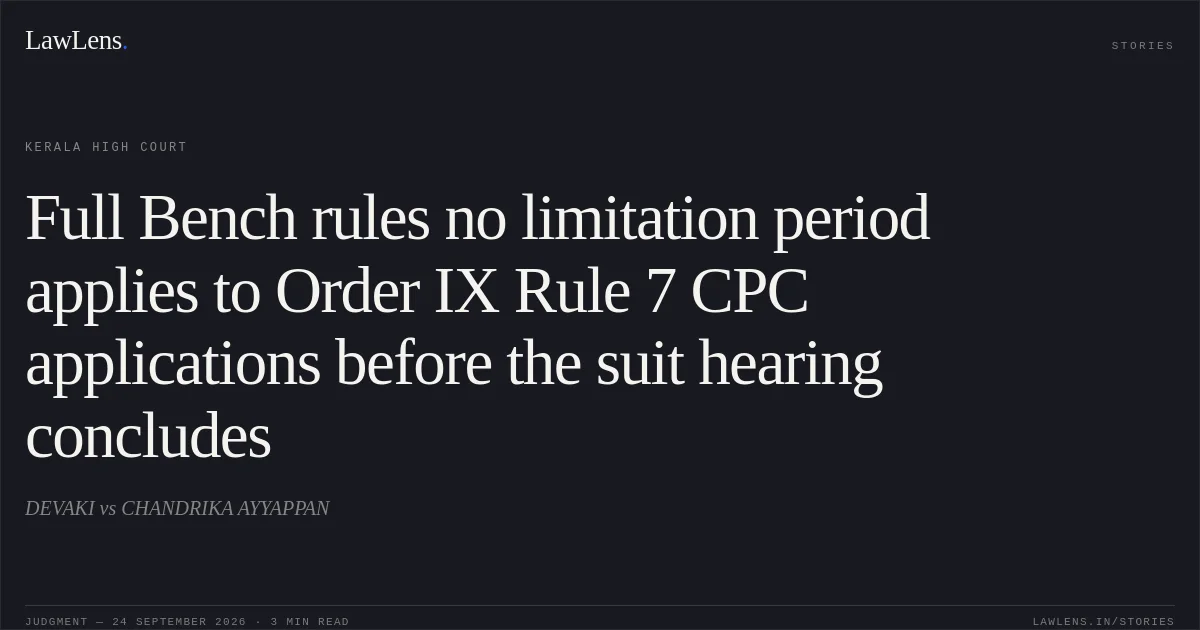
The Full Bench answered both questions in favour of the defendant: an application under Order IX Rule 7 CPC is not subject to any period of limitation under the Limitation Act, 1963, and Article 137 does not apply to such an application.
The application may be filed at the appropriate stage before the hearing of the suit is concluded, provided the defendant satisfies the requirements of Rule 7, including showing good cause for the previous non-appearance.
Source reference: para. 47The contrary view in C.L. Cleetus and the decisions following it was overruled to that extent.
Source reference: para. 48The intra-court reference was accordingly disposed of, and O.P. (Civil) Nos. 519 and 972 of 2024 were directed to be placed before the appropriate Bench according to roster.
Source reference: para. 50Acts & Sections Cited
4 provisions across 1 statute referred to in this judgment. Each provision opens on LawLens.
Limitation Act, 19634
Original Court PDF
DEVAKIvsCHANDRIKA AYYAPPAN
Click to open original judgment
Original judgment, available to read, download and summarize on LawLens.in