Facts
Madhya Bharat (Petitioner/Employer) awarded a contract for Electro-Mechanical works for the Rongnichu Hydro Project to Voith Hydro (Respondent/Contractor) in 2011
Source reference: p.2Following a suspension of work in 2013-2014, Voith Hydro invoked arbitration in 2017
Source reference: p.2-3The Arbitral Tribunal, relying on a Joint Expert Report, passed a unanimous Award on July 31, 2019, awarding Voith Hydro approximately ₹9.03 Crores plus foreign currency components, while rejecting Madhya Bharat's counterclaims
Source reference: p.4-6Madhya Bharat challenged the Award under Section 34 of the Arbitration and Conciliation Act, 1996, primarily contesting the valuation of engineering works, compensation for manufactured materials, site expenses, and loss of profits
Source reference: p.7-9Issues
1. Whether the Arbitral Tribunal’s assessment of the engineering component at 6% of the contract value constituted patent illegality or double recovery
Source reference: p.15 / para. 48-522. Whether the Award for manufactured materials was unsustainable due to the non-delivery of items to the Employer
Source reference: p.22 / para. 69-703. Whether compensation for loss of profits could be awarded without proof of actual loss or tender break-ups
Source reference: p.25 / para. 83-884. Whether the grant of post-award interest at 12% and costs was justified
Source reference: p.29 / para. 93-96Law Applied
The court applied the limited scope of judicial interference under Section 34 of the Arbitration and Conciliation Act, 1996, as interpreted in Associate Builders v. DDA and Ssangyong Engineering & Construction Co. Ltd. v. NHAI, which prohibits the reappreciation of evidence unless the award is perverse or patently illegal
Source reference: p.12-13Regarding the quantification of damages/losses, the court relied on McDermott International Inc. v. Burn Standard Co. Ltd., establishing that the choice of methodology and computation falls within the exclusive domain of the arbitrator
Source reference: p.14Section 31A of the Act was applied regarding the Tribunal’s discretion to allocate costs
Source reference: p.30Reasoning
The Court observed that the Tribunal’s decision on the 6% engineering cost was a fact-based finding derived from Expert testimony and the unique topographical requirements of hydro projects, which does not permit interference
Source reference: para. 54-56On Claim II, the Court upheld the rejection of the Petitioner’s belated demand for delivery of materials, noting that the Petitioner failed to plead this earlier and that the storage/refurbishment costs had already been discounted in the award calculation
Source reference: para. 70-71Regarding Claim IV (Loss of Profit), the Court found that the Tribunal acted reasonably by reducing the claim from 15% to 6%, noting that the Petitioner had already awarded the project to a third party, effectively terminating the contract
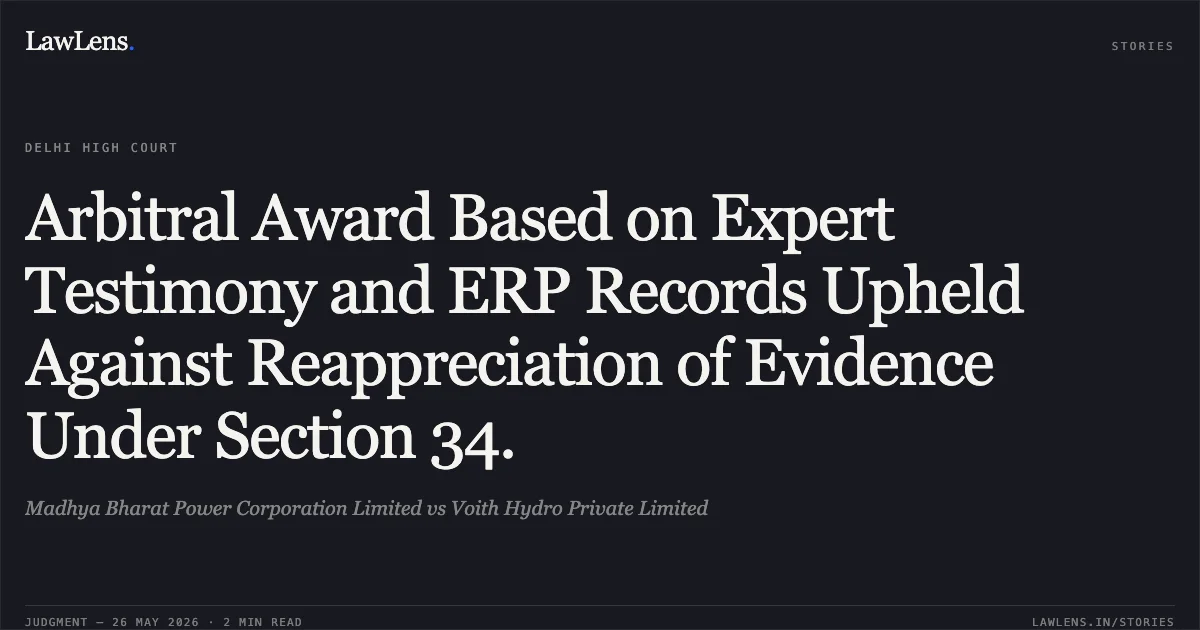
Source reference: para. 86-89The Court emphasized that an Arbitrator is the "ultimate master of the quantity and quality of evidence" and held that the reliance on ERP extracts and Expert reports was a "possible view"
Source reference: para. 39, 78-79Holding
The Court dismissed the Section 34 petition, holding that the Petitioner failed to establish any grounds of patent illegality or perversity
The Court affirmed the Tribunal's findings on all claims, including the 12% post-award interest and the cost allocation, stating they were reasoned and within the Tribunal's discretion. The stay on the enforcement of the Award was effectively vacated.
Source reference: para. 95-98Acts & Sections Cited
3 provisions across 2 statutes referred to in this judgment. Each provision opens on LawLens.
Arbitration and Conciliation Act, 19961
Indian Contract Act, 18722
Original Court PDF
Madhya Bharat Power Corporation LimitedvsVoith Hydro Private Limited
Click to open original judgment
Original judgment, available to read, download and summarize on LawLens.in