Facts
The appellant awarded KMV Projects Package A-4 for construction of Adarsha Vidyalayas and girls’ hostels in Bidar District under the RMSA scheme.
Source reference: no citationThe contract incorporated a price-adjustment clause under Clause 39 of the Conditions of Contract.
Source reference: no citationAlthough the stipulated completion period expired on 16 February 2015, the works were completed later, allegedly due to delays attributable to the appellant, including delay in handing over sites, issuing drawings, approving work slips and releasing payments.
Source reference: para. 5–10A supplementary agreement increased the contract value and provided that the applicability of the price-adjustment clause would be decided after a Government enquiry.
Source reference: para. 8–9After the Government ultimately permitted price adjustment for the relevant packages, KMV invoked arbitration.
Source reference: no citationThe Sole Arbitrator partly allowed claims for price adjustment, unproductive overhead charges, loss of expected profits and costs, awarding a total of ₹3,80,58,227 with interest.
Source reference: para. 16–23The appellant’s petition under Section 34 of the Arbitration and Conciliation Act, 1996 was dismissed by the Commercial Court.
Source reference: no citationThe appellant therefore filed the present appeal under Section 13(1A) of the Commercial Courts Act, 2015 read with Section 37(1)(c) of the Arbitration and Conciliation Act, 1996.
Source reference: para. 1Issues
Whether the Arbitral Tribunal was justified in treating Clause 39, providing for price adjustment, as part of the parties’ contract.
Source reference: para. 24–29Whether the awards under Claim No. 1 for price adjustment, Claim No. 6(a) for unproductive overhead charges, and Claim No. 7 for loss of expected profits were supported by pleadings, evidence and relevant contractual or legal principles.
Source reference: para. 29–50Whether the findings and awards under the impugned claims disclosed patent illegality warranting interference under Sections 34 and 37 of the Arbitration and Conciliation Act, 1996.
Source reference: para. 37, 43, 50–53Whether the consequential award of interest and litigation costs could survive if the substantive claims were set aside.
Source reference: para. 52Law Applied
The Court applied Sections 34 and 37 of the Arbitration and Conciliation Act, 1996, under which an arbitral award may be set aside for patent illegality, including an award unsupported by evidence or relevant material, while recognising that courts should not ordinarily interfere with an arbitral tribunal’s plausible contractual interpretation.
Source reference: para. 28, 37The Court relied on McDermott International Inc. v. Burn Standard Co. Ltd., (2006) 11 SCC 181, concerning the use of the Hudson formula for assessing prolongation-related claims, but held that a formula cannot substitute proof of actual loss.
Source reference: para. 39, 46It referred to A.T. Brij Paul Singh v. State of Gujarat, (1984) 4 SCC 59, and MSK Projects India (JV) Ltd. v. State of Rajasthan, (2011) 10 SCC 573, for the proposition that loss of profit may be recoverable where the employer breaches the contract.
Source reference: para. 46However, Bharat Coking Coal Ltd. v. L.K. Ahuja, (2004) 5 SCC 109, requires a contractor claiming loss of profit from delayed works to plead and establish that it could have utilised its resources or funds in other profitable business.
Source reference: para. 48The Court further applied UNIBROS v. All India Radio, 2023 SCC OnLine SC 1366, which requires proof of delay, absence of contractor responsibility, the contractor’s established status, and credible evidence of actual loss of profitability or missed opportunities; formulae such as Hudson’s are only aids to quantification and cannot independently prove loss.
Source reference: para. 49Reasoning
The Court upheld the Tribunal’s interpretation that Clause 39 formed part of the contract because the executed Agreement expressly incorporated the Conditions of Contract and Contract Data, and no exclusion of Clause 39 appeared in the signed documents.
Source reference: para. 25–29This was a reasoned interpretation of the contract within the Tribunal’s jurisdiction and did not warrant interference under Sections 34 or 37.
Source reference: para. 25–29However, the awards under Claims 1, 6(a) and 7 were unsupported by proof.
Source reference: no citationFor the price-adjustment claim, KMV produced neither a calculation sheet nor documents showing how the claimed amount was derived under the contractual formulae; the Tribunal impermissibly treated the appellant’s failure to respond to a letter mentioning the bill as proof of the claim.
Source reference: para. 32–37The overhead claim was based on an assumed 10% rate, although no evidence established that the overheads represented 10% of the contract value.
Source reference: para. 38–43A witness’s denial of a suggestion in cross-examination could not amount to an admission by the appellant.
Source reference: para. 38–43The loss-of-profit claim likewise lacked supporting pleadings and evidence.
Source reference: para. 44–50The Tribunal assumed a 10% profit margin and calculated compensation for the prolonged period, but KMV neither pleaded nor proved any actual loss, alternative projects, or missed business opportunities.
Source reference: para. 44–50Applying Bharat Coking Coal and UNIBROS, the Court held that such mathematical assumptions and formulae could not replace proof of injury.
Source reference: para. 44–50Since the substantive claims were unsustainable, the related interest and costs awards also could not stand.
Source reference: para. 52Holding
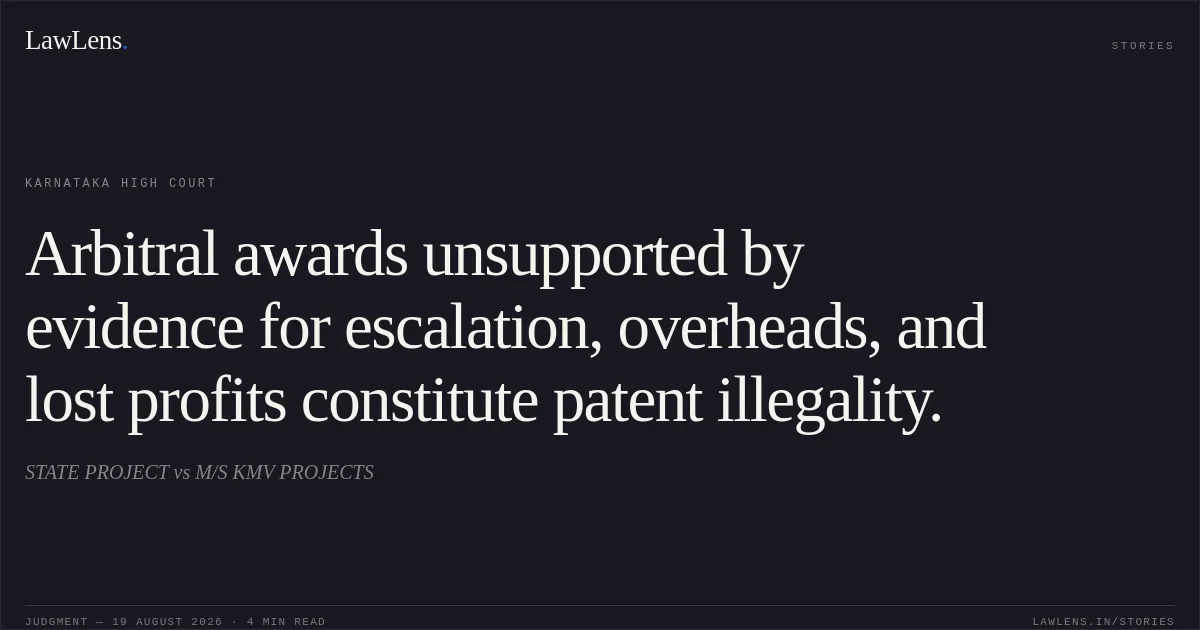
The Court held that the Tribunal’s interpretation incorporating the price-adjustment clause was permissible, but the awards under Claim Nos. 1, 6(a) and 7 were patently illegal because they were not supported by pleadings, evidence or reliable computation.
The awards of interest on those claims and costs under Claim No. 11 were consequently also set aside.
Source reference: para. 52–53The appeal was allowed to that extent, and the arbitral award was set aside insofar as it awarded amounts under Claim Nos. 1, 6(a), 7 and 11.
Source reference: para. 52–53Acts & Sections Cited
5 provisions across 2 statutes referred to in this judgment. Each provision opens on LawLens.
Commercial Courts Act, 20151
Arbitration and Conciliation Act, 19964
Original Court PDF
STATE PROJECTvsM/S KMV PROJECTS
Click to open original judgment
Original judgment, available to read, download and summarize on LawLens.in