Facts
The petitioners are teachers and non-teaching staff (Assistant Teachers, Junior Clerks, and Peons) appointed by various private-aided educational institutions in Nagpur Division between 2003 and 2020
Source reference: p. 79-106Their appointments were duly verified and approved by the Education Officer (Primary), Zilla Parishad, Nagpur, and they were subsequently allotted "Shalarth IDs" to facilitate salary payments via the state's digital system
Source reference: p. 78-79Many petitioners had rendered 10 to 15 years of continuous service
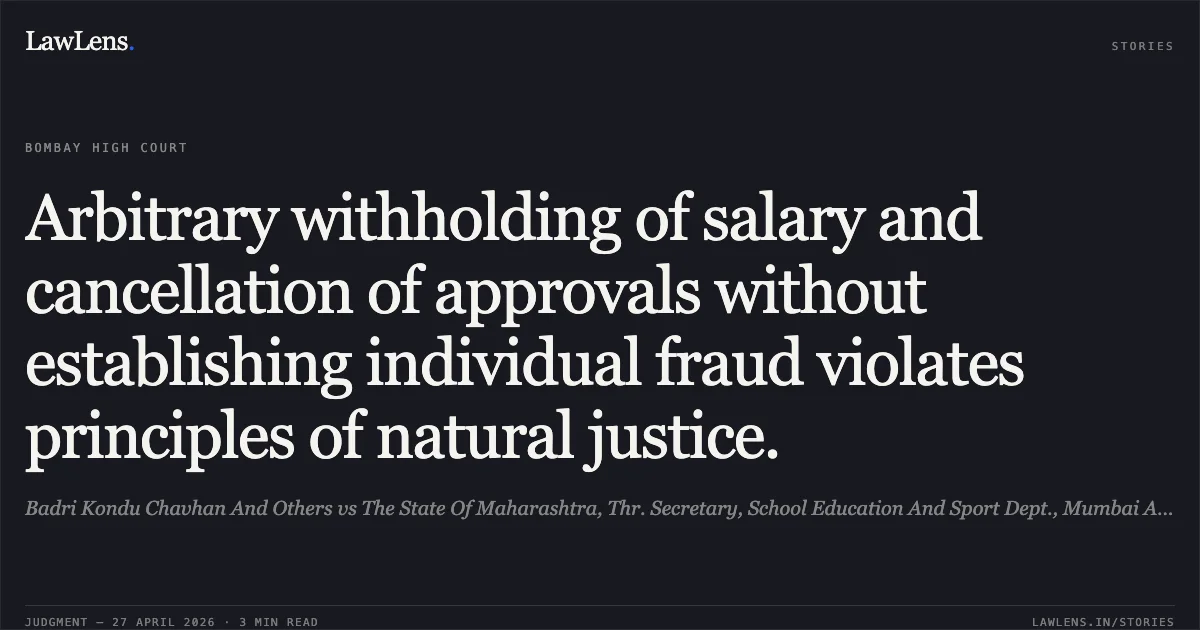
Source reference: p. 100In March 2025, the respondent authorities abruptly stopped the petitioners' salaries and subsequently issued communications cancelling their personal approvals and Shalarth IDs without conducting a formal departmental enquiry
Source reference: p. 76-78The respondents alleged irregularities in the approval process based on a summary scrutiny of outward registers
Source reference: p. 100-101The petitioners challenged these actions as arbitrary and violative of Article 14 and Article 300-A of the Constitution
Source reference: p. 78Issues
1. Whether the respondent authorities acted arbitrarily and in violation of the principles of natural justice by withholding salaries and cancelling approvals without specific show cause notices or a proper hearing
Source reference: p. 78 / p. 1162. Whether salary can be treated as "property" under Article 300-A, thereby prohibiting its deprivation without due process of law
Source reference: p. 107-1083. Whether validly granted approvals can be cancelled after a significant lapse of time (10-15 years) in the absence of established fraud or misrepresentation
Source reference: p. 118Law Applied
Article 300-A of the Constitution, establishing that salary is "property" and cannot be withheld without cogent reasons
Source reference: p. 108principles of Natural Justice, specifically the right to a fair hearing and non-vague notice, as articulated in K.I. Shephard v. Union of India
Source reference: p. 111precedent in Shivanee Prasanna Deshpande v. State of Maharashtra, which mandates that approvals cannot be recalled due to administrative errors unless fraud, misrepresentation, or suppression is proved
Source reference: p. 118Government Resolution (GR) dated 10/06/2022, which prescribes a detailed enquiry procedure involving the concerned employee, management, and the officer who issued the original approval
Source reference: p. 117Reasoning
The court found the respondents' actions to be a "colourable exercise of power" characterized by "undue haste"
Source reference: p. 79, 116It noted that the purported show cause notices were "vague, not specific, and lacks details," preventing petitioners from effectively defending themselves
Source reference: p. 116The court emphasized that a "post-decisional hearing" does not satisfy natural justice, as authorities often proceed with a "closed mind"
Source reference: p. 109Critically, the court observed that the mandatory procedure under the 10/06/2022 GR was bypassed: the officers who originally granted the approvals were not summoned, and the petitioners were merely asked to fill out forms rather than being given a personal hearing
Source reference: p. 117The court reasoned that since the petitioners had no role in the internal allotment of Shalarth IDs or clerical entries in outward registers, they could not be punished for systemic flaws or errors committed by the Education Department
Source reference: p. 79, 115Following Central Electricity Supply Utility of Odisha v. Dhobei Sahoo, the court held that denying pay for service rendered amounts to "forced labour"
Source reference: p. 112Holding
The court quashed and set aside the impugned show cause notices and communications cancelling the petitioners' approvals and Shalarth IDs
It held that the petitioners are entitled to their salaries from March 2025 onwards as they worked without a break in service
Source reference: p. 121The court granted respondents liberty to conduct fresh enquiries only if they issue specific notices alleging fraud or misrepresentation where the employee is a party to such acts
Source reference: p. 120For mere administrative irregularities, the state may recover losses from the erring officers or management, but the employees' restored approvals and salaries must not be questioned
Source reference: p. 120-121The court refused to stay the judgment, citing the dire financial state of the teachers
Source reference: p. 121Acts & Sections Cited
2 provisions across 1 statute referred to in this judgment. Linked provisions open on LawLens.
Code of Criminal Procedure2
Original Court PDF
Badri Kondu Chavhan And OthersvsThe State Of Maharashtra, Thr. Secretary, School Education And Sport Dept., Mumbai And Ors.
Click to open original judgment
Original judgment, available to read, download and summarize on LawLens.in