Facts
The Appellants (Plaintiffs) purchased a three-storey property in Gwalior via court auction in 1964, obtaining symbolic possession in 1973.
Source reference: para. 5Following alleged forceful occupation by the Respondents (Defendants), the Plaintiffs filed a suit for possession and mesne profits in 1982 (CS 3A/1982).
Source reference: para. 6During the pendency of this suit, the parties referred the dispute to private arbitration without seeking leave of the Trial Court, resulting in an award dated 15.09.1983 in favor of the Defendants.
Source reference: para. 7The Defendants successfully sought to make the award a "Rule of the Court" in separate 1984 proceedings.
Source reference: para. 13The Trial Court and High Court subsequently dismissed the 1982 possessory suit, holding that the subject matter of the arbitration was different from the suit and that the award had attained finality.
Source reference: paras. 21-23Issues
1. Whether the subject matter of the 1982 Suit and the arbitral proceedings were identical, necessitating compliance with Section 21 of the Arbitration Act, 1940.
Source reference: para. 272. Whether an arbitral award obtained during the pendency of a suit without a court order of reference under Section 21 is legally effective.
Source reference: para. 273. Whether the arbitral award could be treated as a compromise or adjustment of the suit under the proviso to Section 47 of the 1940 Act in the absence of post-award consent.
Source reference: para. 27Law Applied
Section 21 of the Arbitration Act, 1940 mandates that parties seeking arbitration during a pending suit must apply in writing to the Court for an order of reference.
Source reference: para. 32The proviso to Section 47 of the Arbitration Act, 1940 stipulates that an award obtained "otherwise" (outside the Act's formal procedures) can only be considered as a compromise or adjustment of a pending suit with the "consent of all parties interested".
Source reference: paras. 35-36The Court relied on Naraindas v. Vallabhdas (1971) 3 SCC 642, which established that a reference during a pending suit without a court order is invalid to avoid conflict of jurisdiction, and can only be enforced as a compromise if all parties give post-award consent.
Source reference: para. 50Reasoning
The Court found that the property descriptions in the auction certificate and the 1984 proceedings were identical, contradicting the lower courts' findings that the subject matters differed.
Source reference: para. 41The Court reasoned that Section 21 is mandatory once a suit is pending; knowledge of the suit is irrelevant, yet evidence showed the Defendants were aware of the suit before the award was finalized.
Source reference: paras. 42-43Since the parties bypassed Chapter IV of the Act (Arbitration in Suits), the award was "otherwise obtained".
Source reference: para. 49Applying the proviso to Section 47, the Court determined that the Plaintiffs never provided the requisite post-award consent; rather, they consistently challenged the award.
Source reference: para. 57The Court highlighted that the High Court had previously granted the Plaintiffs liberty to press objections under Section 47 within the 1982 suit, which the lower courts erroneously ignored by treating the award as a final bar to the suit.
Source reference: paras. 55-58Holding
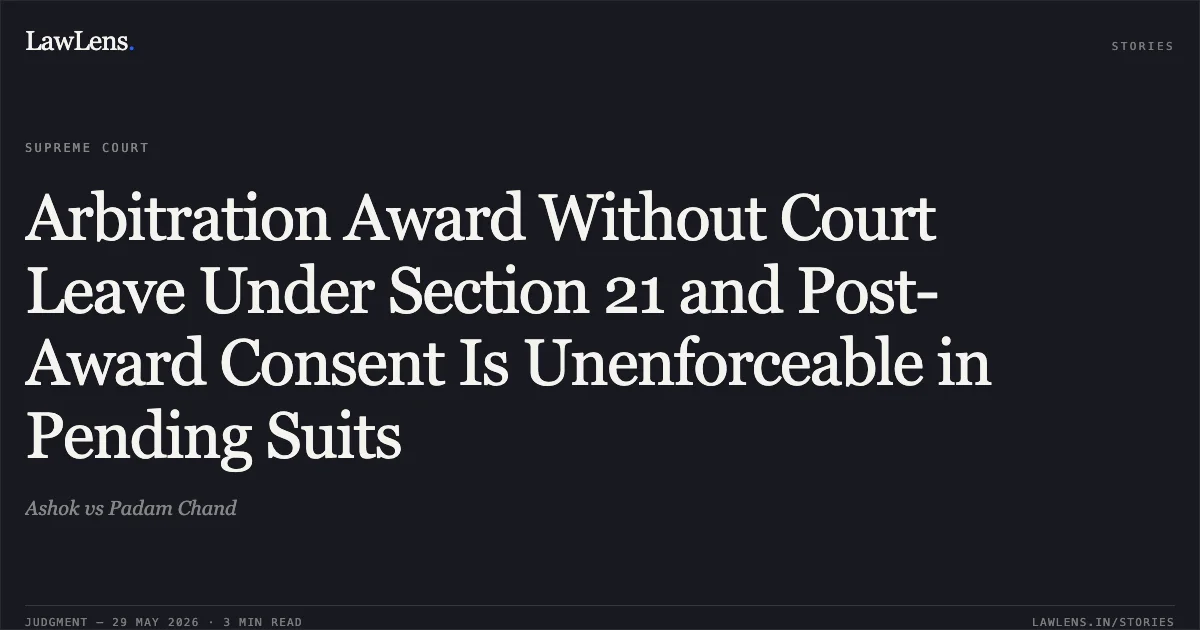
The Court held that the 1983 award was unenforceable against the Plaintiffs for non-compliance with Section 21 and the lack of post-award consent under Section 47.
The Supreme Court allowed the appeal, setting aside the High Court and Trial Court judgments, decreed the 1982 Suit in favor of the Plaintiffs, ordered vacant possession within two months, declared the 2003 sale deed void, remitted the matter for mesne profit determination, and imposed costs of Rs. 1,00,000/- on the Defendants.
Source reference: para. 69Acts & Sections Cited
6 provisions across 2 statutes referred to in this judgment. Each provision opens on LawLens.
Code of Civil Procedure, 19085
Code of Criminal Procedure, 19731
Original Court PDF
AshokvsPadam Chand
Click to open original judgment
Original judgment, available to read, download and summarize on LawLens.in