Facts
The appellants are retired government employees who retired in 2013 and 2014 and have been receiving pensions for approximately 12 years.
Source reference: para. 2Ten years post-retirement, they filed a Writ of Mandamus seeking to count 50% of their prior temporary daily wage service for pensionary benefits.
Source reference: para. 2Their services had been regularized as far back as 1990.
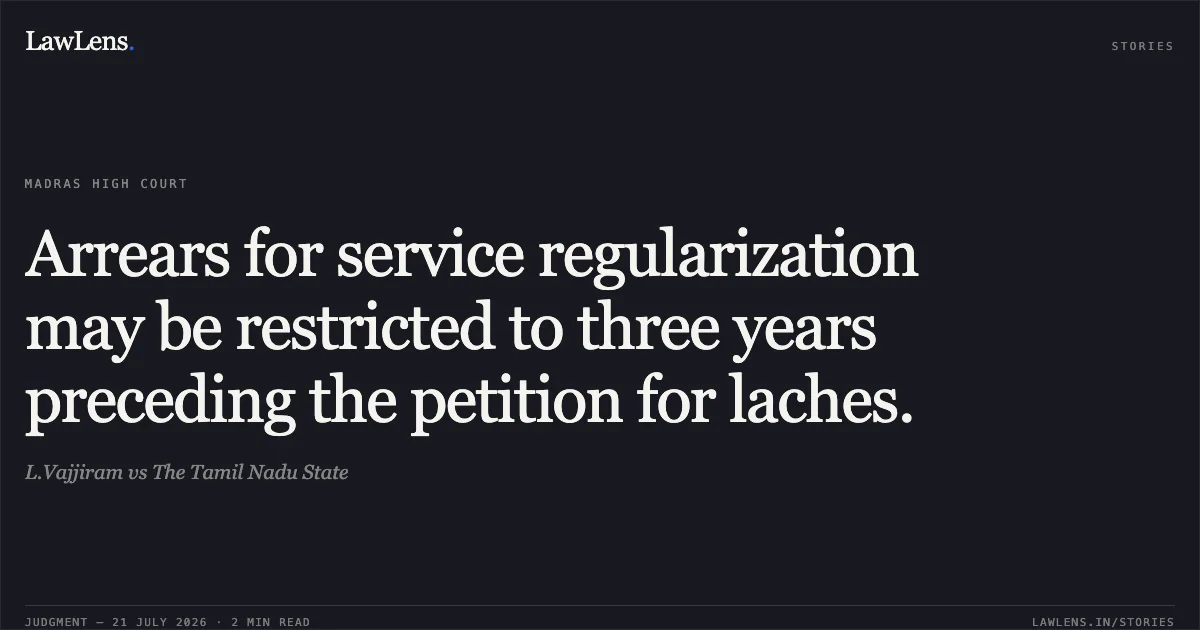
Source reference: para. 3The Writ Court (W.P.No.16034 of 2024) granted the prayer to count 50% of the service but restricted the payment of monetary arrears to a period of three years prior to the filing of the writ petition (from March 2021) due to the long delay.
Source reference: para. 2The appellants challenged this restriction on arrears.
Source reference: para. 1Issues
1. Whether the Writ Court was justified in restricting the arrears of pensionary benefits to three years prior to the filing of the writ petition on the grounds of laches and delay.
Source reference: para. 3Law Applied
Rule 11(4) of the Tamil Nadu Pension Rules, 1978, which governs the counting of half of the service rendered in non-pensionable establishments for the purpose of pensionary benefits.
Source reference: para. 2The equitable principle of "Laches and Delay," holding that while substantive relief may be granted in long-delayed claims, the financial liability (arrears) can be restricted to prevent an undue burden caused by the claimant's own inaction.
Source reference: para. 3Reasoning
The Court observed that the appellants moved the judiciary after a significant lapse of 10 years from the date of retirement and over 30 years from the date of regularization of their services in 1990.
Source reference: para. 3While the Writ Court had already granted the core benefit of counting 50% of the daily wage service, the Division Bench found that the restriction on arrears was a necessary exercise of judicial discretion.
Source reference: para. 3The Court reasoned that since the delay in seeking legal remedy was attributable solely to the appellants, the order restricting arrears to three years prior to the filing of the petition could not be construed as "infirm".
Source reference: para. 3The Court concluded that since the primary benefit sought (service counting) had already been granted, no further interference was warranted.
Source reference: para. 3Holding
The Court held that the restriction of arrears to three years prior to the filing of the writ petition (March 2021) was valid given the 10-year delay in filing the claim.
The High Court dismissed the Writ Appeal, upholding the order of the Single Judge. No costs were awarded.
Source reference: para. 3Acts & Sections Cited
1 provisions across 1 statute referred to in this judgment. Linked provisions open on LawLens.
Letters Patent, 18651
Original Court PDF
L.VajjiramvsThe Tamil Nadu State
Click to open original judgment
Original judgment, available to read, download and summarize on LawLens.in