Facts
The Plaintiff/Respondent (a Satra) leased land to the Defendant/Appellant (a Tea Estate) via a registered deed in 1985 for a 40-year term (1982–2021) at an annual rent of ₹8,554.
Source reference: p. 3The lease contained a forfeiture clause for non-payment of rent by February 28th each year.
Source reference: p. 4The Defendants defaulted on rent from 2008 to 2013. The Plaintiff issued an eviction notice on 02.01.2014 and subsequently filed a suit on 06.03.2014 for cancellation of the lease, recovery of possession, and realization of six years of arrear rent (2008–2013).
Source reference: p. 4Both the Trial Court and First Appellate Court decreed the suit in favor of the Plaintiff.
Source reference: p. 2-3The Defendants appealed to the High Court challenging the maintainability, the procedure followed by the lower appellate court, and the limitation period for rent recovery.
Source reference: p. 6-7Issues
1. Whether the First Appellate Court's failure to formulate "points for determination" as per Order XLI Rule 31 of the CPC vitiated the judgment.
Source reference: p. 6, Issue 12. Whether the decree for recovery of 6 years of arrear rent was in conformity with Article 52 of the Limitation Act, 1963.
Source reference: p. 7, Issue 5Law Applied
Order XLI Rule 31 of the CPC, which mandates that appellate judgments state points for determination and reasons for the decision.
Source reference: p. 10Mrugendra Indravadan Mehta v. Ahmedabad Municipal Corpn. and G. Amalorpavam v. R.C. Diocese of Madurai, establishing that "substantial compliance" with Order XLI Rule 31 is sufficient if the court addresses all substantive issues, even without formal framing.
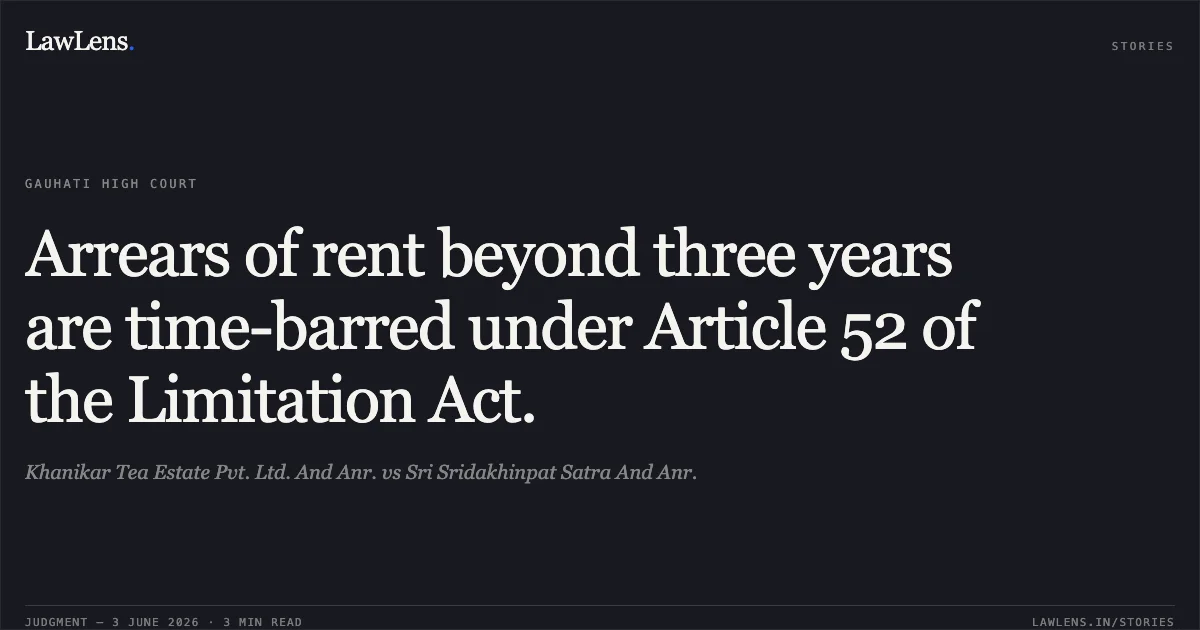
Source reference: p. 10-11Article 52 of the Limitation Act, 1963, which prescribes a 3-year period for recovery of rent arrears from the date they become due.
Source reference: p. 12Article 67, which allows 12 years for recovery of possession.
Source reference: p. 13Kamla Bakshi v. Khairati Lal to affirm that only arrears falling within the 3-year window are "legally recoverable".
Source reference: p. 14Reasoning
On the procedural issue, the High Court found that while the First Appellate Court did not formally frame points for determination, it had discussed all issues framed by the Trial Court and recorded specific findings; thus, there was substantial compliance with the CPC.
Source reference: p. 12Regarding the limitation for rent recovery, the Court held that the lower courts erred by granting arrears for six years (2008–2013). Since the suit was filed on 06.03.2014, any rent due more than three years prior to the filing date was time-barred under Article 52.
Source reference: p. 13The Court rejected the Respondent's argument that "continuous default" or Article 67 extended the money-claim period, clarifying that Article 67 pertains strictly to possession, whereas Article 52 governs the monetary recovery of arrears.
Source reference: p. 14Consequently, the recovery was restricted to the legally permissible three-year window.
Source reference: p. 15Holding
The High Court partly allowed the appeal. It held that the First Appellate Court’s judgment was not vitiated by procedural lapses under Order XLI Rule 31.
However, it modified the decree regarding the realization of rent, ruling that the Plaintiff is only entitled to recover arrears for the three years preceding the suit (2011, 2012, and 2013) rather than six years.
Source reference: p. 15The orders for the cancellation of the lease and eviction of the Defendants were upheld based on concurrent findings of fact.
Source reference: p. 15The case was remanded to the Registry to return records to the lower courts.
Source reference: p. 16Acts & Sections Cited
7 provisions across 3 statutes referred to in this judgment. Each provision opens on LawLens.
Code of Civil Procedure, 19083
Limitation Act, 19633
Transfer of Property Act, 18821
Original Court PDF
Khanikar Tea Estate Pvt. Ltd. And Anr.vsSri Sridakhinpat Satra And Anr.
Click to open original judgment
Original judgment, available to read, download and summarize on LawLens.in