Facts
The Central Bureau of Investigation (CBI), Dehradun, registered FIR No. RC0072023S0006 against the revisionist under Sections 120-B, 420, 467, 468, and 471 of the IPC
Source reference: para. 1, 2Following his arrest, the revisionist was produced before the Special Judicial Magistrate, CBI, Dehradun, and remanded to judicial custody via an order dated 09.10.2024
Source reference: para. 3The revisionist challenged this remand order and the legality of his arrest, asserting that the grounds of arrest were not communicated to him in writing at the time of arrest, thereby violating the constitutional mandates under Articles 21 and 22(1)
Source reference: para. 4, 9The respondent contended that the arrest memo, which contained the essential factual allegations, was duly supplied to the revisionist during the arrest
Source reference: para. 21, 33Issues
1. Whether the arrest of the revisionist was illegal due to non-compliance with the constitutional requirement of communicating the grounds of arrest under Article 22(1) of the Constitution of India
Source reference: para. 262. Whether the consequential remand order dated 09.10.2024 is vitiated and liable to be set aside
Source reference: para. 26Law Applied
Article 22(1) of the Constitution of India, which mandates that an arrested person must be informed of the grounds of arrest as soon as possible
Source reference: para. 27Precedent in Pankaj Bansal v. Union of India (2024) 7 SCC 576, which emphasized that furnishing written grounds of arrest is a vital safeguard
Source reference: para. 28Principles from Vihaan Kumar v. State of Haryana (2025) 5 SCC 799, clarifying that the constitutional mandate is satisfied if the arrested person is informed of the "basic facts" constituting the grounds of arrest in a meaningful manner to enable them to seek legal remedies
Source reference: para. 29, 30Distinction between "reasons for arrest" (statutory necessity) and "grounds of arrest" (factual allegations)
Source reference: para. 31Reasoning
The Court examined the arrest memo prepared by the investigating agency and found that it recorded the essential factual allegations constituting the alleged offences under the IPC
Source reference: para. 32, 33Since this document was admittedly supplied to the revisionist at the time of arrest, the Court reasoned that the requirement of communicating the grounds of arrest in writing was "substantially complied with"
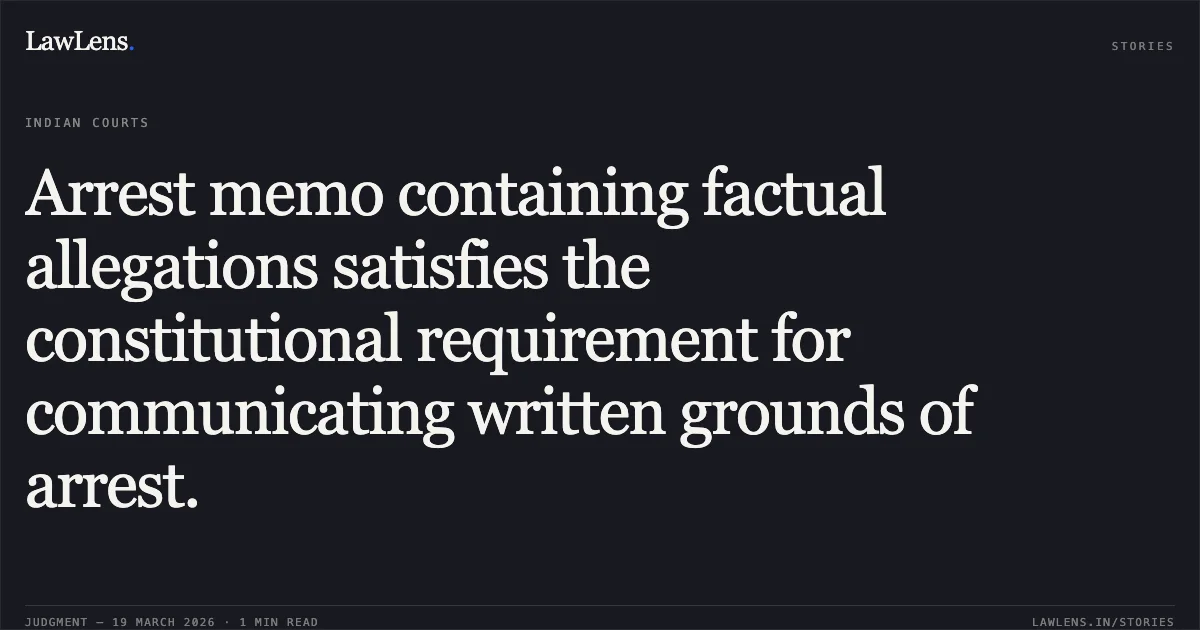
Source reference: para. 34The Court observed that Article 22(1) does not strictly require the grounds of arrest to be recorded on a separate document distinct from the arrest memo, provided the memo effectively conveys the substance of the accusations
Source reference: para. 34, 35Consequently, the Court found that the revisionist was sufficiently informed of the allegations to exercise his legal rights, and therefore, no constitutional violation occurred during the arrest process
Source reference: para. 36, 37Holding
The Court held that the arrest was lawful as the revisionist was duly informed of the factual allegations through the arrest memo supplied at the time of arrest
The Court answered both issues in the negative, concluding that there was no violation of Articles 21 or 22 of the Constitution
Source reference: para. 37The remand order dated 09.10.2024 was upheld as it did not suffer from any illegality
Source reference: OrderThe criminal revision was accordingly dismissed
Source reference: OrderActs & Sections Cited
4 provisions across 1 statute referred to in this judgment. Each provision opens on LawLens.
Indian Penal Code, 18604
Original Court PDF
RAVI KANTvsCENTRAL BUREAU OF INVESTIGATION
Click to open original judgment
Original judgment, available to read, download and summarize on LawLens.in