01Facts
The applicant sought regular bail in FIR No. 355/2024 registered at Police Station Special Cell for offences under Sections 302, 120B, 174A, 419, 420, 468 and 34 IPC.
p. 1 · ¶ 1The prosecution alleged that she honey-trapped the deceased and called him to a restaurant in Rajouri Garden on 18 June 2024, where shooters Ashish and Vikas killed him. The alleged killing was said to have been directed by Himanshu and Sahil, who were proclaimed offenders and were reportedly hiding in the United States.
p. 2 · ¶ 3The applicant had also been declared a proclaimed offender after proceedings under Section 82 CrPC and was apprehended at Lakhimpur, Uttar Pradesh, on 26 October 2024 while allegedly attempting to flee to Nepal.
p. 2 · ¶ 3 · p. 3 · ¶ 6Her sole ground for bail was that written grounds of arrest had not been supplied. She contended that the arrest memo relating to the present case did not record the grounds of arrest.
p. 2 · ¶ 4The State opposed bail, relying on Amar Thapa v. State of NCT of Delhi and contending that the legal position concerning written grounds of arrest remained unsettled; it also argued that no prejudice had been caused.
pp. 2–3 · ¶ 502Issues
i.Whether the alleged failure to furnish written grounds of arrest entitled the applicant to release on bail, notwithstanding that she had been arrested pursuant to her status as a proclaimed offender
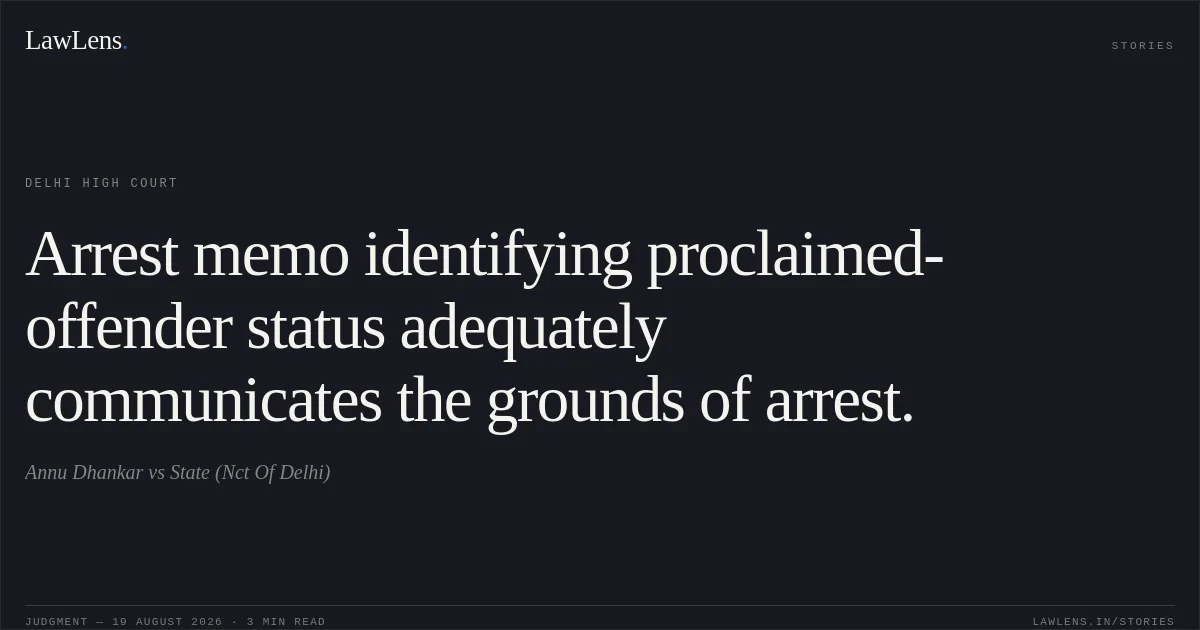
p. 2 · ¶ 4 · p. 3 · ¶ 6ii.Whether the information recorded in the arrest memo—that the applicant was being arrested as a proclaimed offender—constituted adequate compliance with the applicable requirement concerning communication of the basis of arrest
p. 3 · ¶ 6iii.Whether any prejudice was caused to the applicant by the alleged non-supply of written grounds of arrest
p. 3 · ¶ 703Law Applied
The Court considered the offences alleged under Sections 302, 120B, 174A, 419, 420, 468 and 34 IPC, as well as the proclamation procedure under Section 82 CrPC, which applies where a person against whom a warrant has been issued cannot be found and the statutory proclamation process is completed.
p. 1 · ¶ 1 · p. 3 · ¶ 6Relying on Amar Thapa v. State of NCT of Delhi, the Court held that, in the case of a person arrested pursuant to being declared a proclaimed offender, informing the person through the arrest memo that the arrest is on that basis may constitute adequate compliance with the requirement to communicate the basis of arrest.
p. 3 · ¶ 6The Court also considered Mihir Rajesh Shah v. State of Maharashtra & Anr., 2025:INSC:1288, cited by the State regarding the requirement and consequences of furnishing written grounds of arrest.
p. 3 · ¶ 5It further applied the principle that bail relief would not follow where the alleged procedural lapse caused no demonstrated prejudice to the accused.
p. 3 · ¶ 7Provisions in the judgment · 6 · Linked ones open on LawLens
Indian Penal Code, 1860 Section 302Section 419Section 420Section 468Section 34
Code of Criminal Procedure, 1973 Section 82
04Reasoning
The Court distinguished the applicant’s case from a direct arrest during investigation. She had first been arrested on 25 October 2024 pursuant to DD No. 4A after being declared a proclaimed offender through the legally prescribed process of warrants and proclamation under Section 82 CrPC.
p. 3 · ¶ 6The arrest memo expressly informed her that she was being arrested because she was a proclaimed offender, which the Court treated as adequate compliance under Amar Thapa.
p. 3 · ¶ 6In any event, no prejudice was established: she had legal assistance when produced before the Magistrate, the arrest information had also been supplied to her brother, and the Magistrate considered and allowed the Investigating Officer’s application for formal interrogation and arrest in the presence of her counsel.
p. 3 · ¶ 7The Court also took into account the seriousness of the allegations and the applicant’s alleged use of multiple false identities while residing at different places, as noted in the Sessions Court’s order dated 5 June 2026.
p. 4 · ¶ 805Holding
The Court held that the applicant was not entitled to bail merely on the allegation that written grounds of arrest had not been supplied. The arrest memo’s statement that she was being arrested as a proclaimed offender was considered sufficient in the circumstances, and no prejudice had been shown.
p. 3 · ¶ 6–7Considering these factors, the Court found no ground to release her on bail and dismissed the bail application as well as the accompanying application.
p. 4 · ¶ 9A copy of the order was directed to be sent to the Jail Superintendent for immediate communication to the applicant.
p. 4 · ¶ 10Original Court PDF
Annu DhankarvsState (Nct Of Delhi)
Click to open original judgment
Original judgment, available to read, download and summarize on LawLens.in