Facts
The appellant (wife) and respondent (husband) married in 2010 and separated in 2016
Source reference: para. 6-7The parties have been embroiled in a decade-long legal battle involving multiple petitions for divorce, custody, and maintenance
Source reference: para. 3In 2019, the Family Court awarded the appellant interim maintenance of ₹80,000 per month, which the respondent consistently defaulted on, leading to significant arrears
Source reference: para. 12-13The respondent, a practicing advocate, initiated over 80 legal proceedings against the appellant, her family, and her legal counsels across various forums, including disciplinary complaints before the Bar Council
Source reference: para. 31, 42The High Court of Bombay dismissed the appellant’s writ petition seeking expeditious disposal of execution proceedings as infructuous
Source reference: para. 4Both parties eventually moved the Supreme Court seeking a decree of divorce under Article 142 of the Constitution, although the respondent later attempted to withdraw his consent
Source reference: para. 30, 37Issues
1. Whether the marriage between the parties has irretrievably broken down, warranting the exercise of extraordinary jurisdiction under Article 142 to grant a decree of dissolution
Source reference: para. 562. Whether the court should quash all inter-se litigations, including those against advocates and relatives, to provide a complete quietus to the matrimonial dispute
Source reference: para. 563. What constitutes a just and equitable permanent alimony and child support settlement considering the conduct of the parties and the needs of the minor children
Source reference: para. 60-61Law Applied
The Court primarily invoked Article 142 of the Constitution of India, which empowers the Supreme Court to pass such decrees or orders as are necessary for doing "complete justice" in any cause or matter
Source reference: para. 56, 62It relied on the doctrine of "irretrievable breakdown of marriage" as a ground for dissolution in exercise of plenary powers
Source reference: para. 56The Court also adhered to the principles of "welfare of the child" in determining custody and the guidelines for assessing financial capacity for maintenance as established in Rajnesh v. Neha (2021)
Source reference: para. 31, 58Reasoning
The Court observed that the marriage was "dead for all practical purposes" due to nearly nine years of separation and intense acrimony
Source reference: para. 56It heavily criticized the respondent’s conduct, characterizing his filing of 80+ cases as "vindictive, vexatious, and oppressive"
Source reference: para. 53The Court found that the respondent misused his legal expertise to intimidate the appellant’s lawyers and frustrate the recovery of maintenance
Source reference: para. 31, 54Regarding financial capacity, the Court rejected the respondent's plea of destitution, noting that his resignation from family business directorships was a "subterfuge" to evade matrimonial obligations
Source reference: para. 59-60The Court reasoned that given the background of the parties and the high cost of education for the children (one of whom is a Canadian citizen), a substantial consolidated settlement was necessary to ensure the appellant and children were not left destitute upon vacating the shared matrimonial home
Source reference: para. 58-61Holding
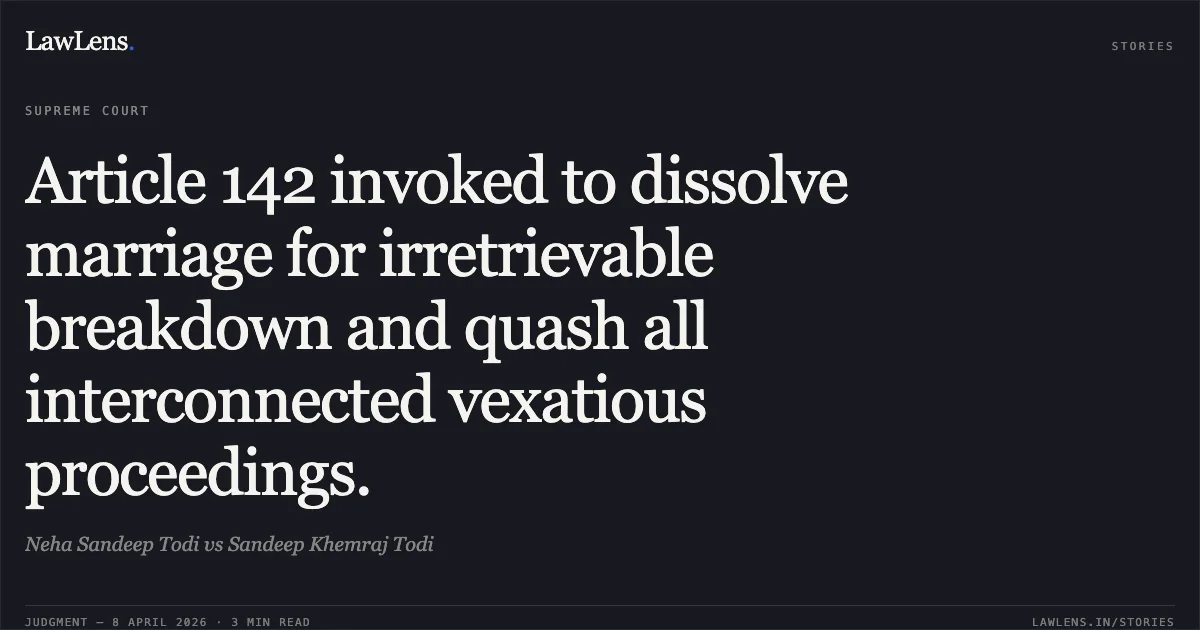
The Supreme Court exercised its jurisdiction under Article 142 to dissolve the marriage and provide a final quietus to all disputes
The Court directed: (i) The marriage stands dissolved
Source reference: para. 62(i-ii)(ii) All pending civil, criminal, and disciplinary proceedings (including FIRs and Bar Council complaints) against either party, their relatives, or lawyers are quashed
Source reference: para. 62(i-ii)(iii) Absolute custody of the two sons remains with the mother, with specific visitation rights for the father
Source reference: para. 62(iii)(iv) The respondent must pay a consolidated sum of ₹5 Crores as full and final settlement for alimony and child support within one year
Source reference: para. 62(v)(v) Upon receipt of the full amount, the appellant shall vacate the matrimonial home
Source reference: para. 62(vi)(vi) Both parties must furnish undertakings to file no further proceedings
Source reference: para. 62(vii)The appeal was disposed of with a decree drawn accordingly
Source reference: para. 63-64Acts & Sections Cited
17 provisions across 3 statutes referred to in this judgment. Each provision opens on LawLens.
Indian Penal Code, 1860
Code of Criminal Procedure, 19736
Advocates Act, 19611
Original Court PDF
Neha Sandeep TodivsSandeep Khemraj Todi
Click to open original judgment
Original judgment, available to read, download and summarize on LawLens.in


