Facts
The wife filed a criminal transfer petition seeking transfer of a Cuttack criminal case to Mumbai and a civil transfer petition seeking transfer of a domestic-violence case to Mumbai; the Supreme Court stayed proceedings in both cases.
Source reference: para. 1–4During their pendency, the husband applied under Article 142 of the Constitution for dissolution of the marriage on the ground of irretrievable breakdown and for quashing pending litigation.
Source reference: para. 5, 18, 22The parties had married on 4 December 2016, lived separately from 2022, and had numerous civil and criminal proceedings pending between them and their family members.
Source reference: para. 5, 18, 22After settlement discussions, the wife consented to divorce and accepted Rs. 35,00,000 as permanent alimony in full and final settlement of her claims.
Source reference: para. 11–14, 24Issues
1. Whether the Court should exercise its Article 142 powers to dissolve the marriage, given the parties’ consent, prolonged separation, and absence of any prospect of reconciliation.
Source reference: para. 20–242. Whether the Court should quash the pending civil and criminal proceedings between the parties and their family members as part of doing complete justice.
Source reference: para. 5, 15–18, 23–25Law Applied
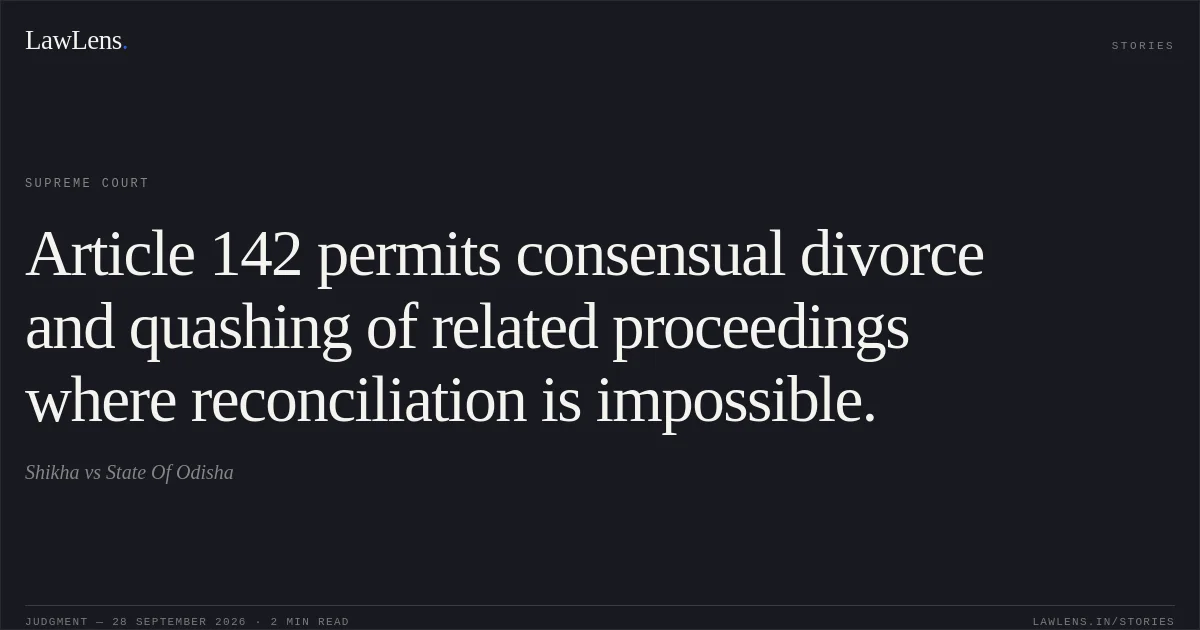
Article 142(1) of the Constitution empowers the Supreme Court to pass orders necessary to do “complete justice” in a cause or matter, including, in an appropriate case, to dissolve a marriage and bring related proceedings to an end.
Source reference: para. 20In Shilpa Sailesh v. Varun Sreenivasan, (2023) 14 SCC 231, the Court held that this power may be exercised where the statutory conditions and relevant circumstances justify a decree, but its exercise depends on the facts of each case; relevant considerations include the parties’ genuine and voluntary decision, separation, prospects of reconciliation, settlement, and arrangements concerning alimony.
Source reference: para. 20In Rinku Baheti v. Sandesh Sharda, (2025) 3 SCC 686, the Court reiterated that divorce on irretrievable breakdown under Article 142 is discretionary, not a matter of right, and may be granted where the marriage is beyond repair and dissolution is necessary to do complete justice.
Source reference: para. 21Reasoning
The Court found that the parties had lived separately since 2022, their marriage had reached a dead end, and reconciliation was not possible; it also noted the extensive litigation arising from the matrimonial dispute and the parties’ agreement to part ways.
Source reference: para. 22–23Having regard to the wife’s consent and the husband’s payment of the agreed Rs. 35,00,000 in full and final settlement of her claims, the Court concluded that exercising Article 142 jurisdiction would bring the dispute to a just and final resolution.
Source reference: para. 24It accordingly extended relief to the cases identified in both parties’ lists and other civil or criminal cases filed inter se between them.
Source reference: para. 17–18, 25Holding
The Court allowed the husband’s Article 142 application and dissolved the marriage solemnised on 4 December 2016.
It quashed the pending cases listed in the judgment and any other civil or criminal cases filed inter se between the parties, directed them not to file fresh cases against each other, and disposed of both transfer petitions.
Source reference: para. 25–27The Registry was directed to draw up a decree.
Source reference: para. 28Acts & Sections Cited
10 provisions across 6 statutes referred to in this judgment. Each provision opens on LawLens.
Indian Penal Code, 18604
Hindu Marriage Act, 19551
Protection of Women from Domestic Violence Act, 20051
Code of Criminal Procedure, 19732
Code of Civil Procedure, 19081
Family Courts Act, 19841
Original Court PDF
ShikhavsState Of Odisha
Click to open original judgment
Original judgment, available to read, download and summarize on LawLens.in