Facts
The applicant, Vasudev, was arrested on May 11, 2023, following a police raid where 7.00 KG of opium (a commercial quantity) was allegedly seized from him and a co-accused on a motorcycle
Source reference: para. 2, 10He was charged under Sections 8/18 and 29 of the Narcotic Drugs and Psychotropic Substances (NDPS) Act.
Source reference: no citationThis is the applicant's fourth bail application; previous applications were either dismissed for want of prosecution, dismissed with liberty, or granted as temporary bail
Source reference: para. 3Currently, the trial remains pending with only two out of thirty-one enlisted witnesses examined
Source reference: para. 1, 10The Trial Court's status report suggests the trial will take approximately 9–10 months to conclude
Source reference: para. 1Crucially, the independent seizure witnesses (PW1 and PW2) did not support the prosecution's case during their examination
Source reference: para. 6, 10Issues
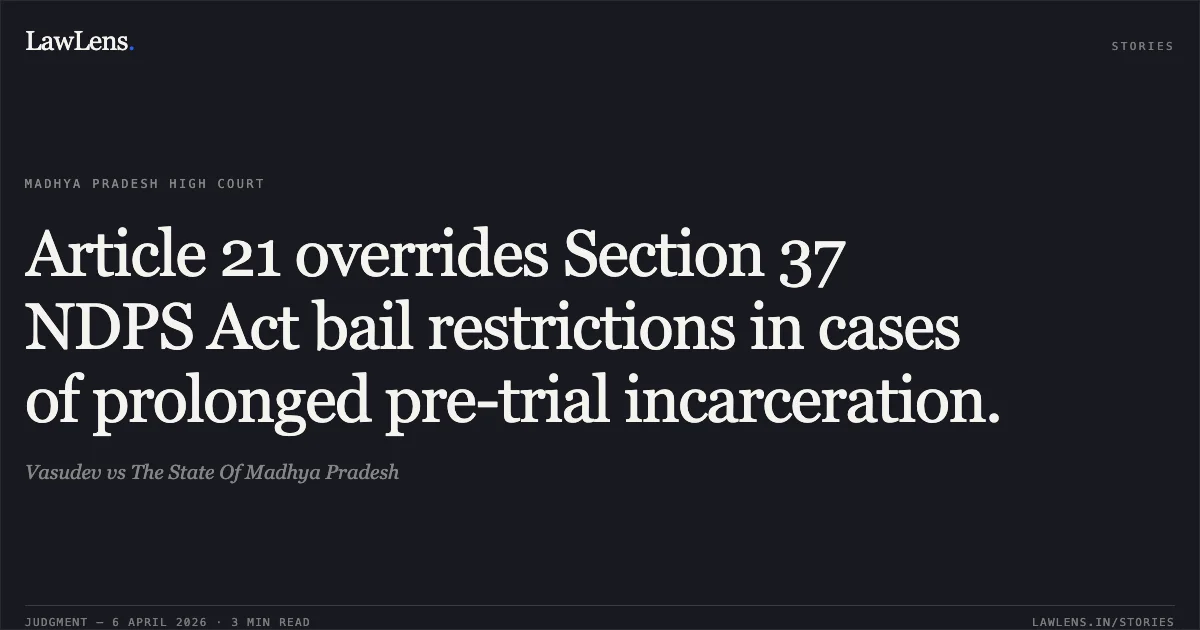
1. Whether prolonged incarceration and slow trial progress constitute a violation of Article 21 of the Constitution sufficient to override the statutory bar under Section 37(1)(b) of the NDPS Act
Source reference: para. 7, 132. Whether the hostility of independent seizure witnesses and the lack of previous convictions justify the grant of bail in a case involving commercial quantities of narcotics
Source reference: para. 6, 14Law Applied
The court primarily applied Section 483 of the Bharatiya Nagarik Suraksha Sanhita (BNSS), 2023, for the grant of bail
Source reference: para. 2It addressed the statutory embargo created by Section 37(1)(b) of the NDPS Act
Source reference: para. 13Article 21 of the Constitution of India, which guarantees the right to a fair and speedy trial
Source reference: para. 7, 11Establishing that constitutional courts may grant bail despite restrictive penal provisions if an accused's fundamental rights are infringed by prolonged trial delay (Union of India v. K.A. Najeeb (2021) and Sheikh Javed Iqbal v. State of Uttar Pradesh (2024))
Source reference: para. 11Conditional liberty may be considered when trial witnesses do not support the prosecution and the trial is delayed (Ankur Chaudhary v. State of Madhya Pradesh (2024))
Source reference: para. 13Reasoning
The Court noted that the applicant has been in judicial custody for nearly three years, yet the trial is far from conclusion with twenty-nine witnesses still to be examined
Source reference: para. 14Applying the principles from K.A. Najeeb, the Court reasoned that while the NDPS Act contains stringent provisions, constitutional courts must lean in favor of the rule of law and personal liberty when trial delays become oppressive
Source reference: para. 11The Court emphasized that the independent seizure witnesses (PW1 and PW2) failed to support the prosecution, which, combined with the lack of substantial criminal antecedents (the applicant having been acquitted in his only prior case), reduced the likelihood of recidivism or evidence tampering
Source reference: para. 9, 14Consequently, the Court found that continued incarceration was no longer compelling and that the right to a speedy trial outweighed the statutory restrictions of the NDPS Act
Source reference: para. 14, 15Holding
The Court answered the issues in the affirmative, holding that prolonged custody without trial progress militates against the fundamental right to life and liberty
The application for bail was allowed
Source reference: para. 15The Court directed the applicant’s release on a personal bond of Rs. 75,000 with one solvent surety of the same amount, subject to strict conditions: the applicant must attend all hearing dates, refrain from committing similar offences, and must not induce or threaten any person acquainted with the facts of the case
Source reference: para. 16The order remains effective until the conclusion of the trial, provided the bail conditions are not breached
Source reference: para. 17Acts & Sections Cited
8 provisions across 4 statutes referred to in this judgment. Each provision opens on LawLens.
Bharatiya Nagarik Suraksha Sanhita, 20232
Narcotic Drugs and Psychotropic Substances Act, 19854
Unlawful Activities (Prevention) Act, 19671
Code of Criminal Procedure, 19731
Original Court PDF
VasudevvsThe State Of Madhya Pradesh
Click to open original judgment
Original judgment, available to read, download and summarize on LawLens.in