Facts
The petitioner sought protection against alleged forcible eviction from the house in which she and her family were residing, attributing the threatened dispossession to Respondent No. 8, an Assistant Sub-Inspector of Police, and the police authorities.
Source reference: p. 1According to the petitioner, a tenancy dispute with the landlady was settled when the landlady agreed to sell the house to the petitioner’s husband; an agreement was executed and ₹10 lakhs was paid pursuant to it.
Source reference: p. 2The petitioner alleged that, despite this agreement, the landlady subsequently executed a registered sale deed in favour of Shailendra Kumar Rai, Respondent No. 9, and that the police acted at the purchaser’s instance to evict her.
Source reference: p. 2She further alleged that the house was demolished, resulting in her dispossession, and stated that she was taking steps to institute a civil suit.
Source reference: pp. 2–3The State contended that the police had taken all requisite steps on the complaints received and had no role in the petitioner’s eviction; it also submitted that the petitioner had produced no document establishing her right over the property.
Source reference: p. 3Respondent No. 9 asserted that he was a bona fide purchaser under a valid sale deed, had obtained municipal mutation and an electricity connection, and disputed the petitioner’s alleged tenancy and possession.
Source reference: pp. 3–4Issues
1. Whether the High Court, exercising jurisdiction under Article 226 of the Constitution, could adjudicate the disputed questions concerning title, possession, tenancy, and the parties’ competing claims over the property.
Source reference: pp. 4–72. Whether the petitioner was entitled to a writ directing the police authorities to protect her claimed possession or restrain her alleged forcible eviction without first establishing her civil rights before an appropriate civil court.
Source reference: p. 7Law Applied
The Court applied the principle that jurisdiction under Article 226 is extraordinary and supervisory in nature, intended to ensure that public authorities act within the bounds of law and jurisdiction, rather than to determine private rights relating to property.
Source reference: pp. 4–6Relying on Mohd. Hanif v. State of Assam, (1969) 2 SCC 782, the Court held that writ jurisdiction is primarily a public-law remedy and is not ordinarily available for declaring or adjudicating private rights.
Source reference: pp. 4–6It further relied on P.R. Murlidharan v. Swami Dharmananda Theertha Padar, (2006) 4 SCC 501, for the proposition that approaching the writ court to resolve disputed questions of title is an abuse of process where the civil court is the appropriate forum.
Source reference: p. 6Accordingly, disputed claims concerning title, tenancy, possession, and alleged dispossession must ordinarily be determined in civil proceedings.
Source reference: pp. 6–7Reasoning
The Court found that the petitioner’s claim depended upon disputed factual and civil questions, including the alleged agreement to sell, payment of ₹10 lakhs, the subsequent registered sale deed in favour of Respondent No. 9, the existence of a tenancy, the parties’ possession, and the alleged role of the police in the eviction and demolition.
Source reference: pp. 2–4The affidavit of the State authorities indicated that the police had taken the requisite steps in accordance with law, and the Court did not find a basis for issuing a public-law direction against them.
Source reference: p. 4Since determination of the petitioner’s claimed possession and proprietary or tenancy rights would require adjudication of contested evidence, the Court held that Article 226 was not the appropriate forum for granting the requested protection.
Source reference: pp. 6–7Holding
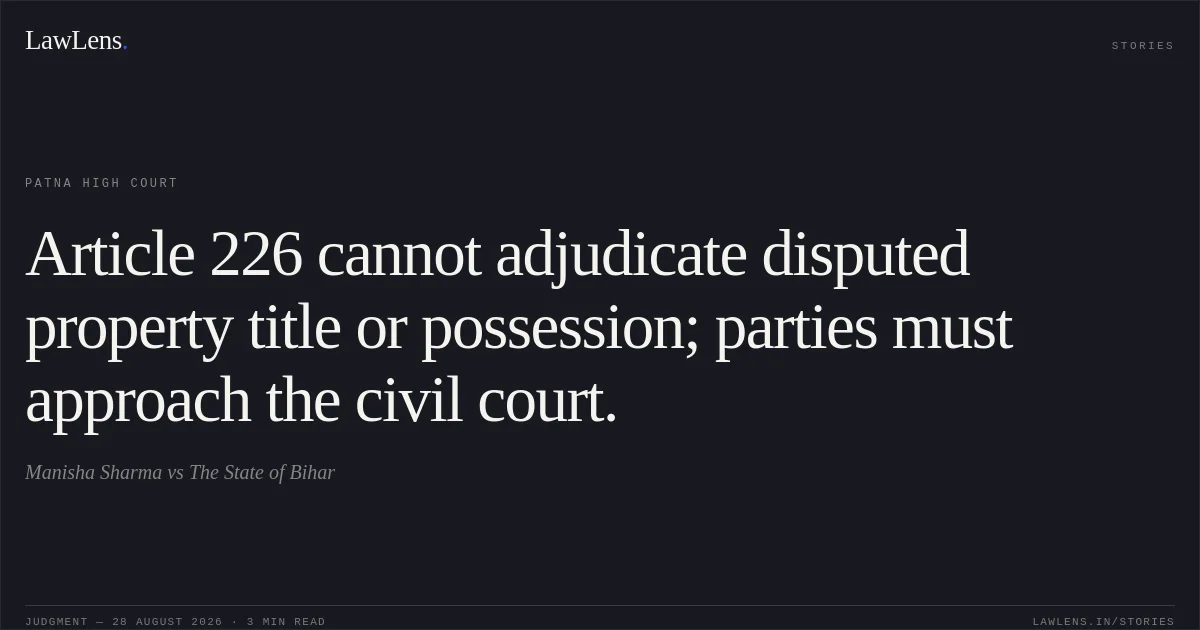
The Court declined to adjudicate the disputed questions of title, tenancy, and possession in the writ proceedings and held that seeking protection of the petitioner’s claimed possession without first establishing it before a civil court would constitute an abuse of the writ jurisdiction.
The writ petition was accordingly disposed of with liberty to the petitioner to approach the appropriate civil court for redressal of her grievance.
Source reference: p. 7All pending interlocutory applications, if any, were also disposed of.
Source reference: p. 7Original Court PDF
Manisha SharmavsThe State of Bihar
Click to open original judgment
Original judgment, available to read, download and summarize on LawLens.in
![Courts will not interfere with transfers absent mala fides or violation of statutory rules.. M Ramya vs EMPLOYEES STATE INSURANCE CORPORATION (ESIC). CAT - ['Chennai']. LawLens](/stories/thumbnails/courts-will-not-interfere-with-transfers-absent-mala-fides-or-violation-of-statutory-rules-a6845e9ca6f548fca284c51c8351957f.webp)
![Courts cannot direct one-time recruitment age relaxation absent authority in the governing rules or advertisement.. UT OF PUDUCHERRY vs M ANDAL. CAT - ['Chennai']. LawLens](/stories/thumbnails/courts-cannot-direct-one-time-recruitment-age-relaxation-absent-authority-in-the-governing-895d78fde47143e2a8ed0207c4b6a44f.webp)
![A review cannot correct an allegedly erroneous decision absent an error apparent on the record.. Ajit Kumar Jha vs RAILWAY BOARD. CAT - ['Delhi']. LawLens](/stories/thumbnails/a-review-cannot-correct-an-allegedly-erroneous-decision-absent-an-error-apparent-on-the-re-8ac952fd4eba470c92f7da20af72a220.webp)