Facts
The petitioner claimed ownership and possession of residential land situated at Mauza Bagh Mirza Dil, Saran, and alleged that on 14 March 2024 Respondent Nos. 9–11, along with others, forcibly entered the property using weapons and a JCB machine, broke the boundary wall, and erected an iron-sheet partition.
Source reference: p. 3The petitioner alleged that Respondent No. 9, his daughter, had been pressuring him and his wife to sell the property and hand over the sale proceeds, and had executed a sale deed in favour of Respondent Nos. 10 and 11 on 16 February 2024 during the pendency of Title Suit No. 265 of 2023.
Source reference: p. 3The State contended that the petitioner owned 4.18 kathas of land, on which his house stood, and that Respondent No. 9 had sold three kathas to Respondent Nos. 10 and 11, claiming a coparcenary right in the property.
Source reference: pp. 3–4The petitioner approached the High Court under Article 226 seeking protection of life and property, restoration of possession, action against police officials, and maintenance of status quo pending adjudication of the title suit.
Source reference: pp. 2–3Issues
Whether the High Court should exercise its writ jurisdiction under Article 226 to determine disputed questions of title and possession and direct restoration of the petitioner’s property?
Source reference: pp. 4–8; paras. 8–10Whether the petitioner was entitled to writ directions against the State authorities for protection of possession, restoration of possession, and departmental or criminal action against police officials?
Source reference: pp. 2–4, 8; paras. 7–11Law Applied
The Court applied the principle that jurisdiction under Article 226 is extraordinary and supervisory, intended to ensure that public authorities act within the bounds of law, and is not ordinarily a forum for declaring or adjudicating private rights relating to title and possession, as explained in Mohd. Hanif v. State of Assam, (1969) 2 SCC 782.
Source reference: pp. 5–7; para. 8The Court further relied on P.R. Murlidharan v. Swami Dharmananda Theertha Padar, (2006) 4 SCC 501, which holds that approaching the writ court for determination of a title dispute, where the civil court is the appropriate forum, amounts to an abuse of process.
Source reference: p. 7; para. 9Accordingly, disputed civil rights must ordinarily be established before the competent civil court before consequential protection or restoration is sought through writ proceedings.
Source reference: pp. 7–8; para. 10Reasoning
The Court noted that the parties’ competing claims concerning ownership, possession, the alleged coparcenary right, and the validity and effect of the sale deed involved substantial disputed questions of fact and civil law.
Source reference: pp. 3–4, 8; para. 8Although the petitioner sought restoration of possession and directions against the police, granting such relief would necessarily require the High Court to determine the parties’ underlying title and possessory rights. Such adjudication falls outside the ordinary scope of Article 226 and is appropriately undertaken in the pending civil proceedings.
Source reference: pp. 7–8; para. 10The Court also found, on the basis of the authorities’ affidavit, that the State authorities had taken necessary steps in accordance with law, including registration of an FIR.
Source reference: p. 4; para. 7Therefore, no further writ direction for protection, restoration, or departmental action was warranted in the present proceedings.
Source reference: pp. 4, 8; paras. 7, 10Holding
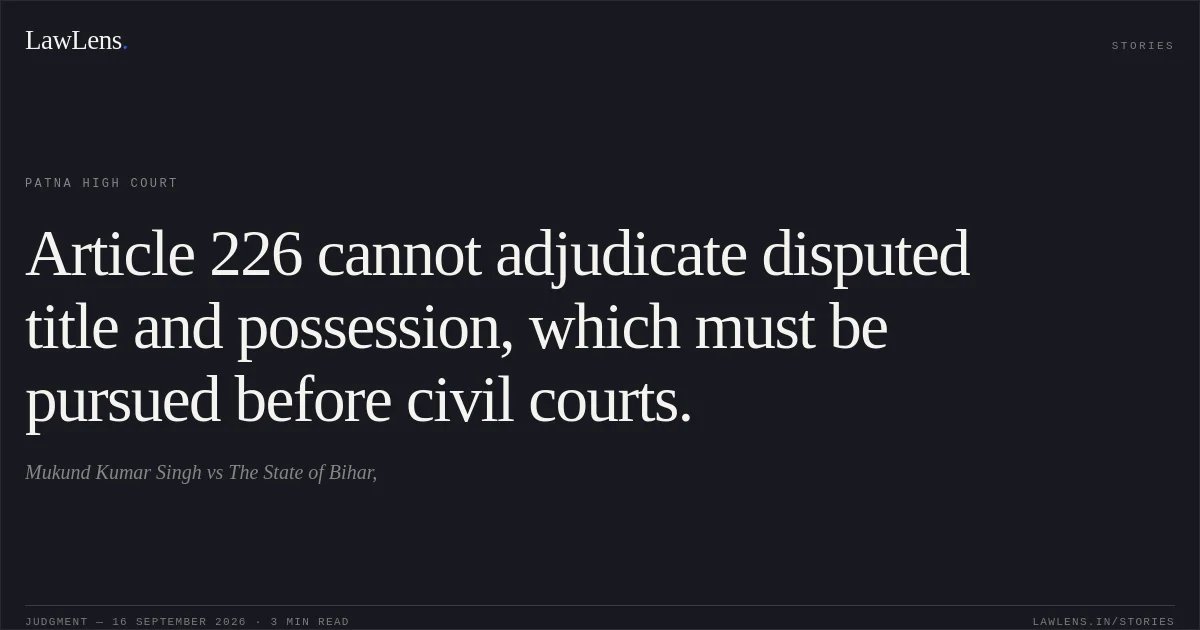
The Court held that the writ petition was not maintainable for adjudicating the disputed questions of title and possession or for directing restoration of the property.
The petitioner was granted liberty to approach the appropriate civil court for redressal of his grievances.
Source reference: p. 8; para. 11The writ petition was accordingly disposed of, without granting the substantive reliefs sought under Article 226.
Source reference: p. 8; para. 11Original Court PDF
Mukund Kumar SinghvsThe State of Bihar,
Click to open original judgment
Original judgment, available to read, download and summarize on LawLens.in