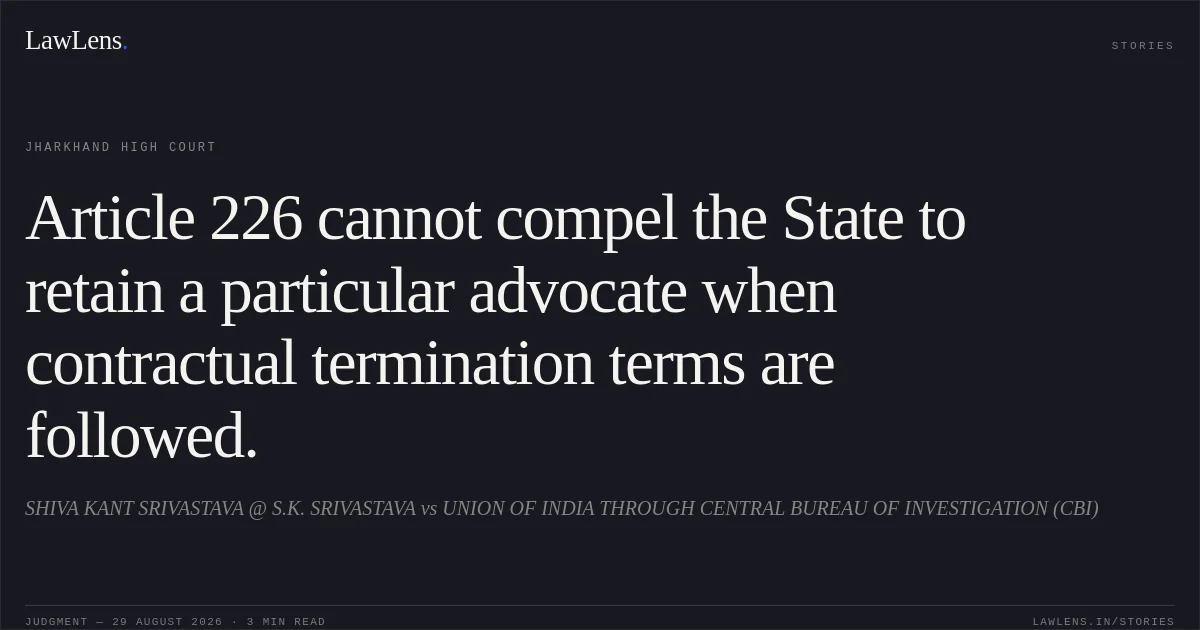
Facts
The petitioner had been engaged by the CBI as counsel on its Additional Panel of Advocates for animal husbandry cases pursuant to a letter dated 8 April 2003.
Source reference: p.1, para.3He was handling several cases relating to the animal husbandry scam.
Source reference: no citationRelying on a Directorate of Prosecution letter dated 18 September 2013, the petitioner contended that any change of counsel or transfer of officers required the permission of the High Court.
Source reference: p.1, para.3By letter dated 8 July 2026, the respondents terminated his engagement, with effect from 9 August 2026, after providing one month’s notice.
Source reference: p.4, para.8The petitioner challenged the termination on the grounds of violation of natural justice, discrimination under Article 14, and mala fides, and sought quashing of the termination order and protection against interference with his engagement.
Source reference: p.1, paras.2–4The respondents relied on the Ministry of Personnel, Public Grievances and Pensions notification dated 30 January 1997, under which the engagement of counsel was terminable by one month’s written notice.
Source reference: p.3, paras.5–6Issues
1. Whether the termination notice dated 8 July 2026 was illegal or arbitrary so as to warrant interference under Article 226 of the Constitution.
Source reference: p.3, para.72. Whether the petitioner was entitled to a prior hearing before termination of his engagement as counsel.
Source reference: p.2, para.43. Whether the termination was discriminatory or mala fide in violation of Article 14 of the Constitution.
Source reference: pp.2–3, para.4; p.5, paras.11–124. Whether the respondents could be compelled to continue utilising the petitioner’s services as an advocate.
Source reference: p.5, para.13Law Applied
The Court applied Clause IV of the Ministry of Personnel, Public Grievances and Pensions notification dated 30 January 1997, which permitted termination of a counsel’s engagement by one month’s written notice.
Source reference: p.3, paras.5–6; p.4, para.8It relied on Kumari Shrilekha Vidyarthi v. State of U.P., (1991) 1 SCC 212, for the principle that State action in contractual matters remains subject to Article 14 and must not be arbitrary, while distinguishing its application to en bloc termination of government advocates.
Source reference: p.4, para.9The Court also relied on State of U.P. v. Rakesh Kumar Kesari, AIR 2011 SC 1705, for the rule that Article 226 cannot be invoked to compel the State to utilise the services of a particular advocate, since the State is entitled to select its own counsel.
Source reference: p.5, para.13Allegations of mala fides must be supported by concrete material, and the concerned officer against whom mala fides are alleged should ordinarily be impleaded by name.
Source reference: p.5, para.12The Court additionally referred to Mundrika Prasad Singh v. State of Bihar, 1979 INSC 192, regarding dignified relinquishment of public office by a government pleader.
Source reference: p.5, para.14Reasoning
The Court held that the impugned letter complied with the governing 1997 notification because it afforded the petitioner one month’s written notice and made the disengagement effective only from 9 August 2026.
Source reference: p.4, para.8Consequently, the petitioner’s contention that the respondents lacked authority to terminate his engagement was rejected.
Source reference: no citationThe 2013 letter did not assist him because the animal husbandry trials had already concluded.
Source reference: p.4, para.9The reliance on Shrilekha Vidyarthi was misplaced: unlike the en bloc termination considered there, the present disengagement was an individual action taken in accordance with the applicable terms of engagement.
Source reference: p.4, paras.9–10The allegations of discrimination and mala fides were unsupported by documentary or other cogent material; mere pleading was insufficient, and the concerned officer had not been impleaded by name.
Source reference: p.5, para.12Further, the Court held that the respondents could not be compelled to continue the petitioner’s engagement, as the State retained the discretion to choose its counsel.
Source reference: p.5, para.13Holding
The Court answered the principal issue against the petitioner and held that the termination notice dated 8 July 2026 was neither illegal nor arbitrary.
Since the notice complied with the one-month termination condition and the allegations of natural-justice violations, discrimination, and mala fides were unsubstantiated, no judicial interference under Article 226 was warranted.
Source reference: pp.4–5, paras.8–13The writ petition was dismissed, all pending interlocutory applications were closed, and no order as to costs was made.
Source reference: p.6, para.15Original Court PDF
SHIVA KANT SRIVASTAVA @ S.K. SRIVASTAVAvsUNION OF INDIA THROUGH CENTRAL BUREAU OF INVESTIGATION (CBI)
Click to open original judgment
Original judgment, available to read, download and summarize on LawLens.in
![A police constable cannot be removed for unauthorized absence without a Rule 359-compliant inquiry.. Mohammad Sidiq Khan vs D/o Home Ut Of Jammu & Kashmir. CAT - ['Srinagar']. LawLens](/stories/thumbnails/a-police-constable-cannot-be-removed-for-unauthorized-absence-without-a-rule-359-compliant-7b43fc316bd94f22a62676153bbc9d54.webp)
![A Review DPC lacks authority to determine or alter inter se seniority.. SAURABH KUMAR vs REVENUE. CAT - ['Patna']. LawLens](/stories/thumbnails/a-review-dpc-lacks-authority-to-determine-or-alter-inter-se-seniority-4b21640f20af46fcabdfc8273d2ce959.webp)