Facts
The petitioner was appointed as a Lower Division Clerk on compassionate grounds by Babasaheb Bhim Rao Ambedkar Bihar University on 6 April 2018 and was posted to the Department of English, where he joined on 3 May 2018.
Source reference: p. 2–3; para. 4He claimed that, despite joining and continuously working, he was not paid salary from 3 May 2018 onwards and was subsequently prevented from marking attendance.
Source reference: p. 3–4; para. 4The University admitted that he worked until 5 September 2018, but contended that he thereafter remained unauthorisedly absent; it also alleged that documents relied upon by him, including absentee reports and representations, were forged or fabricated.
Source reference: p. 6–10; paras. 7, 9The petitioner disputed the allegations and asserted that he had continued attending the Department but was not permitted to mark attendance.
Source reference: p. 7–8; para. 8The writ petition initially sought payment of salary and arrears, and was later amended to include directions permitting the petitioner to mark attendance and granting consequential service benefits.
Source reference: p. 1–2; paras. 2–3Issues
Whether the petitioner was entitled to payment of salary for the period from 3 May 2018 to 5 September 2018, which the University admitted he had worked?
Source reference: p. 14–15; para. 14Whether the High Court, in exercise of jurisdiction under Article 226 of the Constitution, could determine the disputed factual question of whether the petitioner worked in the University after 5 September 2018?
Source reference: p. 14–15; para. 14Whether the University should conduct an enquiry into the petitioner’s alleged service after 5 September 2018 and determine his entitlement to salary and other service benefits?
Source reference: p. 15; para. 14Law Applied
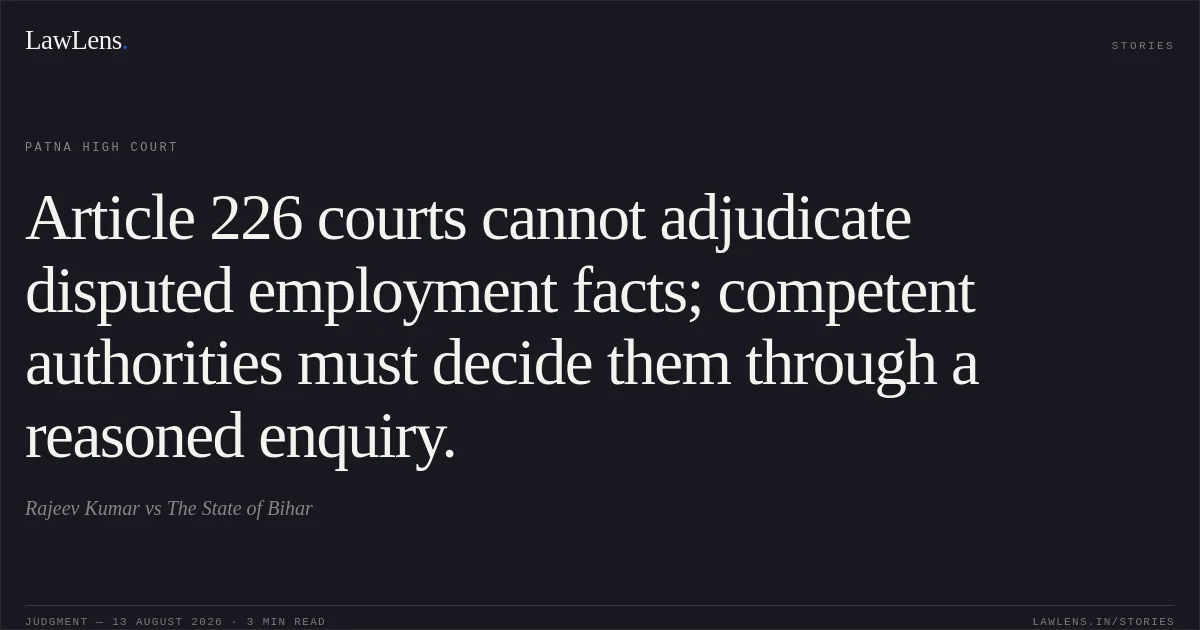
The Court applied the principle that the writ jurisdiction under Article 226 of the Constitution of India is ordinarily not appropriate for adjudicating seriously disputed questions of fact requiring examination of evidence.
Source reference: p. 14; para. 14At the same time, where an admitted or undisputed fact establishes that an employee worked for a specified period, the employer cannot withhold salary for that period without lawful justification.
Source reference: p. 14–15; para. 14The Court further directed that any determination concerning subsequent absence, salary, service benefits, or disciplinary action must comply with the principles of natural justice, including an opportunity to the employee to appear and produce supporting documents, and must culminate in a reasoned and speaking order under the applicable University Act and Statutes.
Source reference: p. 15; para. 14Reasoning
The Court found that the petitioner’s appointment and joining were undisputed, and that the University expressly admitted that he worked from 3 May 2018 until 5 September 2018.
Source reference: p. 13–14; para. 13Accordingly, the claim for salary for that admitted period did not involve a disputed question of fact and could be granted directly.
Source reference: p. 13–14; para. 13However, the parties gave conflicting accounts regarding the petitioner’s presence after 5 September 2018: the petitioner relied on absentee reports and alleged that he had been prevented from marking attendance, whereas the University relied on the report of the Head of Department stating that he had been absent since September 2018 and alleged fabrication of documents.
Source reference: p. 13–14; para. 13Since resolution of that conflict would require factual enquiry and assessment of evidence, the Court declined to decide the issue under Article 226.
Source reference: p. 14–15; para. 14Instead, it entrusted the enquiry to the Vice-Chancellor, subject to the petitioner being given a fair opportunity to present his case and supporting material.
Source reference: p. 14–15; para. 14Holding
The writ petition was disposed of with directions that the Vice-Chancellor shall pay the petitioner salary for the period 3 May 2018 to 5 September 2018, if it had not already been paid.
The Vice-Chancellor was further directed to conduct an enquiry into whether the petitioner worked after 5 September 2018, provide him an opportunity of hearing, and complete the exercise within three months from receipt or production of the judgment.
Source reference: p. 15; para. 14If the enquiry established that the petitioner had worked, salary and other service benefits were to be paid immediately; if not, a reasoned and speaking order was to be passed in accordance with law.
Source reference: p. 15; para. 14The University was thereafter left at liberty to initiate disciplinary action under the applicable Act and Statutes.
Source reference: p. 15; para. 14Pending applications were also disposed of.
Source reference: p. 16; para. 16Original Court PDF
Rajeev KumarvsThe State of Bihar
Click to open original judgment
Original judgment, available to read, download and summarize on LawLens.in