Facts
The petitioners alleged that private respondents constructed a seven-foot boundary wall and installed an iron gate on land claimed by the petitioners at Mauza Bhatarih/Batadih, Khata No. 35, Plot No. 2, and dispossessed them.
Source reference: paras. 2–10, pp. 2–7The parties asserted competing chains of title deriving from common vendors, and each side relied on registered sale deeds, mutation, and rent payments.
Source reference: paras. 2–10, pp. 2–7The petitioners also alleged that the authorities failed to act on their complaints.
Source reference: paras. 2–10, pp. 2–7They sought removal of the wall and action against the private respondents and erring officers.
Source reference: paras. 2–10, pp. 2–7The State and private respondents maintained that the dispute concerned contested title and possession requiring civil adjudication.
Source reference: paras. 7–10, pp. 5–7Issues
Whether the High Court should exercise jurisdiction under Article 226 to resolve the parties’ competing claims to title and possession and order removal of the boundary wall.
Source reference: paras. 11–12, pp. 7–10Whether the petitioners’ grievance concerning official inaction warranted relief in the writ proceeding, notwithstanding the underlying private property dispute.
Source reference: paras. 10, 13–14, pp. 7, 11Law Applied
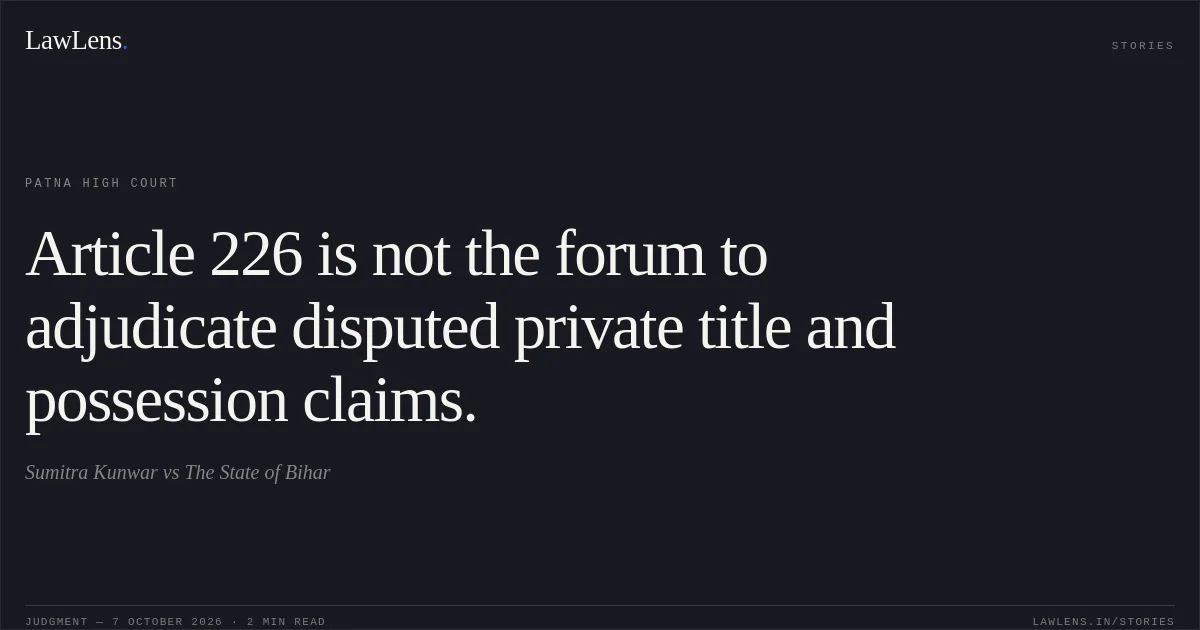
Article 226 confers extraordinary public-law jurisdiction, ordinarily not intended to determine private rights or adjudicate disputed questions of title requiring assessment of evidence.
Source reference: para. 11, pp. 7–10In Mohd. Hanif v. State of Assam, (1969) 2 SCC 782, the Supreme Court described Article 226 as a supervisory jurisdiction directed to ensuring that public authorities and tribunals act within their jurisdiction, rather than as a forum for declaring private rights.
Source reference: para. 11, pp. 7–10P.R. Murlidharan v. Swami Dharmananda Theertha Padar, (2006) 4 SCC 501, reiterates that resort to writ jurisdiction for adjudication of a title dispute, for which a civil court is the appropriate forum, may constitute an abuse of process.
Source reference: para. 11, p. 10Reasoning
The Court found that both sides advanced competing title claims supported by separate conveyances, mutation entries, and assertions of possession.
Source reference: paras. 11–12, pp. 7–11Resolving those claims and determining whether the petitioners had been dispossessed would require adjudication of disputed facts and evidence, making the civil court the appropriate forum rather than a writ proceeding under Article 226.
Source reference: paras. 11–12, pp. 7–11The Court separately observed that police authorities should take necessary action if either party faces a law-and-order situation.
Source reference: para. 13, p. 11Holding
The Court declined to order removal of the boundary wall or determine the parties’ title and possession through writ jurisdiction.
It disposed of the petition with liberty to the petitioners to seek redress before the appropriate civil court, while stating that the police authorities are expected to address any law-and-order situation.
Source reference: paras. 12–15, p. 11The pending interlocutory applications were also disposed of.
Source reference: para. 15, p. 11Original Court PDF
Sumitra KunwarvsThe State of Bihar
Click to open original judgment
Original judgment, available to read, download and summarize on LawLens.in