Facts
The petitioner filed a writ of certiorarified mandamus to quash an encroachment removal notice dated 19.01.2026 issued by the Greater Chennai Corporation (GCC) under Section 128(1)(b) of the Tamil Nadu Urban Local Bodies Act, 1998
Source reference: p. 1-2The GCC identified 16 houses and 9 shops as encroachments on Corporation property and initiated enforcement actions
Source reference: p. 2The petitioner contended that no personal hearing was granted and that enforcement began before a final order was passed
Source reference: p. 2Conversely, the respondent submitted that hearing notices were issued on 14.02.2026 and 20.02.2026, which the petitioner ignored, leading to a final eviction order on 12.03.2026
Source reference: p. 3Issues
1. Whether the respondent authorities followed the statutory procedure for the removal of encroachments as prescribed under Section 128 of the Tamil Nadu Urban Local Bodies Act, 1998.
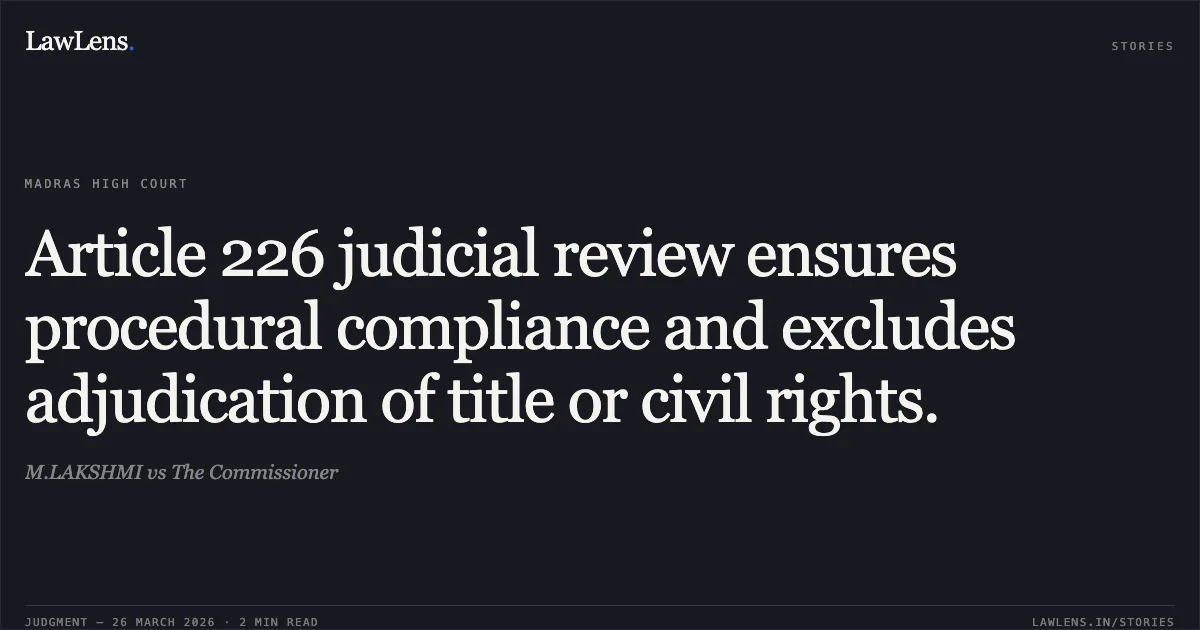
Source reference: p. 32. Whether the High Court, under Article 226 of the Constitution, can adjudicate disputed questions of title or civil rights in a writ proceeding.
Source reference: p. 4-5Law Applied
The court primarily applied Section 128(1)(b) of the Tamil Nadu Urban Local Bodies Act, 1998, which empowers authorities to remove structures encroaching on public streets or lands after providing a seven-day show-cause notice
Source reference: p. 3It further applied the principle of judicial review under Article 226 of the Constitution of India, holding that the court's role is to ensure that the decision-making process is in consonance with statutes and rules, rather than reviewing the decision itself or adjudicating disputed facts/civil rights
Source reference: p. 4-5Reasoning
The court found that the GCC strictly adhered to the procedural requirements of Section 128 of the Act. Specifically, a seven-day notice was issued, and despite the petitioner submitting an explanation, they failed to appear for two scheduled personal hearings on 16.02.2026 and 23.02.2026
Source reference: p. 3-4The court noted that a final order was passed on 12.03.2026 after considering the petitioner's written representation, and this order was handed over to the petitioner's counsel during the court proceedings
Source reference: p. 4Regarding the petitioner's claim of holding a patta (title deed) for the land, the court reasoned that such claims constitute "disputed facts" or "civil rights" that cannot be adjudicated under Article 226
Source reference: p. 5The court’s jurisdiction is limited to verifying procedural compliance, which was established in this case
Source reference: p. 5Holding
The High Court dismissed the writ petition, holding that the respondent followed the due process of law under Section 128 of the Act
The court held that if the petitioner wishes to establish title or ownership (based on the patta), they must seek a remedy through a competent civil court rather than through a writ petition
Source reference: p. 5All connected miscellaneous petitions were closed
Source reference: p. 5Original Court PDF
M.LAKSHMIvsThe Commissioner
Click to open original judgment
Original judgment, available to read, download and summarize on LawLens.in