Facts
The Petitioner, a small contractor, was awarded a work order on 18.01.2024 for the electrification of the Government High School at Salihaghat, District Baloda Bazar-Bhatapara, for a contract value of Rs. 5.03 lakhs
Source reference: para. 3The Petitioner claimed to have completed the work by 16.03.2024, after which a sum of Rs. 4,82,158/- allegedly became due
Source reference: para. 4Despite multiple internal recommendations for payment by departmental authorities between June 2024 and May 2025, the respondents failed to release the funds
Source reference: para. 4The Petitioner filed a writ petition under Article 226 of the Constitution of India seeking a writ of mandamus for the release of the admitted dues and interest, contending that the withholding of payment was arbitrary and violative of Articles 14, 21, and 300-A
Source reference: paras. 2, 6The State opposed the maintainability of the petition, arguing that the matter involved disputed questions of fact arising from a contract
Source reference: para. 11Issues
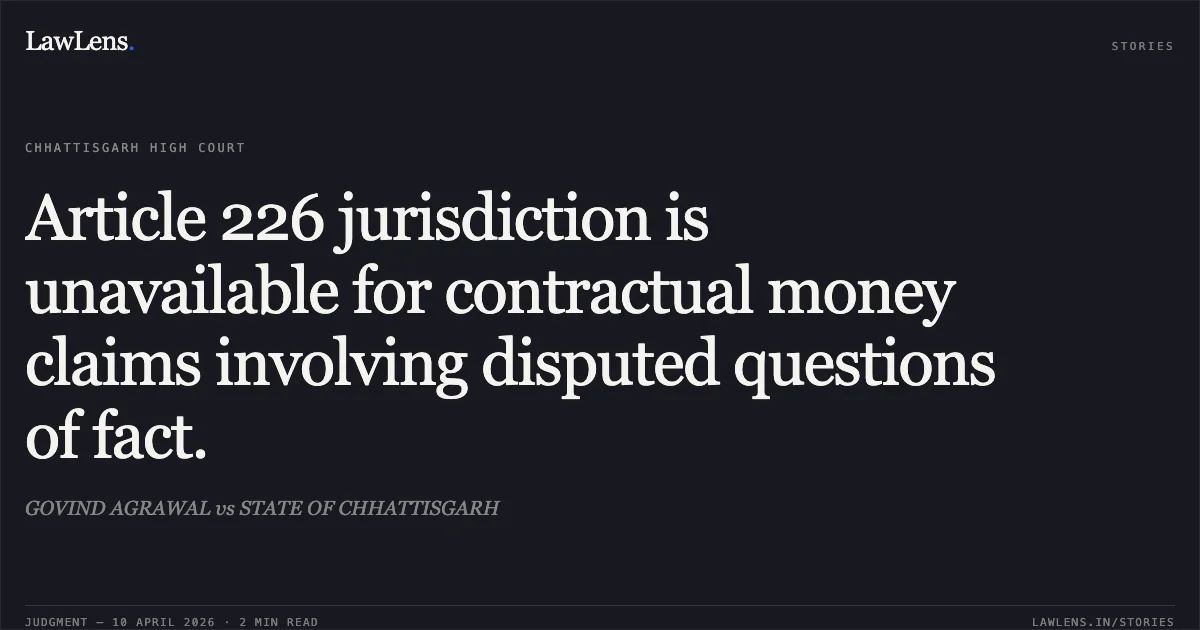
1. Whether the High Court should exercise its extraordinary jurisdiction under Article 226 of the Constitution of India to adjudicate claims for payment arising out of a purely contractual relationship involving potential disputed questions of fact.
Source reference: paras. 13, 19, 20Law Applied
The court emphasized the settled principle that Article 226 jurisdiction should not be exercised when a case involves "disputed questions of fact"
Source reference: para. 13It relied on Chairman, Grid Corporation of Orissa Ltd. (GRIDCO) v. Sukamani Das (1999) 7 SCC 298 and S.P.S. Rathore v. State of Haryana (2005) 10 SCC 1, which established that writ courts are not the proper forum for matters requiring evidence better suited for a civil court
Source reference: paras. 14-15The court further cited Union of India v. Puna Hinda (2021) 10 SCC 690, holding that pure contractual matters lacking statutory flavor are best adjudicated by agreed forums like arbitration or civil courts
Source reference: para. 17Finally, it applied the rule from M.P. Power Management Co. Ltd. v. Sky Power Southeast Solar India (P) Ltd. (2023) 2 SCC 703, stating that the existence of an alternate remedy and the necessity of factual resolution are grounds to decline relief in contractual writ petitions
Source reference: para. 18Reasoning
The court observed that although the Petitioner characterized the dues as "admitted," the claim originated strictly from a contractual relationship
Source reference: para. 20Resolving the dispute would require a detailed examination of records, verification of physical measurements, and assessment of compliance with contractual conditions—tasks the court deemed inappropriate for a summary proceeding under Article 226
Source reference: para. 20The court distinguished the Petitioner's reliance on State of Chhattisgarh v. Baba Vishwanath Construction (WA No. 123 of 2025), noting that the precedent involved a clear, unequivocal admission of liability that left no scope for factual adjudication, whereas the present case required detailed verification of unverified claims
Source reference: para. 21Consequently, the court found that the Petitioner’s grievance did not warrant the exercise of extraordinary writ jurisdiction
Source reference: para. 22Holding
The High Court dismissed the writ petition as not maintainable, holding that the Petitioner must seek recourse through appropriate alternate legal remedies
The court clarified that it would not undertake the adjudication of disputed or unverified contractual claims in writ proceedings
Source reference: para. 21Liberty was reserved for the Petitioner to approach the appropriate forum under the law
Source reference: para. 23No costs were awarded
Source reference: para. 23Original Court PDF
GOVIND AGRAWALvsSTATE OF CHHATTISGARH
Click to open original judgment
Original judgment, available to read, download and summarize on LawLens.in