Facts
The petitioner, Nehrulal, approached the High Court under Article 226 of the Constitution seeking a direction to the competent authorities to expeditiously decide his pending representations concerning the appointment of a Panchayat Karmi and an order dated 29 March 2005 in Case No. 203/Nya. Panch./2003-04.
Source reference: para. 1The record disclosed that the Director, Panchayat had passed an adverse order against the petitioner on 22 December 2005, allowing an appeal filed by Respondent No. 9, Anil Kumar Tandon.
Source reference: para. 3The petitioner did not state or produce any material showing that the Director’s order had been challenged before a higher appellate forum or competent authority. Instead, he filed the present writ petition, framed as a request for adjudication of a pending representation, after a delay of approximately two decades.
Source reference: paras. 4–6Issues
Whether the High Court, in exercise of its jurisdiction under Article 226, could direct the authorities to decide a pending representation when the foundational adverse order dated 22 December 2005 had not been challenged and had attained finality?
Source reference: paras. 3–6Whether a stale claim could be revived by styling the relief as a direction to decide a representation, thereby bypassing statutory delays and the consequences of laches?
Source reference: paras. 5–7Law Applied
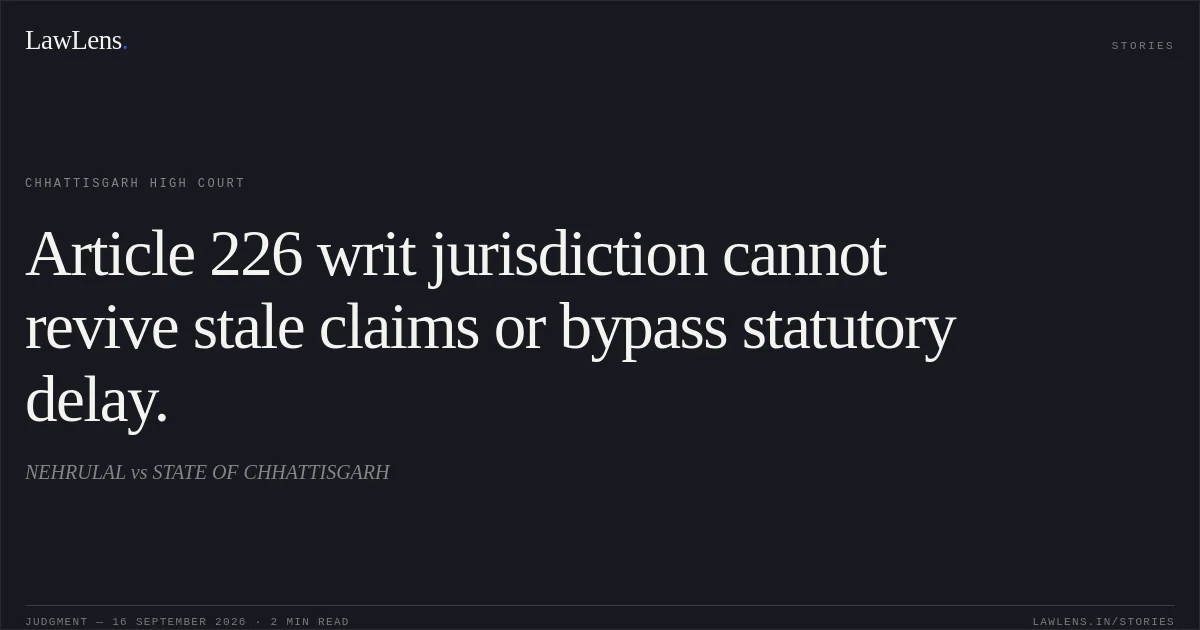
Article 226 confers discretionary and extraordinary writ jurisdiction, which cannot ordinarily be invoked to circumvent statutory limitations, unsettle concluded matters, or revive stale claims.
Source reference: paras. 4–6Where an adverse administrative order has not been challenged before the appropriate appellate or revisional forum within the prescribed period, it may be treated as having attained finality. A litigant cannot avoid the consequences of delay and laches by seeking a mandamus merely for consideration of a belated representation when the representation effectively seeks to reopen the original, unchallenged order.
Source reference: paras. 4–6Reasoning
The Court examined the substance of the petitioner’s claim rather than its formulation as a request for disposal of a representation. It found that the operative and foundational order adverse to the petitioner was the Director Panchayat’s order dated 22 December 2005, which allowed Respondent No. 9’s appeal.
Source reference: para. 3Since the petitioner failed to show that this order had been challenged before any competent higher forum, the Court held that it had attained finality.
Source reference: paras. 4, 6The Court further concluded that permitting the present petition would allow the petitioner to bypass the applicable statutory delay and revive a stale dispute by indirectly seeking reconsideration of the original order. Accordingly, the discretionary writ jurisdiction under Article 226 was unavailable.
Source reference: paras. 5–6Holding
The Court held that the petitioner could not obtain a direction for adjudication of his pending representations because the underlying order dated 22 December 2005 had remained unchallenged and had attained finality.
The petition was therefore dismissed as a belated attempt to reopen a stale matter and bypass statutory delays. No relief was granted.
Source reference: paras. 6–8Original Court PDF
NEHRULALvsSTATE OF CHHATTISGARH
Click to open original judgment
Original judgment, available to read, download and summarize on LawLens.in