Facts
The petitioner, a widow residing at Anandanagar, Dhubri, alleged that her deceased husband’s brother and his sons were threatening and harassing her and her children with the object of forcibly occupying the family’s landed properties.
Source reference: p.2–3, para. 3She had instituted Title Suit No. 117/2025 before the Civil Judge, Junior Division, Bilasipara, seeking declaration of title, confirmation of possession, partition and permanent injunction; the suit remained pending.
Source reference: p.4, para. 7Following alleged threats, the petitioner’s son submitted an FIR to the Officer-in-Charge, Bilasipara Police Station on 2 July 2026. The petitioner alleged that the police neither registered the FIR nor took effective action.
Source reference: p.3, para. 4A representation seeking police protection was thereafter submitted to the District Commissioner on 9 July 2026.
Source reference: p.3, para. 4The writ petition sought directions for registration and fair investigation of the FIR, personal supervision by the Superintendent of Police, and immediate police protection for the petitioner’s family and properties.
Source reference: p.3–4, paras. 5–6The State contended that the petitioner had not first approached the Superintendent of Police or the jurisdictional Magistrate under the statutory remedies available under the BNSS.
Source reference: p.3–4, para. 6Issues
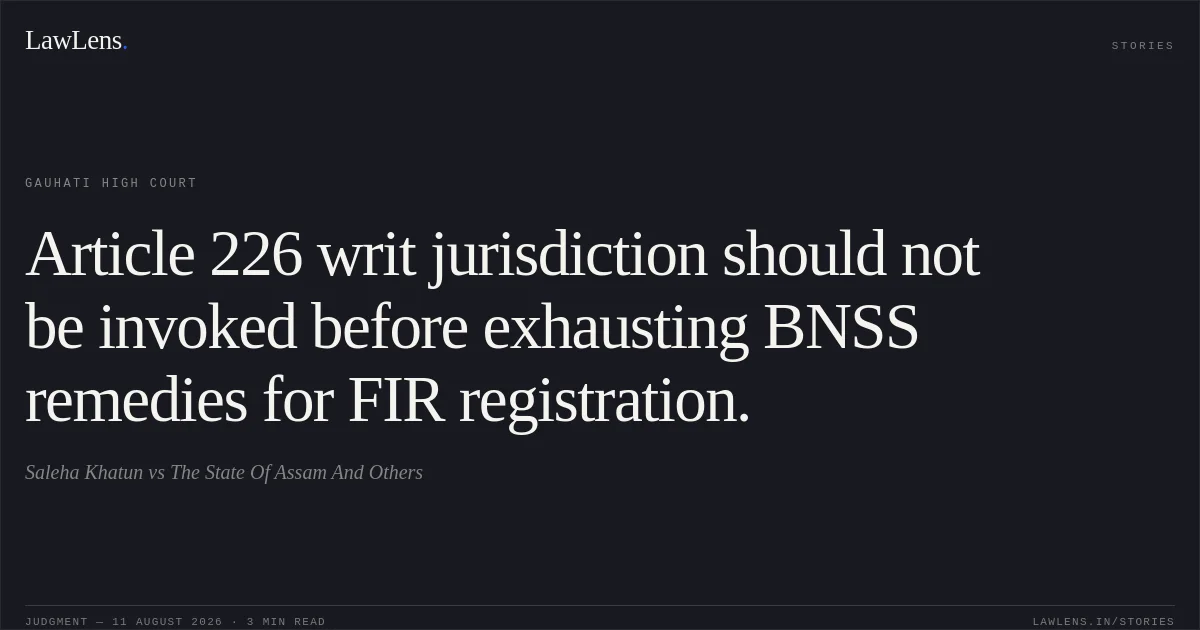
Whether the High Court should entertain a writ petition under Article 226 seeking registration of an FIR and a direction for proper investigation when the petitioner had not exhausted the remedies under Sections 173(4) and 175(3), BNSS.
Source reference: p.10–12, paras. 14–16Whether the petitioner was entitled to a direction for immediate police protection for herself, her family and the disputed properties without first approaching the competent police authority for assessment of threat perception.
Source reference: p.11–12, para. 15Law Applied
The Court applied Article 226 of the Constitution and the principle that writ jurisdiction is discretionary and should ordinarily not be invoked where an efficacious statutory remedy exists.
Source reference: p.8–9, paras. 11–12Section 173(4), BNSS permits an aggrieved person to approach the Superintendent of Police when the officer-in-charge refuses to record information disclosing a cognizable offence; Section 175(3), BNSS empowers the jurisdictional Magistrate, upon consideration of the prescribed application and inquiry, to order investigation.
Source reference: p.8–9, paras. 11–12Relying on Sakiri Vasu v. State of Uttar Pradesh , (2008) 2 SCC 409, and Sudhir Bhaskarrao Tambe v. Hemant Yashwant Dhage , (2016) 6 SCC 277, the Court held that grievances concerning non-registration of an FIR or improper investigation should ordinarily be pursued first before the superior police authority and thereafter before the Magistrate, who may order and monitor a proper investigation.
Source reference: p.4–8, paras. 8–10The Court also relied on Sujal Viswas Attavar v. State of Maharashtra , (2026) 5 SCR 273, which reaffirmed that Article 226 should not ordinarily be invoked as a forum of first instance when the BNSS remedies are available, particularly absent imminent danger to life or liberty.
Source reference: p.9–11, paras. 13–14Reasoning
The Court found that neither the petitioner nor the informant had approached the jurisdictional Superintendent of Police or Magistrate after the alleged failure to register the FIR on 2 July 2026.
Source reference: p.11, para. 15The petitioner therefore bypassed the sequential statutory mechanism under Sections 173(4) and 175(3), BNSS, making the writ petition premature.
Source reference: p.11, para. 15The existence of a pending civil title and injunction suit further demonstrated that the property dispute was already before the competent civil court, although that fact did not determine the alleged criminality of the threats.
Source reference: p.4, para. 7As to police protection, the Court held that the petitioner had not established a prima facie basis for an immediate judicial direction, having neither followed the statutory procedure nor approached the competent authority empowered to assess the actual threat perception.
Source reference: p.11–12, para. 15No finding was made on the merits of the alleged FIR or on whether the allegations disclosed a criminal offence.
Source reference: p.12, para. 17Holding
The High Court declined to entertain the writ petition because the petitioner had not exhausted the efficacious remedies under the BNSS.
The petitioner was granted liberty to approach the jurisdictional Magistrate under Section 173(4) read with Section 175(3), BNSS, in accordance with the prescribed procedure and formalities.
Source reference: p.12, para. 16No direction was issued for registration or investigation of the FIR, police protection, or supervision by the Superintendent of Police.
Source reference: p.12, paras. 16–17The Court expressly clarified that its observations would not prejudice the merits of the petitioner’s allegations.
Source reference: p.12, para. 17Acts & Sections Cited
9 provisions across 3 statutes referred to in this judgment. Each provision opens on LawLens.
Code of Civil Procedure, 19081
Code of Criminal Procedure, 19735
Bharatiya Nagarik Suraksha Sanhita, 20233
Original Court PDF
Saleha KhatunvsThe State Of Assam And Others
Click to open original judgment
Original judgment, available to read, download and summarize on LawLens.in