Facts
Respondent No. 1 filed O.S. No. 17 of 2020 seeking declaration and perpetual injunction concerning the suit property, alleging that the petitioner and other respondents were attempting to encroach upon and carry out work on it.
Source reference: p. 3–7The Trial Court allowed respondent No. 1’s application for temporary injunction under Order XXXIX Rules 1 and 2 CPC.
Source reference: p. 3–7The petitioner’s appeal was dismissed by the First Appellate Court, prompting this petition under Article 227 of the Constitution.
Source reference: p. 3–7The High Court noted the petitioner’s claim of purchase in 1990, but also the material indicating that she had sold the property to respondent No. 1’s father by registered sale deed in 1995 and delivered possession; respondent No. 1 claimed possession through inheritance and produced supporting documents.
Source reference: p. 3–7Issues
1. Whether the Trial Court and First Appellate Court erred in granting and affirming temporary injunctive relief in favour of respondent No. 1
Source reference: p. 4–72. Whether the impugned orders disclosed an error or illegality warranting interference under Article 227 of the Constitution
Source reference: p. 8Law Applied
Order XXXIX Rules 1 and 2 CPC permit temporary injunction where the applicant establishes a prima facie case, balance of convenience in their favour, and likely irreparable hardship absent relief.
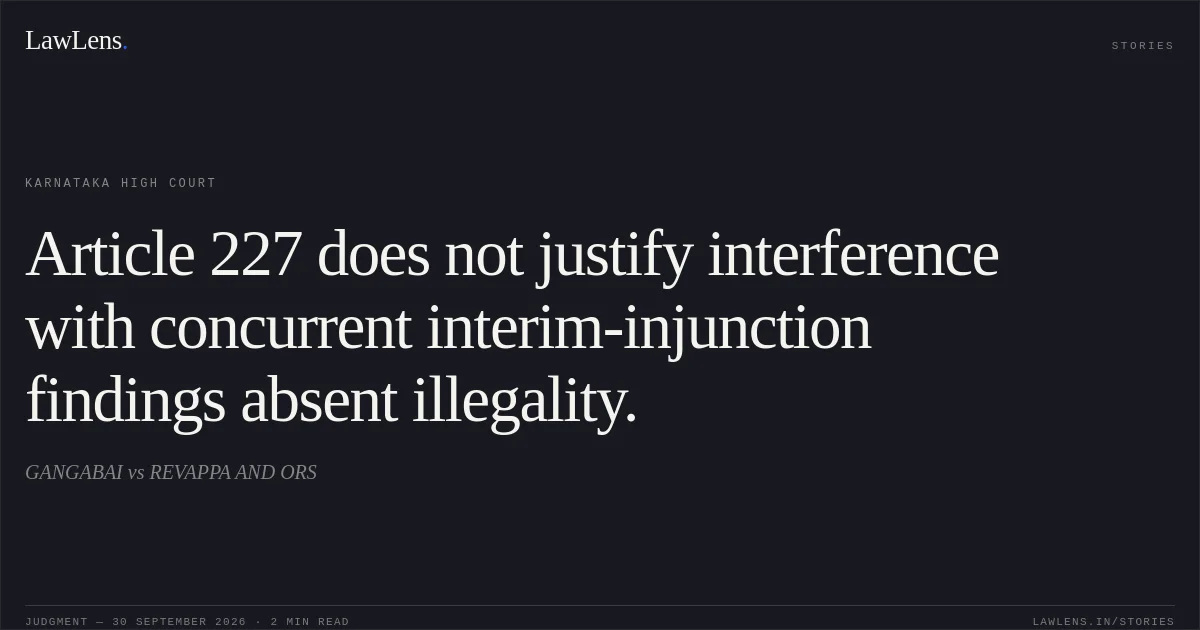
Source reference: p. 7The High Court also applied the limited scope of judicial review under Article 227, relying on Radhey Shyam v. Chhabi Nath, (2015) 5 SCC 423; supervisory jurisdiction does not warrant interference merely because another view of the facts may be possible, absent an error or illegality in the subordinate court’s order.
Source reference: p. 8Reasoning
The High Court considered the registered sale deed in favour of respondent No. 1’s father, the asserted delivery and continuity of possession, respondent No. 1’s succession to that possession, and the documents produced in support.
Source reference: p. 6–8It found that the Trial Court had properly concluded that respondent No. 1 established a prima facie case, that the balance of convenience favoured him, and that refusal of an injunction would cause greater hardship.
Source reference: p. 6–8The First Appellate Court had reappraised the record and rightly affirmed that decision.
Source reference: p. 6–8In view of the limited supervisory scope under Article 227, the High Court found no error or illegality justifying intervention.
Source reference: p. 6–8Holding
The Court answered the issues against the petitioner, declined to interfere with the concurrent orders granting temporary injunction, and dismissed the writ petition.
Original Court PDF
GANGABAIvsREVAPPA AND ORS
Click to open original judgment
Original judgment, available to read, download and summarize on LawLens.in