Facts
The petitioner, claiming to represent Hanuman Temple, asserted that land comprising Khasra Nos. 1630 and 1631, measuring 3.35 acres, belonged to the temple.
Source reference: para. 1–4, 9–10He challenged an alleged 1957 transfer made without court permission and disputed the private respondents’ claims under later registered sale and gift deeds and the corresponding revenue entries.
Source reference: para. 1–4, 9–10He also objected to proposed compensation disbursement for land acquired for a railway underbridge project.
Source reference: para. 1–4, 9–10The Civil Judge rejected his application for temporary injunction under Order XXXIX Rules 1 and 2 CPC; the Additional District Judge dismissed his appeal.
Source reference: para. 1–4, 9–10The petitioner then invoked Article 227.
Source reference: para. 1–4, 9–10Issues
Whether the petitioner established grounds for temporary injunction under Order XXXIX Rules 1 and 2 CPC, including a prima facie case, balance of convenience, and irreparable injury
Source reference: para. 8–10Whether the courts below committed an error warranting interference under Article 227 of the Constitution
Source reference: para. 8, 10–12Law Applied
Under Order XXXIX Rules 1 and 2 CPC, temporary injunction requires the cumulative establishment of a prima facie case, balance of convenience, and likelihood of irreparable injury; a prima facie case alone is insufficient (Dalpat Kumar v. Prahlad Singh, (1992) 1 SCC 719).
Source reference: para. 8Grant or refusal of interlocutory injunction is a discretionary determination, and interference is unwarranted merely because another view is possible; the discretion must be shown to be arbitrary, capricious, perverse, or contrary to settled principles (Wander Ltd. v. Antox India (P) Ltd., 1990 Supp SCC 727).
Source reference: para. 8Article 227 supervisory jurisdiction is limited and is not an appellate jurisdiction for reassessing facts; intervention is justified in cases such as jurisdictional failure, patent perversity, or manifest injustice (Shalini Shyam Shetty v. Rajendra Shankar Patil, (2010) 8 SCC 329).
Source reference: para. 11A Hindu deity is a juristic person, and a worshipper with a legitimate interest may, in appropriate circumstances, protect its property (Bishwanath v. Shri Thakur Radha Ballabhji, AIR 1967 SC 1044).
Source reference: para. 9Revenue entries do not, by themselves, confer title.
Source reference: para. 9Reasoning
The competing claims involved disputed questions concerning the petitioner’s authority to represent the deity, the identity and correlation of the khasra lands, the validity and effect of the alleged 1957 transfer, and the parties’ respective titles.
Source reference: para. 9Those matters could not be conclusively resolved at the interlocutory stage; the petitioner’s allegations did not, without supporting prima facie material, establish entitlement to an injunction.
Source reference: para. 9As to compensation, the petitioner had to show that the proposed disbursement concerned the very land claimed and that the resulting injury could not be adequately addressed through legal remedies.
Source reference: para. 10The Court found no basis to conclude that the lower courts had ignored relevant evidence or exercised their discretion perversely.
Source reference: para. 10–11Given the limits of Article 227, it would not substitute its discretion for theirs.
Source reference: para. 10–11Holding
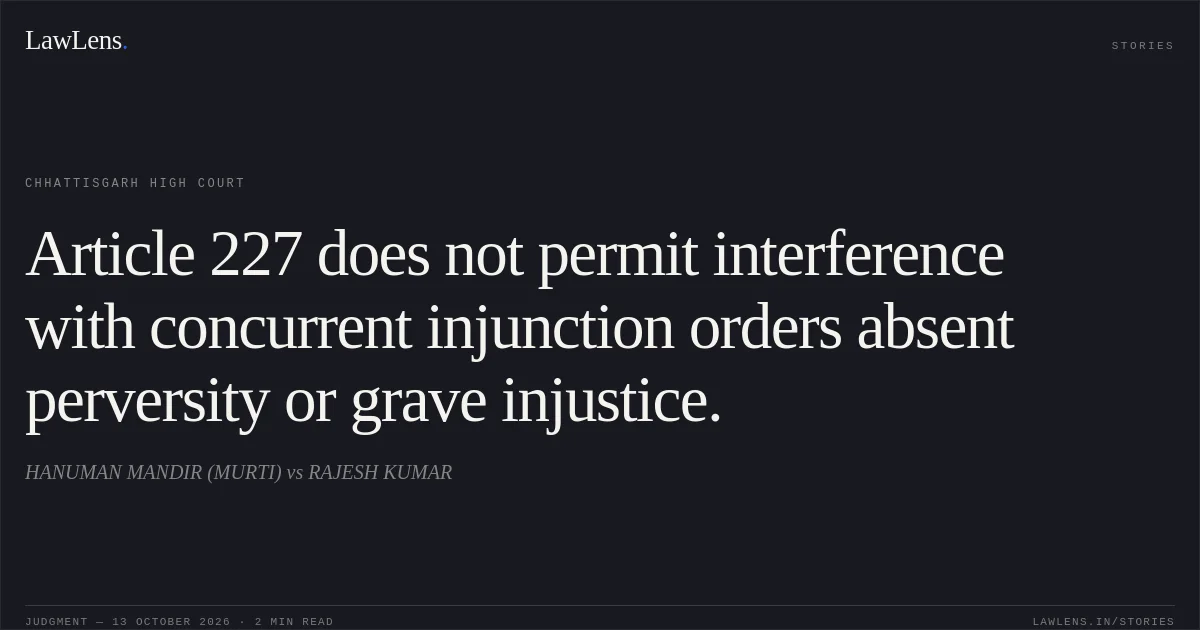
The High Court held that no ground for supervisory interference with the concurrent orders rejecting temporary injunction was made out.
The petition under Article 227 was dismissed.
Source reference: para. 12The Court did not finally determine the parties’ competing title claims, which remained for adjudication by the competent civil court.
Source reference: para. 9Acts & Sections Cited
1 provisions across 1 statute referred to in this judgment. Each provision opens on LawLens.
Code of Civil Procedure, 19081
Original Court PDF
HANUMAN MANDIR (MURTI)vsRAJESH KUMAR
Click to open original judgment
Original judgment, available to read, download and summarize on LawLens.in


