Facts
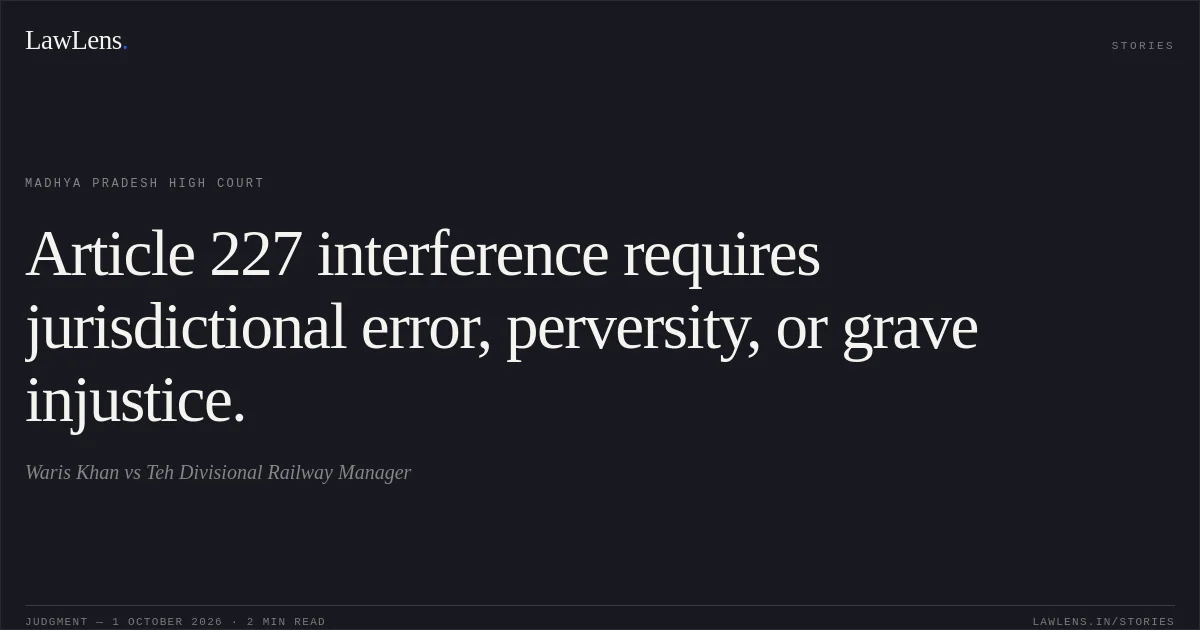
The petitioners challenged the Principal District Judge, Ujjain’s order dated 16 June 2026 refusing interim protection in their appeal under Section 9 of the Public Premises (Eviction of Unauthorized Occupants) Act, 1971 (“PPE Act”).
Source reference: paras. 1, 3The underlying eviction order, made under Section 5 of the PPE Act, directed the petitioners to vacate land identified as Survey Nos. 1937 and 1938 within three days.
Source reference: paras. 1, 3The petitioners relied on proceedings before the Waqf Tribunal concerning Survey Nos. 1938 and 1939, including status-quo orders, and contended that demarcation connected the disputed land to the Waqf claim.
Source reference: paras. 4–5The respondents maintained that the Waqf proceedings and status-quo orders did not concern Survey No. 1937, and relied on earlier decisions holding that Survey Nos. 1938 and 1939 (except 9,743 sq. ft. notified as Waqf property) belonged to the Railway.
Source reference: paras. 6, 9–10The High Court dismissed the petition under Article 227.
Source reference: paras. 14–15Issues
Whether the District Judge’s refusal of interim protection disclosed a jurisdictional error or other ground warranting interference under Article 227.
Source reference: paras. 1, 14Whether the Waqf Tribunal’s status-quo orders and the petitioners’ claim concerning demarcation of the land required interim protection against the Railway’s eviction action.
Source reference: paras. 5–6, 9–11Law Applied
Section 9 of the PPE Act provides an appeal against an eviction order, while Sections 4 and 5 govern the notice and eviction process.
Source reference: paras. 1, 3Article 227 confers supervisory, not appellate, jurisdiction: under Shalini Shyam Shetty v. Rajendra Shankar Patil, 2010 (8) SCC 329, and Nandi Infrastructure Corridor Enterprises Ltd. v. B. Gurappa Naidu, 2026 SCC OnLine SC 745, interference is ordinarily warranted only for an unwarranted assumption or refusal of jurisdiction, gross abuse, patent perversity, or a manifest failure of justice; the High Court cannot merely reappreciate facts or substitute its view.
Source reference: paras. 12–14The Court also relied on the earlier Waqf Tribunal decision, affirmed by the High Court, concerning ownership of Survey Nos. 1938 and 1939, and applied the principles of res judicata and approbation and reprobation.
Source reference: paras. 10–11Reasoning
The Court held that the Waqf claim and status-quo orders related to Survey Nos. 1938 and 1939, whereas the eviction action concerned Survey Nos. 1937 and 1938; it therefore rejected the petitioners’ contention that the orders necessarily barred the eviction action.
Source reference: para. 9It also found the asserted overlap between survey numbers erroneous, referring to the similarity of the 1927 and 2026 Patwari maps and concluding that the Commissioner’s final report indicated encroachment on Railway-owned Survey No. 1937.
Source reference: para. 9The Court further considered the earlier Tribunal and High Court decisions on title, found that the petitioners had suppressed the earlier litigation, and accepted the respondents’ res judicata and approbation-and-reprobation arguments.
Source reference: paras. 10–11Applying the restrictive Article 227 standard, it found no jurisdictional error, perversity, or illegality warranting supervisory intervention.
Source reference: paras. 12–14Holding
The High Court dismissed the petition as meritless and declined to interfere under Article 227 with the order refusing interim protection.
The judgment’s concluding paragraph describes the subordinate court’s decision as rejecting the PPE Act appeal, although the procedural history identifies the challenged order as the dismissal of the stay application while the Section 9 appeal remained pending.
Source reference: paras. 1, 3, 14–15Acts & Sections Cited
4 provisions across 2 statutes referred to in this judgment. Each provision opens on LawLens.
Code of Civil Procedure, 19081
Original Court PDF
Waris KhanvsTeh Divisional Railway Manager
Click to open original judgment
Original judgment, available to read, download and summarize on LawLens.in