Facts
The petitioner challenged the judgment dated 28 September 2022 by which the Wakf Tribunal, West Bengal dismissed Suit No. 16 of 2007.
Source reference: para. 1–2The suit sought declarations that the Schedule-A properties formed part of the Salim Chowdhury Wakf Estate, that the contesting defendants had no right or title therein, and an injunction restraining their alienation.
Source reference: para. 17The plaintiffs relied principally on an alleged dedication by Chowdhury Mohammed Salim, a registered Tauliatnama dated 4 July 1879, entries in the record-of-rights, and enrolment of the estate with the Board of Auqaf under E.C. No. 3974.
Source reference: para. 3–6, 20–21The original Wakf deed and Tauliatnama were not proved before the Tribunal, and the plaintiffs did not produce the Wakf register, enrolment records, or documentary proof of alleged transfers or attempted alienations by the defendants.
Source reference: para. 23–25The Tribunal held that the plaintiffs had failed to establish their locus, cause of action, entitlement to mutawalliship or beneficial interest, and compliance with Section 89 of the Wakf Act, 1995.
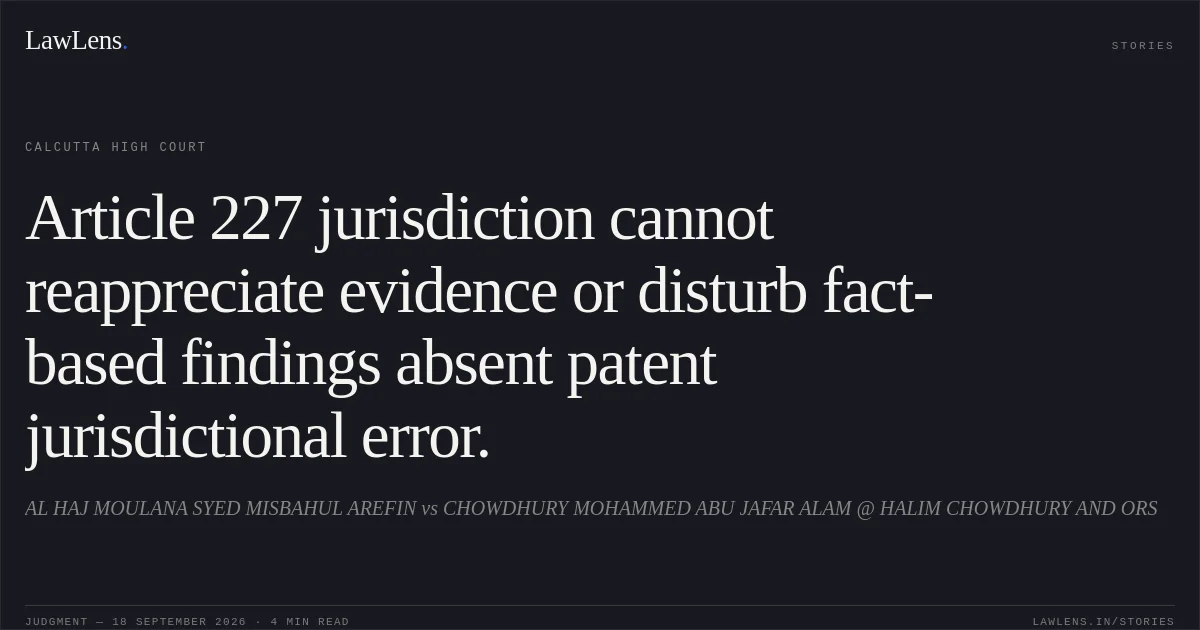
Source reference: para. 26–29The High Court considered the challenge under Article 227 of the Constitution and Section 115 of the Code of Civil Procedure, 1908.
Source reference: para. 28, 32Issues
Whether the plaintiffs established their locus, status as mutawallis or beneficiaries, and entitlement to seek declarations and injunctions concerning the Schedule-A properties.
Source reference: para. 29–30Whether the plaintiffs proved that the disputed properties constituted part of the Salim Chowdhury Wakf Estate and that the defendants had no right, title or interest therein.
Source reference: para. 22–25, 29Whether the suit was maintainable in the absence of a valid cause of action and compliance with the mandatory notice requirement under Section 89 of the Wakf Act, 1995.
Source reference: para. 26, 30Whether the High Court, in proceedings under Article 227 of the Constitution and/or Section 115 CPC, could grant relief for correction of the record-of-rights or otherwise interfere with the Tribunal’s findings.
Source reference: para. 26–28, 32Law Applied
The Court applied Section 89 of the Wakf Act, 1995, which bars institution of a suit against the Wakf Board in respect of an act purportedly done under the Act until expiry of two months after a written notice stating the cause of action, parties and relief claimed, with a corresponding statement in the plaint.
Source reference: para. 31It applied the supervisory limits under Article 227 of the Constitution and Section 115 CPC, under which the High Court does not ordinarily reassess evidence as a regular appellate court and interferes only for jurisdictional error, illegality, material irregularity or patent perversity.
Source reference: para. 28, 32The Court considered Order VII Rule 7 CPC and the principles in Srinivas Ram Kumar Firm v. Mahabir Prasad and Bhagwati Prasad v. Chandramaul, which permit relief on an alternative or admitted case only where the issue was substantially pleaded, tried and met by the opposite party.
Source reference: para. 26–27It also relied on Sayyed Ali v. A.P. Wakf Board, holding that once a valid Wakf is established, “once a wakf, always a wakf,” and subsequent revenue or patta entries do not destroy its Wakf character.
Source reference: para. 30However, the party asserting the Wakf character and seeking consequential relief must still prove the relevant dedication, entitlement and factual basis for the relief claimed.
Source reference: para. 24, 29–31Reasoning
The High Court found no basis to interfere with the Tribunal’s factual conclusions.
Source reference: para. 23–24, 30–31Although the plaintiffs asserted that the properties had been dedicated as Wakf and enrolled under E.C. No. 3974, they failed to prove the original Wakf deed or Tauliatnama, and therefore failed to establish the Wakif’s intention, the extent of the dedication, or the alleged line of succession to mutawalliship.
Source reference: para. 23–24, 30–31The revenue records, including Exhibit 1, could indicate the properties’ association with the Wakf Estate but did not, without the foundational documents and supporting evidence, establish the plaintiffs’ personal entitlement to act as mutawallis or beneficiaries.
Source reference: para. 24, 28–29The allegations that the defendants or their predecessors had transferred or attempted to transfer Wakf properties were unsupported by sale deeds, other transfer documents, or specific evidence of threatened alienation.
Source reference: para. 25, 29The notice relied upon under Section 89 did not disclose a legally sustainable cause of action, and the Tribunal was justified in holding that the suit could not proceed on that basis.
Source reference: para. 26, 30Finally, the High Court declined to direct correction of the record-of-rights because such relief had not been properly established in the pleadings and evidence, and the supervisory jurisdiction under Article 227 could not be converted into a regular appellate reappraisal of the Tribunal’s decision.
Source reference: para. 26–28, 32Holding
The High Court dismissed the revision application and upheld the Wakf Tribunal’s dismissal of Suit No. 16 of 2007.
It held that the plaintiffs failed to prove the Wakf dedication and their locus or entitlement to claim mutawalliship, failed to substantiate the alleged alienations or threatened transfers, and instituted the suit without a valid cause of action satisfying Section 89 of the Wakf Act, 1995.
Source reference: para. 26, 29–31No direction for correction of the record-of-rights or other substantive relief was granted.
Source reference: para. 33The connected applications, if any, were also disposed of.
Source reference: para. 33Acts & Sections Cited
3 provisions across 2 statutes referred to in this judgment. Each provision opens on LawLens.
Unified Waqf Management, Empowerment, Efficiency and Development Act, 19952
Code of Civil Procedure, 19081
Original Court PDF
AL HAJ MOULANA SYED MISBAHUL AREFINvsCHOWDHURY MOHAMMED ABU JAFAR ALAM @ HALIM CHOWDHURY AND ORS
Click to open original judgment
Original judgment, available to read, download and summarize on LawLens.in
![Caregiver exemption from routine transfer is discretionary, not an absolute right, where alternative care exists.. Gyanod Kumar vs MINISTRY OF STATISTICS & PROGRAMME IMPLEMANTATION. CAT - ['Allahabad']. LawLens](/stories/thumbnails/caregiver-exemption-from-routine-transfer-is-discretionary-not-an-absolute-right-where-alt-e82e11e068a44d2bb4a62626fc3758c8.webp)
![Continuous temporary-status service without formal regularisation qualifies for family pension and retiral benefits.. SMT SUNITA SHROTRIYA vs DEPTT OF POSTS. CAT - ['Allahabad']. LawLens](/stories/thumbnails/continuous-temporary-status-service-without-formal-regularisation-qualifies-for-family-pen-40429eb8145043c5bd51d3cb1db3408a.webp)