Facts
The petitioner filed his original income-tax return for AY 2019–20 declaring total income of approximately ₹231.73 crore and claiming a refund of ₹6,07,570.
Source reference: paras. 3–4Subsequently, upon the petitioner’s application under Section 119(2)(b), the delay was condoned and he filed a revised return treating compensation received on repurchase of unexercised employee stock options (“ESOPs”) as capital gains, rather than as salary.
Source reference: paras. 3–4The revised return was processed under Section 143(1), resulting in a refund of approximately ₹27.13 crore, including interest under Section 244A.
Source reference: para. 2The Principal Commissioner initiated revision proceedings under Section 263 by issuing a hearing notice dated 13 January 2026, alleging that the treatment of the ESOP compensation as capital gains was erroneous and prejudicial to the Revenue, and that interest under Section 244A had been wrongly granted on a belated refund claim.
Source reference: paras. 13, 48The petitioner challenged the notice under Articles 226 and 227, contending that an intimation under Section 143(1), particularly one involving no adjustment, is not an “order” capable of revision under Section 263.
Source reference: paras. 5–11Issues
1. Whether an intimation issued under Section 143(1) of the Act, without any adjustment to the return, constitutes an “order” for the purpose of exercising revisional jurisdiction under Section 263?
Source reference: para. 52. Whether the Principal Commissioner could invoke Section 263 to examine the petitioner’s change in the head of income from salary to capital gains and the consequential refund granted upon processing of the revised return?
Source reference: paras. 47–503. Whether the writ petition was maintainable against a notice initiating Section 263 proceedings, notwithstanding the availability of an alternative statutory remedy?
Source reference: paras. 17–19Law Applied
The Court applied Section 263 of the Act, which permits revision only of an “order” passed by a subordinate authority that is erroneous and prejudicial to the interests of the Revenue.
Source reference: para. 22Section 143(1) provides for limited, largely mechanical processing and specified adjustments, whereas scrutiny under Sections 143(2) and 143(3) involves an adjudicatory assessment going beyond the return.
Source reference: paras. 20–28Relying principally on Assistant Commissioner of Income Tax v. Rajesh Jhaveri Stock Brokers (P.) Ltd., (2008) 14 SCC 208, the Court held that an intimation under Section 143(1) is not an assessment order and that an acknowledgment or intimation generated through ministerial processing does not, by itself, involve adjudication.
Source reference: paras. 23–30, 37The Court also relied on the distinction reflected in Sections 246 and 246A: an intimation involving a statutory adjustment may be treated as an appealable order, but an intimation without adjustment remains only an intimation.
Source reference: paras. 43–45The deeming provision treating an intimation as a notice of demand under Section 156 could not be extended to deem the intimation to be an assessment order.
Source reference: paras. 33–38The Court further recognised the exceptional availability of writ jurisdiction where proceedings are without jurisdiction, applying the principles in Whirlpool Corporation v. Registrar of Trade Marks, Mumbai, (1998) 8 SCC 1.
Source reference: paras. 17–19Reasoning
The Court found that the revised return had been processed under Section 143(1) without any adjustment, and that the Revenue’s objection required an examination of whether the ESOP compensation was taxable under the head “salary” or “capital gains.”
Source reference: paras. 26–30, 49Such an inquiry involved adjudication beyond the narrow and limited scope of Section 143(1), and could properly have been undertaken through scrutiny proceedings under Section 143(2).
Source reference: paras. 26–30, 49The Court held that the intimation was not preceded by an adjudicatory process and therefore did not constitute an “order” for Section 263 purposes.
Source reference: paras. 40, 46The fact that the intimation determined a refund, or operated as a notice of demand, did not alter its legal character; the statutory fiction under Section 156 was confined to recovery machinery and could not be expanded to create an assessment order.
Source reference: paras. 33–39Although an intimation containing permissible adjustments may, in an appropriate case, be treated as an order capable of appeal and potentially revision, that qualification did not apply here because the intimation was admittedly without adjustment.
Source reference: paras. 41–45Since the jurisdictional defect was apparent on the face of the proceedings, the Court entertained the writ petition despite the alternative remedy.
Source reference: paras. 17–19Holding
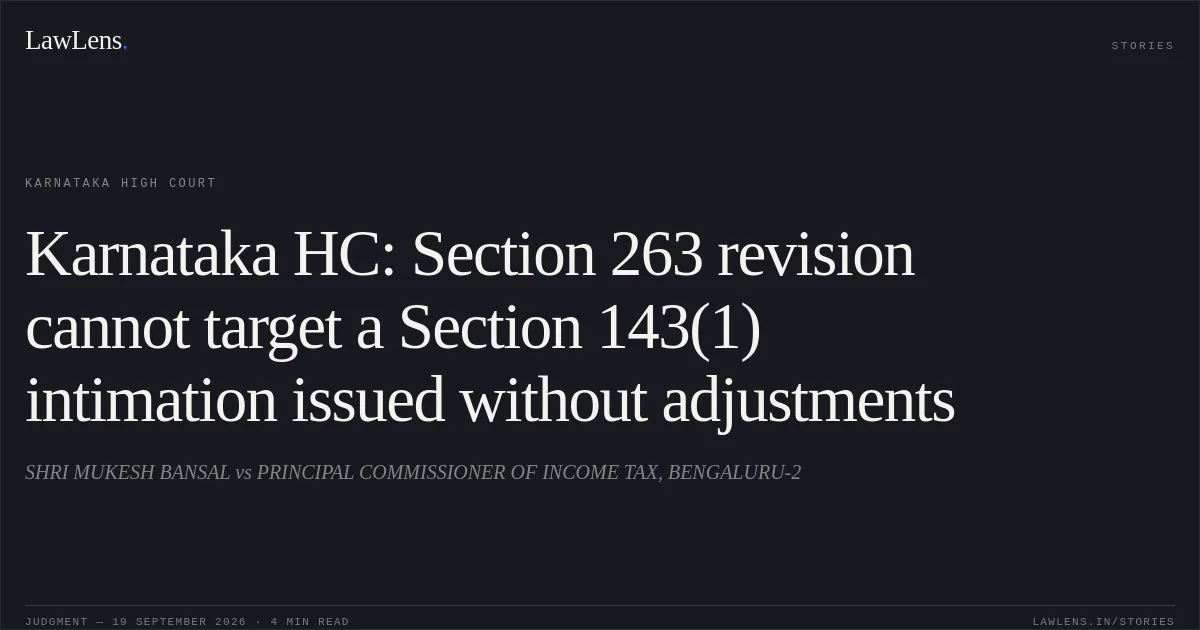
The Court answered the principal issue in the negative: an unadjusted intimation under Section 143(1) is not an “order” amenable to revision under Section 263.
The Revenue could not use Section 263 to adjudicate the proper tax treatment of the ESOP compensation after the revised return had merely been processed under Section 143(1), particularly when the statutory route of scrutiny under Section 143(2) had not been pursued.
Source reference: paras. 31–32, 47–50The notice dated 13 January 2026 initiating Section 263 proceedings was held to be without jurisdiction, was quashed and set aside, and the writ petition was accordingly allowed.
Source reference: para. 51Acts & Sections Cited
16 provisions across 1 statute referred to in this judgment. Linked provisions open on LawLens.
Income Tax Act, 1961
Original Court PDF
SHRI MUKESH BANSALvsPRINCIPAL COMMISSIONER OF INCOME TAX, BENGALURU-2
Click to open original judgment
Original judgment, available to read, download and summarize on LawLens.in