Facts
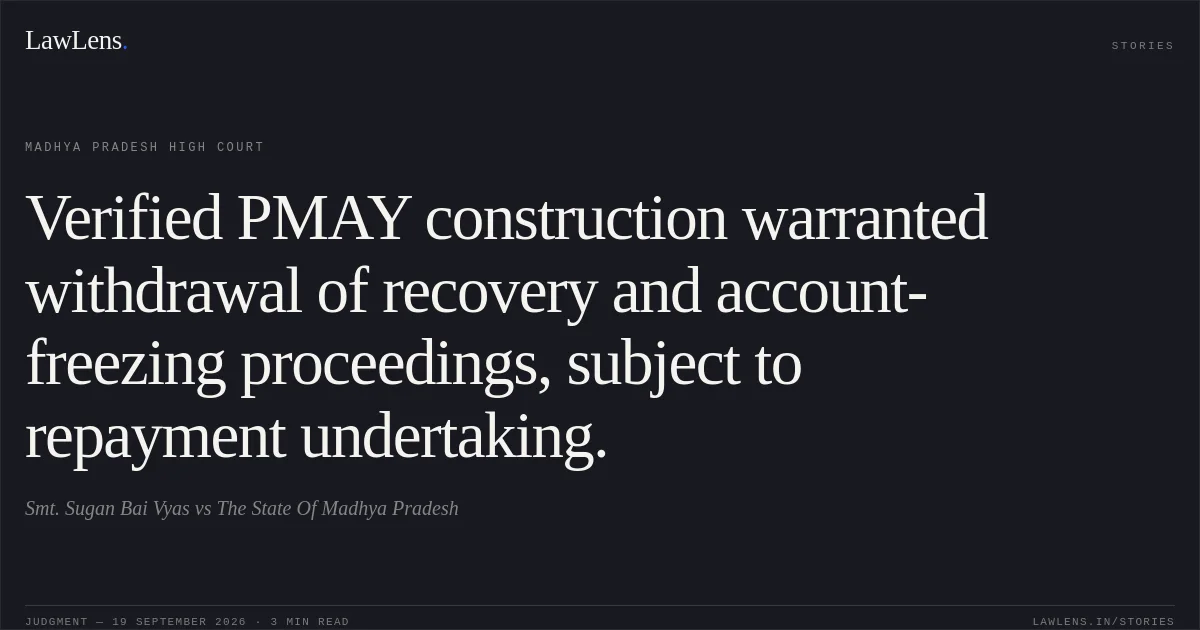
The petitioner applied for reconstruction of her house under the Pradhan Mantri Awas Yojana (PMAY), pursuant to which the Municipal Corporation sanctioned and paid ₹2,50,000 to her.
Source reference: p.1Before granting the benefit, the Corporation verified documents including a registered sale deed in the petitioner’s favour and electricity bills evidencing her possession. Its officers inspected the property in 2018, found that the house had been constructed, and uploaded photographs of the construction on the Corporation’s website.
Source reference: p.2In 2022, Narendra Kumar Shrivastava, claiming an interest in the property, filed a civil suit and also lodged a complaint before the CM Grievance Cell. Following the complaint, the Corporation issued proceedings seeking recovery of the PMAY amount and requested the petitioner’s bank to freeze her account.
Source reference: pp.1–2The petitioner challenged the action before the High Court, while the Corporation objected that she had already filed Civil Suit RCS No. 57/2025 concerning the same notice and had not placed the complete plaint on record.
Source reference: p.2Issues
Whether the Municipal Corporation could continue recovery proceedings and freeze the petitioner’s bank account merely on the basis of a third-party complaint, after it had earlier verified the petitioner’s documents and construction?
Source reference: pp.1–3Whether the petitioner’s bank account was required to be de-frozen pending determination of the competing claims concerning title to the property?
Source reference: pp.2–3Whether the writ petition could be disposed of by granting relief against the recovery and freezing proceedings while protecting the Corporation through a conditional undertaking by the petitioner?
Source reference: p.3Law Applied
No specific statutory provision or judicial precedent was expressly cited. The Court applied the principle that administrative action affecting a person’s financial rights must be based on a proper verification of facts and cannot be continued mechanically solely on the basis of an unadjudicated third-party complaint.
Source reference: no citationThe Court also applied an equitable restitutionary principle: where the petitioner ultimately suffers an adverse determination concerning the property or the related proceedings, she must refund the amount received under the PMAY scheme with interest at 6% per annum.
Source reference: p.3The Court further exercised its writ jurisdiction to issue consequential directions to the Corporation and the concerned bank to withdraw the impugned proceedings and restore operation of the bank account.
Source reference: pp.2–3Reasoning
The Court noted that the Corporation had initially accepted the petitioner’s registered sale deed and possession documents, inspected the construction, verified that the house had been constructed, and uploaded photographs of it on its website.
Source reference: p.2The later recovery action and bank freeze appeared to have been initiated only because of the complaint made by a third party whose title or interest had not yet been judicially established.
Source reference: pp.1–2Since the title dispute was pending and the Corporation’s own earlier verification supported the petitioner’s claim, the Court found it appropriate to withdraw the proceedings initiated pursuant to the complaint rather than permit coercive recovery or continued freezing of the account.
Source reference: p.3At the same time, recognising the Corporation’s concern regarding title, the Court required the petitioner to file an affidavit undertaking to repay the entire amount with 6% annual interest if an adverse order was passed in the relevant proceedings or concerning the property.
Source reference: p.3Holding
The writ petition was partly allowed and disposed of.
Respondents 2 to 5 were directed to withdraw all proceedings initiated pursuant to the third-party complaint and to communicate the decision to the bank within seven days.
Source reference: p.3The respondent bank was directed to de-freeze the petitioner’s account expeditiously and, in any event, within seven days even if the Corporation failed to communicate within that period.
Source reference: p.2The petitioner was directed to file, within seven days, an affidavit undertaking to repay the entire PMAY amount with interest at 6% per annum if an adverse order was passed in the pending proceedings or concerning the property; copies were to be submitted to the Corporation, the High Court Registry, and the bank.
Source reference: p.3Original Court PDF
Smt. Sugan Bai VyasvsThe State Of Madhya Pradesh
Click to open original judgment
Original judgment, available to read, download and summarize on LawLens.in