Facts
The petitioner was granted compassionate appointment by order dated 11.01.2012.
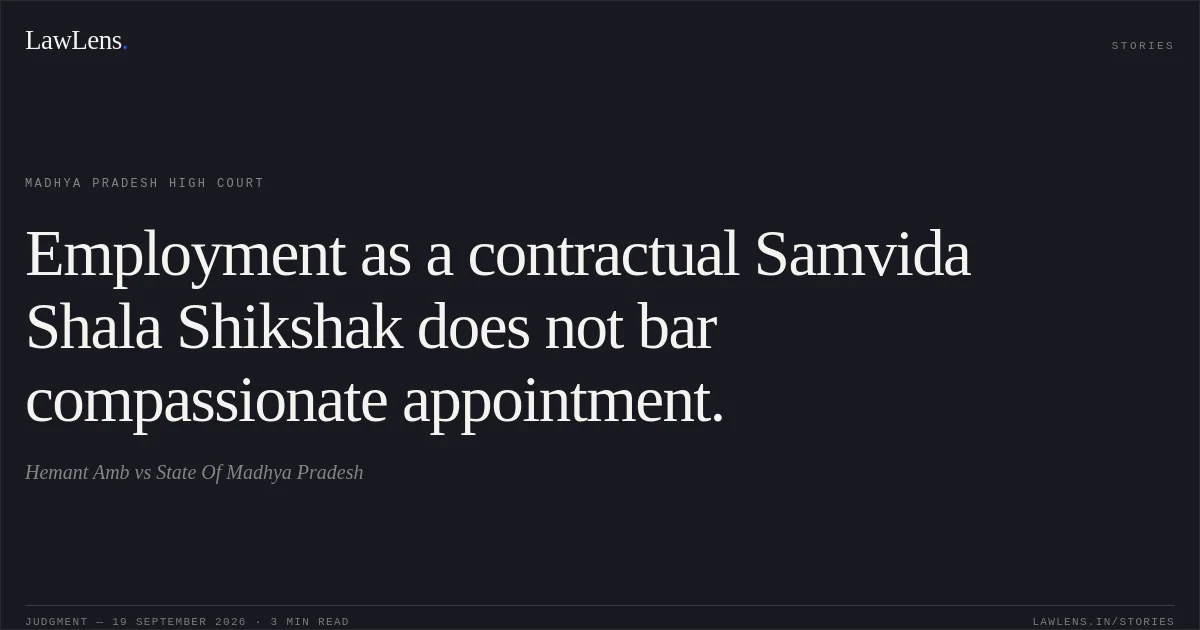
Source reference: paras. 2–6; p. 1The appointment was subsequently cancelled by respondent No. 4 on 28.03.2012 on the ground that the petitioner had concealed material facts and supplied incorrect information, since his elder brother was working as a contractual Samvida Shala Shikshak Grade-III.
Source reference: paras. 2–6; p. 1The respondents treated the brother’s employment as Government service and concluded that the petitioner was ineligible for compassionate appointment under the applicable 2008 policy.
Source reference: paras. 2–6; p. 1The petitioner contended that Samvida Shala Shikshak employment was contractual and did not constitute regular Government service.
Source reference: paras. 2–6; p. 1He challenged the cancellation and sought restoration of appointment with consequential salary benefits.
Source reference: paras. 2–6; p. 1Issues
1. Whether the petitioner’s elder brother’s employment as a contractual Samvida Shala Shikshak Grade-III could be treated as employment in Government service so as to disqualify the petitioner from compassionate appointment.
Source reference: paras. 6–8; pp. 1, 8–92. Whether the order dated 28.03.2012 cancelling the petitioner’s compassionate appointment on the ground of concealment and ineligibility was legally sustainable.
Source reference: paras. 6, 8–9; pp. 1, 8–103. Whether the petitioner was entitled to restoration of the appointment order dated 11.01.2012 and consequential benefits, including back wages.
Source reference: para. 9; p. 9Law Applied
Compassionate appointment is an exception to the general rule of public employment and must be governed strictly by the applicable scheme or policy; the scheme is binding on both the employer and the claimant, as explained in Bhawani Prasad Sonkar v. Union of India , (2011) 4 SCC 209.
Source reference: paras. 7(6), 7(11); pp. 4–7The policy prevailing at the relevant time is applicable while considering a claim for compassionate appointment, following Canara Bank v. M. Mahesh Kumar , (2015) 7 SCC 412.
Source reference: para. 7(5); p. 4Employees of Panchayats and local bodies are not Government servants, as held in Janpad Panchayat & Zila Panchayat v. State of Madhya Pradesh , 1992 MPLJ 804, and Panchayat Karmachari Sangh v. State of Madhya Pradesh , M.P. No. 963/1983, decided on 30.07.1988.
Source reference: para. 8; p. 8Similarly, employees of a Municipal Corporation are not Government servants because the Corporation is a distinct legal entity, as held in Mohandas v. Devandas , AIR 1995 MP 185.
Source reference: para. 8; p. 8Reasoning
The Court found that the cancellation order proceeded solely on the assumption that the petitioner’s brother’s contractual employment as a Samvida Shala Shikshak amounted to Government service.
Source reference: paras. 6–8; pp. 1, 8Applying the decisions concerning Panchayat, local-body and municipal employees, the Court held that such employment could not legally be equated with Government service.
Source reference: para. 8; p. 8Consequently, the petitioner’s brother’s employment did not constitute a valid disqualification under the compassionate-appointment policy, and the allegation that the petitioner had concealed a material fact or furnished incorrect information was unsustainable.
Source reference: para. 8; p. 8The Court therefore held that the foundational basis of the cancellation order was legally erroneous.
Source reference: para. 8; p. 8It also relied on the coordinate Bench decision in Gaurav Dubey v. State of M.P. & Others , W.P. No. 4187/2017, decided on 22.07.2022, which applied the same principle in the context of compassionate appointment.
Source reference: paras. 7–8; pp. 2–8Holding
The Court allowed the petition to the extent indicated.
It quashed the cancellation order dated 28.03.2012, restored the compassionate appointment order dated 11.01.2012, and directed the respondents to reinstate the petitioner forthwith with consequential benefits.
Source reference: para. 9(i)–(iii); p. 9However, the petitioner was denied back wages for the intervening period on the principle of “no work, no pay”.
Source reference: para. 9(iii); p. 9The directions were required to be complied with within one month from receipt of a certified copy of the order.
Source reference: para. 9(iv); p. 9Original Court PDF
Hemant AmbvsState Of Madhya Pradesh
Click to open original judgment
Original judgment, available to read, download and summarize on LawLens.in