Facts
On 25 August 2019, the police allegedly raided the petitioners and accused them of hunting a wild boar using a 30.06 sporting rifle without a licence.
Source reference: para. 3The police seized the rifle, an air gun, and a vehicle, and registered Crime No. 141/2019 for offences under Sections 3, 25(1) and 27 of the Arms Act, 1959; Sections 9 and 51 of the Wild Life (Protection) Act, 1972; and Sections 146 and 196 of the Motor Vehicles Act, 1988.
Source reference: para. 3A charge-sheet was filed, resulting in C.C. No. 1216/2021 before the Principal Civil Judge (Jr. Dn.) and JMFC, Srirangapatna.
Source reference: para. 1In the connected writ petition, petitioner Ramesh N. challenged the rejection of his application under Section 457 Cr.P.C. for release of a .177-calibre air gun seized during the raid.
Source reference: para. 2Issues
Whether the criminal proceedings for offences under Sections 3, 25(1) and 27 of the Arms Act, 1959, and Sections 9 and 51 of the Wild Life (Protection) Act, 1972, were liable to be quashed, particularly when the weapon was licensed and no complaint had been filed by an authorised officer under Section 55 of the Wild Life (Protection) Act?
Source reference: para. 10, Point No. 1; paras. 16–29Whether the Trial Court erred in rejecting the application under Section 457 Cr.P.C. for release of the .177-calibre air gun?
Source reference: para. 10, Point No. 2; paras. 30–34Law Applied
Section 3 of the Arms Act, 1959 prohibits acquisition, possession or carrying of firearms or ammunition without a licence; Sections 25(1B) and 27 penalise possession or use in contravention of Section 3 or Section 5, while Section 30 provides the general penalty for contravention of a licence condition or rule where no specific punishment is prescribed.
Source reference: paras. 15–18The Court relied on Surinder Singh v. State (Union Territory of Chandigarh), (2021) 20 SCC 24, holding that, after amendment, Section 27 is confined to use in contravention of Section 5 or Section 7 and does not criminalise every unlawful use of a licensed weapon.
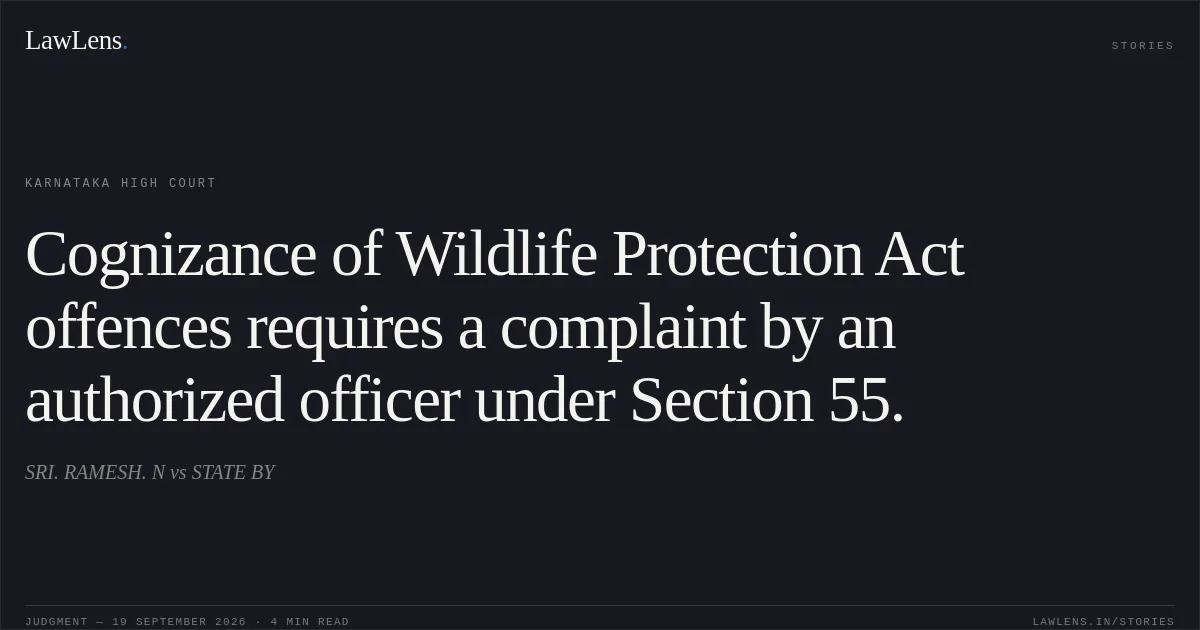
Source reference: para. 25Under Sections 9 and 51 of the Wild Life (Protection) Act, hunting of protected wild animals is prohibited and punishable; however, Section 55 creates a cognizance bar, permitting prosecution only upon a complaint by the specified competent authority or an otherwise authorised person.
Source reference: paras. 20–23The Court followed State of Bihar v. Murad Ali Khan, (1988) 4 SCC 655, which held that cognizance under the Wild Life (Protection) Act can be taken only on a complaint by the statutory officer identified in Section 55.
Source reference: para. 24The Court also applied the Arms Rules, 2016, under which air weapons falling within Category III(f)(ii)—having muzzle energy below 20 joules or 15 foot-pounds and/or bore below 0.177 inches or 4.5 mm—do not require an arms licence.
Source reference: paras. 31–33Section 457 Cr.P.C. authorises the Court to pass orders regarding custody and release of property seized during criminal proceedings.
Source reference: no citationReasoning
The Court found that the rifle was covered by a licence issued by the competent authority, although any alleged breach of the licence conditions could be examined at trial.
Source reference: para. 16The allegations did not disclose manufacture, sale, transfer or possession for sale in contravention of Section 5, nor did they establish use of prohibited arms under Section 7.
Source reference: paras. 17–18Consequently, the invocation of Sections 3, 25 and 27 of the Arms Act merely because the licensed rifle was allegedly used for hunting was legally unsustainable; at most, the relevant violation could attract Section 30 if properly established.
Source reference: paras. 17–18, 25, 27More fundamentally, the prosecution under Sections 9 and 51 of the Wild Life (Protection) Act had originated solely from a police case and charge-sheet.
Source reference: paras. 21–29Since no complaint had been filed by an officer authorised under Section 55, the Magistrate was barred from taking cognizance of those offences, notwithstanding that the police could register the case and collect material during investigation.
Source reference: paras. 21–29Regarding the air gun, the FSL report only established that it was a functioning .177-calibre air gun; it did not connect the weapon with the alleged hunting.
Source reference: para. 30As the air gun fell within the non-licensable Category III(f)(ii) under the Arms Rules, 2016, and continued seizure could cause deterioration, the Trial Court’s apprehension that it might be used for a future offence was insufficient to refuse release.
Source reference: paras. 31–33Holding
The Criminal Petition was allowed, and the criminal proceedings in C.C. No. 1216/2021 were quashed because cognizance of the Wild Life (Protection) Act offences had been taken in violation of Section 55.
The prosecuting authority was granted liberty to initiate appropriate proceedings by filing a complaint through a competent officer under Section 55.
Source reference: para. 35(iii)The connected writ petition was also allowed; the Trial Court’s order refusing release of the air gun was set aside, and the Investigating Officer was directed to release it on the petitioner furnishing an indemnity bond of ₹1,00,000 with one surety, subject to the conditions that it not be sold or altered and be produced whenever required by the authority or Court.
Source reference: para. 35(iv)–(vi)Acts & Sections Cited
33 provisions across 4 statutes referred to in this judgment. Each provision opens on LawLens.
Arms Act, 1959
Wild Life (Protection) Act, 19727
Motor Vehicles Act, 19882
Code of Criminal Procedure, 19734
Original Court PDF
SRI. RAMESH. NvsSTATE BY
Click to open original judgment
Original judgment, available to read, download and summarize on LawLens.in