Facts
Respondent No. 5 lodged a complaint before the Economic Offences Wing, Crime Branch, Ahmedabad, alleging that after receiving goods, the applicants made payment against some bills but failed to pay approximately ₹5,68,80,113.
Source reference: p.6The applicants challenged show-cause notices dated 15 June 2026 and a subsequent notice dated 3 September 2026, contending that the dispute was purely commercial and that the police were being used as recovery agents.
Source reference: pp.1–3, 5–6Applicant No. 1 appeared before the Investigating Officer on 22 June 2026, sought time to produce account details, and supplied them on 5 August 2026.
Source reference: pp.5–6Upon comparing those details with the complainant’s account, the Investigating Officer found discrepancies and issued a further notice.
Source reference: pp.5–6The applicants had also obtained protection from the Sessions Court directing that ten days’ prior notice be given before registration of an FIR.
Source reference: p.4Issues
Whether the show-cause notices and the preliminary inquiry conducted by the Economic Offences Wing were liable to be quashed on the ground that the underlying dispute was civil or commercial in nature.
Source reference: pp.1–3, 5–8Whether the duration of the inquiry violated the time-bound preliminary-inquiry principles stated in Lalita Kumari v. Government of Uttar Pradesh.
Source reference: pp.4, 7–8Whether the principle in The Correspondence, RBANMS Educational Institution v. B. Gunashekhar concerning intimation to tax authorities regarding cash consideration exceeding ₹2,00,000 for immovable-property conveyances applied to the present commercial-debt dispute.
Source reference: pp.3–4, 6–7Whether the applicants were entitled to restrain the police from continuing the inquiry or taking further steps pursuant to the complaint.
Source reference: pp.1–3, 7–8Law Applied
The Court applied the principle from Lalita Kumari v. Government of Uttar Pradesh, reported in (2023) 9 SCC 695, that a preliminary inquiry, where permissible, should ordinarily be completed within 15 days and, in exceptional cases, within six weeks with reasons recorded in the general diary.
Source reference: pp.4, 7The Court further relied on the principle that police may conduct a preliminary inquiry to ascertain whether a prima facie case exists before registering an FIR.
Source reference: p.7The decision in The Correspondence, RBANMS Educational Institution v. B. Gunashekhar, Civil Appeal No. 5200 of 2025, requiring the jurisdictional Sub-Registrar to intimate the Income Tax Authority where cash consideration exceeding ₹2,00,000 is disclosed in a document presented for registration of an immovable-property conveyance, was held applicable only in that specific statutory and factual context.
Source reference: pp.3–4, 6The Court also recognised that an applicant must cooperate with an ongoing police inquiry and that judicial interference at the inquiry stage is limited where no FIR has yet been registered and procedural protection against coercive action already exists.
Source reference: pp.6–8Reasoning
The Court declined to treat the matter as merely a recovery proceeding because the complaint alleged non-payment following receipt of goods and the record contained an admission by the applicant acknowledging the complainant’s debt.
Source reference: p.6Although the applicants characterised the dispute as civil, the police were still entitled to examine the allegations and determine whether a prima facie criminal case existed before registering an FIR.
Source reference: pp.6–7The delay in the inquiry was not attributable solely to the police: after appearing on 22 June 2026, Applicant No. 1 sought time and supplied account details only on 5 August 2026; those details then had to be confronted with the complainant because discrepancies emerged.
Source reference: pp.5–8Consequently, the Court held that the time-bound principle in Lalita Kumari had not been violated in the circumstances.
Source reference: pp.7–8The reliance on RBANMS Educational Institution was rejected because that decision concerned cash consideration disclosed in an immovable-property conveyance before the Sub-Registrar, whereas the present matter involved an alleged outstanding commercial debt.
Source reference: p.6Since the Sessions Court had already protected the applicants by directing ten days’ prior notice before registration of an FIR, the continued inquiry and issuance of notices did not cause legally cognisable prejudice.
Source reference: p.8Holding
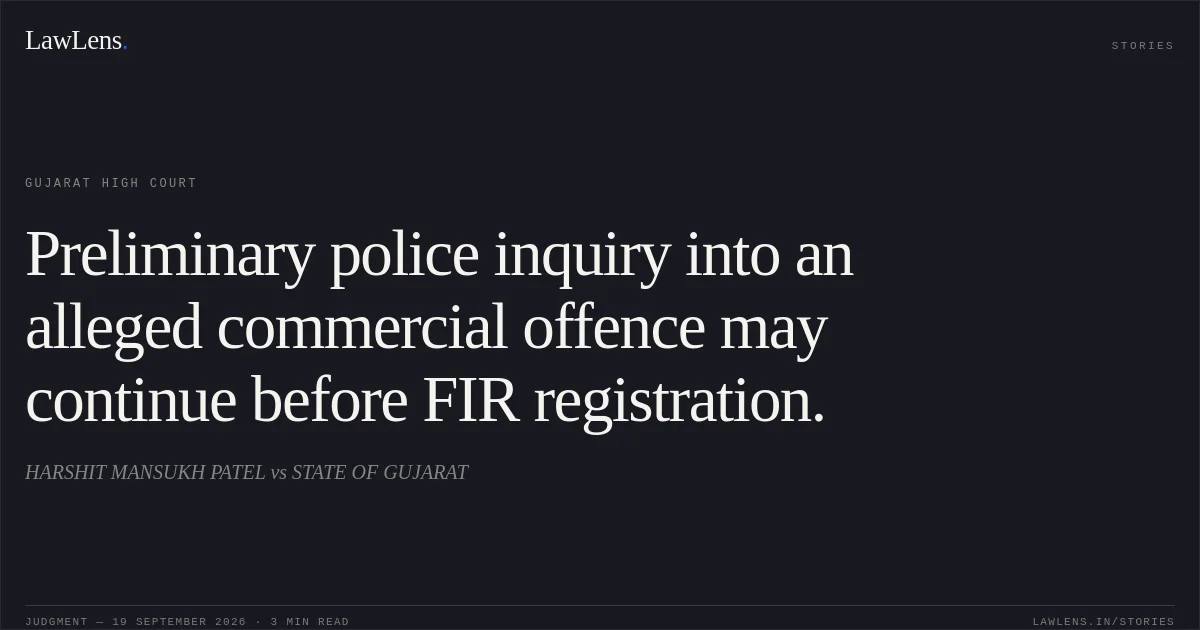
The Court held that the applicants were not entitled to quashing of the notices or termination of the EOW inquiry.
The inquiry was permissible for determining whether a prima facie case existed, the delay was substantially explained by the applicants’ failure to promptly provide the requested records, and the Lalita Kumari time-limit principle was not breached.
Source reference: pp.7–8The application was rejected, the Rule was discharged, and the applicants were required to cooperate with the inquiry; no further relief, including restraint against the police, compensation, or directions to tax authorities, was granted.
Source reference: p.8Original Court PDF
HARSHIT MANSUKH PATELvsSTATE OF GUJARAT
Click to open original judgment
Original judgment, available to read, download and summarize on LawLens.in