Facts
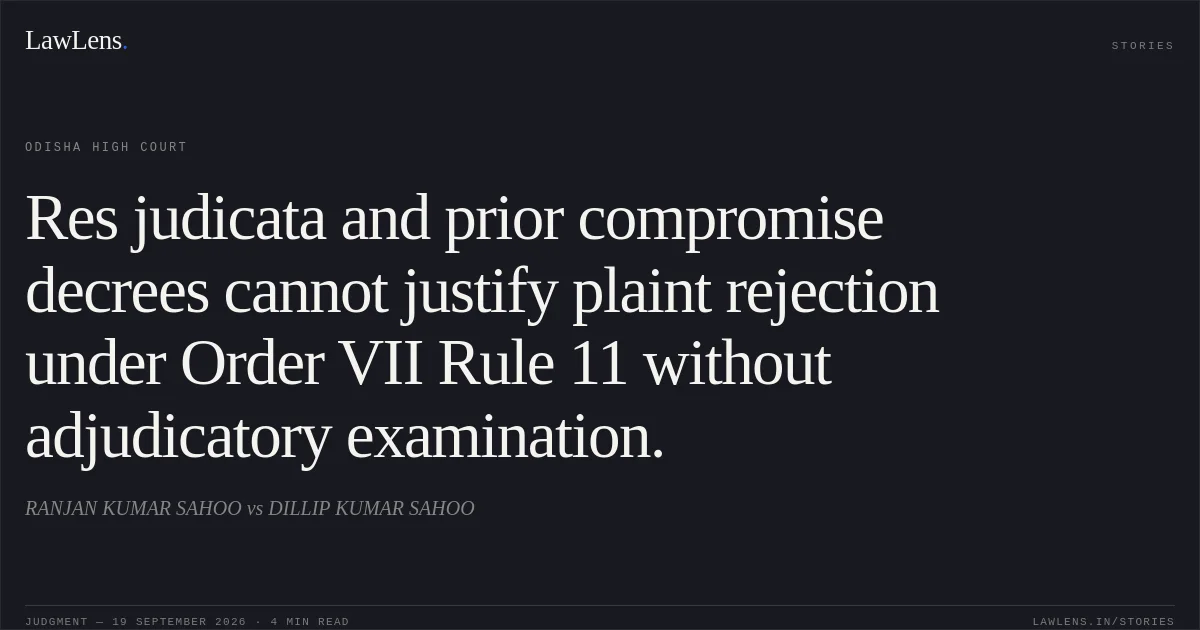
Opposite Party No.1 instituted C.S. No.877 of 2024 before the Civil Judge (Senior Division), First Court, Cuttack, seeking partition and determination of his 1/4th share in property jointly purchased by the parties under a registered sale deed dated 13 July 2010.
Source reference: p.2, para. 2(i)-(ii)An earlier partition proceeding, C.S. No.586 of 2010, had culminated in a compromise under which each party’s 1/4th share was recognised, followed by preparation of a joint Record-of-Rights.
Source reference: p.2, para. 2(iii)The Plaintiff nevertheless pleaded that the property had not been divided by metes and bounds, that the parties remained in possession of different portions by mutual arrangement, and that the Defendants had refused his demand for amicable partition made on 31 July 2024.
Source reference: pp.2-3, para. 2(iv)The Petitioner-Defendant No.1 sought rejection of the plaint under Order VII Rule 11(a) and (d) CPC, contending that the suit was barred by the earlier compromise decrees, res judicata, constructive res judicata, Order XXIII Rule 3-A, Order II Rule 2, and other alleged defects.
Source reference: pp.3-5, para. 2(v); para. 3The Civil Judge rejected the application, holding that the plaint disclosed a cause of action and that the alleged bars could not be determined without examining disputed matters and the earlier proceedings.
Source reference: pp.6-8, para. 5The Defendant thereafter invoked the High Court’s revisional jurisdiction under Section 115 CPC.
Source reference: no citationIssues
1. Whether the plaint disclosed a real and subsisting cause of action for partition so as to avoid rejection under Order VII Rule 11(a) CPC?
Source reference: pp.8-9, paras. 7-9; pp.13-14, paras. 17-182. Whether the suit was apparent on the face of the plaint to be barred by res judicata, constructive res judicata, Order XXIII Rule 3-A, Order II Rule 2, or any other law under Order VII Rule 11(d) CPC?
Source reference: pp.10-12, paras. 10-16; pp.14-15, paras. 19-233. Whether the Civil Judge committed jurisdictional error or material irregularity in refusing to reject the plaint?
Source reference: pp.15-16, paras. 24-26Law Applied
The Court applied Section 115 CPC concerning revisional interference and Order VII Rule 11(a) and (d) CPC, under which a plaint may be rejected where it discloses no cause of action or where the suit appears from the plaint to be barred by law.
Source reference: no citationRelying on Saleem Bhai v. State of Maharashtra, (2003) 1 SCC 557, and Kuldeep Singh Pathania v. Bikram Singh Jaryal, (2017) 5 SCC 345, the Court held that the plaint must be read as a whole and that the Defendant’s written statement or defence cannot ordinarily be considered at the Order VII Rule 11 stage.
Source reference: pp.8-9, paras. 7-8Under Dahiben v. Arvindbhai Kalyanji Bhanusali, (2020) 7 SCC 366, the plaint must be meaningfully scrutinised, including documents relied upon by the Plaintiff, and may be rejected where clever drafting creates only an illusion of a cause of action.
Source reference: p.9, para. 9Relying on Srihari Hanumandas Totala v. Hemant Vithal Kamat, (2021) 9 SCC 99, and Pandurangan v. T. Jayarama Chettiar, (2025) 10 SCC 279, the Court held that res judicata ordinarily requires examination of the earlier pleadings, issues, judgment and decree, and therefore generally cannot be conclusively determined under Order VII Rule 11(d) solely from the plaint.
Source reference: pp.10-12, paras. 10-12The Court further relied on Shub Karan Bubna v. Sita Saran Bubna, (2009) 9 SCC 689, for the distinction between declaration of shares and actual partition by metes and bounds, and Pushpa Devi Bhagat v. Rajinder Singh, (2006) 5 SCC 566, for the rule that an independent suit to set aside a compromise decree on the ground that the compromise was unlawful is barred under Order XXIII Rule 3-A CPC.
Source reference: pp.12-14, paras. 15-20Reasoning
The Court held that the plaint, read as a whole and assuming its averments to be correct for the limited purpose of Order VII Rule 11, pleaded that although the parties’ 1/4th shares had been recognised in the earlier compromise, the property had not actually been partitioned by metes and bounds and the Defendants had subsequently refused amicable partition.
Source reference: pp.13-14, paras. 17-18These averments disclosed a triable cause of action; whether the earlier compromise merely declared the parties’ shares or effected a complete partition required examination of the compromise terms, pleadings, decree and evidence, and could not be decided on the Defendant’s interpretation at the threshold.
Source reference: pp.11-13, paras. 13-16The present suit did not expressly seek to set aside or invalidate the compromise decree; rather, it relied upon the shares recognised therein and sought their actual division, so the bar under Order XXIII Rule 3-A was not apparent from the plaint.
Source reference: pp.14-15, paras. 19-21Similarly, the pleas of res judicata, Order II Rule 2, suppression, fraud, and non-joinder involved disputed factual and legal questions not suitable for determination under Order VII Rule 11 on the basis of the Defendant’s assertions alone.
Source reference: p.15, paras. 22-23Consequently, the Trial Court’s refusal to reject the plaint disclosed no jurisdictional error or material irregularity warranting revision.
Source reference: pp.15-16, paras. 24-25Holding
The High Court answered the issues against the Petitioner. It held that the plaint disclosed a cause of action under Order VII Rule 11(a) CPC and that no statutory bar under Order VII Rule 11(d), including res judicata, Order XXIII Rule 3-A or Order II Rule 2, was apparent from the plaint.
The Civil Revision Petition was dismissed, the order dated 17 April 2026 rejecting the Order VII Rule 11 application was affirmed, and any interim order was vacated.
Source reference: p.16, paras. 24-27The Court clarified that it expressed no final opinion on the legal effect of the earlier compromise decrees, the plea of res judicata, prior partition, or the Plaintiff’s ultimate entitlement to partition; those issues remained open for trial.
Source reference: p.16, para. 25Acts & Sections Cited
3 provisions across 1 statute referred to in this judgment. Each provision opens on LawLens.
Code of Civil Procedure, 19083
Original Court PDF
RANJAN KUMAR SAHOOvsDILLIP KUMAR SAHOO
Click to open original judgment
Original judgment, available to read, download and summarize on LawLens.in