Facts
The petitioner, Police Constable No. 124 Mukesh Kumar, was subjected to a departmental enquiry, pursuant to which the Disciplinary Authority imposed the punishment of withholding one annual increment with cumulative effect by order dated 05.11.2016.
Source reference: para. 2; p. 1The petitioner challenged the punishment before the Inspector General, Gwalior Range, but his appeal was rejected by order dated 07.01.2017. He contended that the appellate order was non-speaking, that the grounds raised in his appeal had not been considered, and that Regulation 226 of the Police Regulations had not been properly applied.
Source reference: para. 2; p. 1The State defended the departmental enquiry and submitted that the charges had been duly proved and that the punishment and appellate decision were lawful.
Source reference: para. 3; p. 2Issues
Whether the appellate authority’s order dated 07.01.2017, rejecting the petitioner’s departmental appeal, was invalid for being non-speaking and unreasoned?
Source reference: paras. 5–6; pp. 2–3Whether the matter should be remanded to the appellate authority for reconsideration of the petitioner’s appeal by passing a reasoned order after granting an opportunity of personal hearing?
Source reference: paras. 11–13; pp. 6–7Law Applied
Under Article 226 of the Constitution, the High Court may judicially review administrative and quasi-judicial orders for arbitrariness, non-application of mind, and violation of fair decision-making requirements. A quasi-judicial authority exercising appellate powers over disciplinary punishment must pass a speaking and reasoned order addressing the material grounds raised by the delinquent employee.
Source reference: paras. 7–9; pp. 3–4In State of Punjab v. Bandip Singh, (2016) 1 SCC 724, the Supreme Court held that an administrative or executive decision must be self-contained and disclose the reasons supporting the conclusion. In Kranti Associates (P) Ltd. v. Masood Ahmed Khan, (2010) 9 SCC 496, the Supreme Court held that recording reasons is essential for fairness, transparency, accountability, effective judicial review, and restraint against arbitrary exercise of power; mere “rubber-stamp reasons” are insufficient.
Source reference: paras. 7–10; pp. 3–6Reasoning
The High Court examined the appellate order and found that, although the petitioner had specifically challenged the departmental enquiry, denial of adequate opportunity of defence, non-compliance with Regulation 226, and the absence of a speaking disciplinary order, the Appellate Authority merely stated that the enquiry had been properly conducted, the charges were proved, and no material ground had been shown for interference.
Source reference: paras. 5–6; pp. 2–3The authority did not independently analyse the petitioner’s grounds or provide reasons explaining why they were rejected. Since the appellate authority was exercising quasi-judicial powers, the absence of cogent reasons rendered the order non-speaking and unsustainable under the principles laid down in Bandip Singh and Kranti Associates. The Court therefore confined its interference to the defective appellate decision and did not adjudicate the merits of the disciplinary charges or punishment.
Source reference: paras. 7–14; pp. 3–7Holding
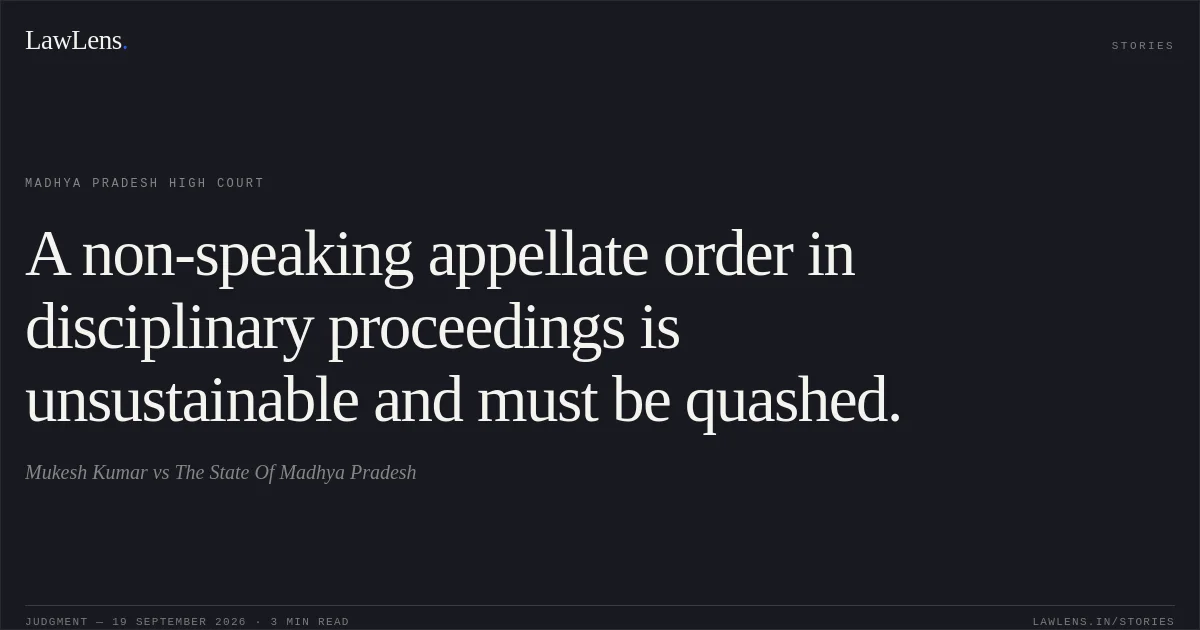
The High Court held that the appellate order dated 07.01.2017 was non-speaking and unreasoned and accordingly quashed it.
The matter was remanded to the Inspector General, SAF, Gwalior Range, with directions to permit the petitioner to submit a fresh and detailed appeal within two weeks, consider both the fresh and earlier appeals on merits without rejecting them on the ground of delay, grant the petitioner a personal hearing, and pass a reasoned and speaking order within two months from receipt of the certified copy of the judgment. The Court expressly stated that it had not expressed any opinion on the merits of the case, and the writ petition was disposed of accordingly.
Source reference: paras. 13–15; pp. 6–7Original Court PDF
Mukesh KumarvsThe State Of Madhya Pradesh
Click to open original judgment
Original judgment, available to read, download and summarize on LawLens.in