01Facts
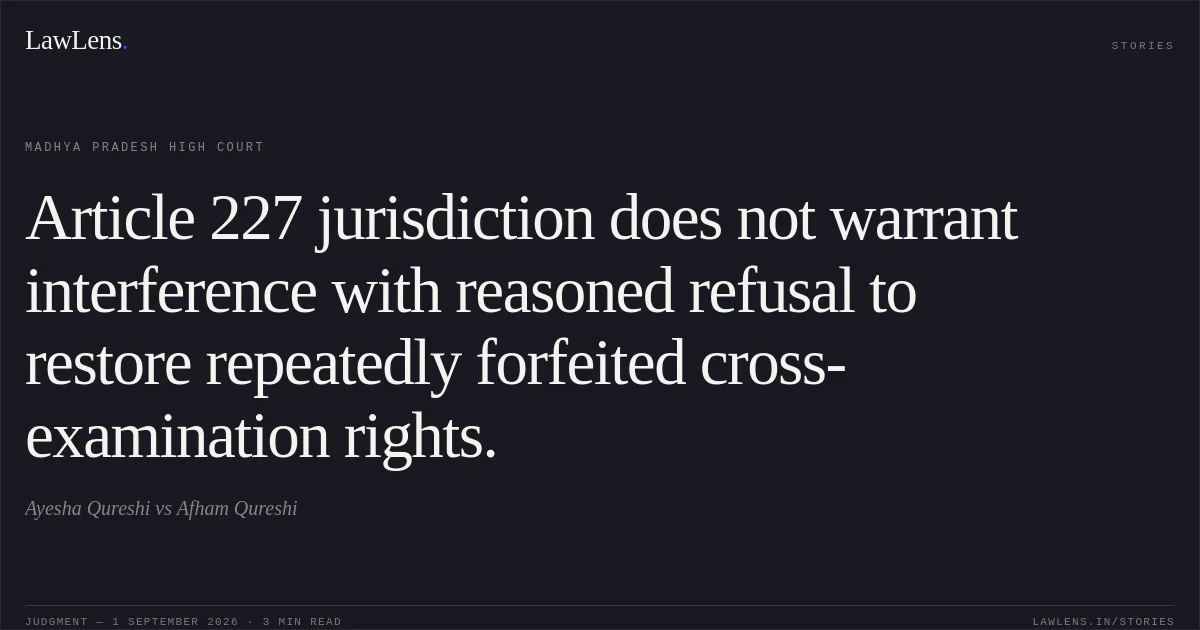
The petitioners invoked Article 227 of the Constitution challenging the Family Court’s order dated 24 July 2026, which rejected their application under Section 151 of the Code of Civil Procedure, 1908 (“CPC”) seeking restoration of their right to cross-examine the respondent’s witness, stated to be the petitioners’ father.
p. 1 · ¶ 2In an earlier proceeding, M.P. No. 5560 of 2025, the High Court had restored the petitioners’ right to cross-examine by order dated 29 October 2025.
p. 2 · ¶ 4, 6Thereafter, approximately 24 adjournments were granted. On 11 May 2026, despite repeated calls and a direction for personal appearance, neither the petitioners nor their counsel appeared before the Family Court, which consequently closed their right to cross-examine at 3:25 p.m.
p. 2 · ¶ 4The petitioners subsequently filed an application under Section 151 CPC on 19 June 2026 for recall of that order. They also filed M.P. No. 4165 of 2026 before the High Court challenging the same order, but withdrew it on 22 July 2026 without obtaining liberty to file a fresh petition.
pp. 2–3 · ¶ 4The Family Court dismissed the Section 151 application by a reasoned order dated 24 July 2026, noting the petitioners’ non-appearance, repeated opportunities, and failure to disclose the pending/earlier High Court proceedings.
pp. 3–6 · ¶ 4, 602Issues
i.1. Whether the Family Court committed a jurisdictional error or acted perversely in refusing, under Section 151 CPC, to restore the petitioners’ right to cross-examine the witness.
pp. 1, 6–7 · ¶ 2, 6–7ii.2. Whether the High Court ought to exercise its supervisory jurisdiction under Article 227 of the Constitution to interfere with the Family Court’s discretionary order.
p. 4 · ¶ 5iii.3. Whether the petitioners’ conduct—including repeated adjournments, non-appearance despite directions, parallel proceedings, and non-disclosure of material facts—justified refusal of further indulgence.
pp. 2–6 · ¶ 4, 603Law Applied
The Court applied Article 227 of the Constitution, under which the High Court exercises supervisory—not appellate—jurisdiction over subordinate courts and cannot ordinarily substitute its own factual or discretionary conclusions for those of the trial court.
pp. 3–4 · ¶ 5–6It also applied Section 151 CPC, which preserves the inherent power of a court to pass orders necessary to secure the ends of justice or prevent abuse of process, particularly where no specific procedural remedy is available.
p. 4 · ¶ 6The exercise of inherent power remains discretionary and cannot be used to reward procedural default, repeated delay, suppression of material facts, or abuse of process.
pp. 4–6 · ¶ 6–7No specific judicial precedent was relied upon in the judgment.
Provisions in the judgment · 1 · Linked ones open on LawLens
Code of Civil Procedure, 1908 Section 151
04Reasoning
The High Court held that the Family Court had provided adequate opportunity to the petitioners: their right had already been restored in the earlier proceedings, and nearly six months and 24 adjournments followed before the date fixed for cross-examination.
pp. 4–5 · ¶ 6On 11 May 2026, the petitioners failed to appear despite repeated calls and a direction for personal appearance, justifying closure of their cross-examination right.
pp. 2, 5–6 · ¶ 4, 6The petitioners’ subsequent conduct further disentitled them to equitable relief: while their Section 151 application was pending before the Family Court, they filed a separate High Court petition challenging the same order, later withdrew it without liberty, and failed to disclose that proceeding to the Family Court.
pp. 2–3, 5–6 · ¶ 4, 6Applying the limited scope of Article 227 review, the Court found that the Family Court’s order was neither illegal, perverse, without jurisdiction, nor contrary to law.
p. 6 · ¶ 7Although the Court considered imposing heavy costs for delaying the proceedings, it refrained from doing so because petitioner No. 1 was a woman and was allegedly not receiving substantial maintenance from her husband.
p. 6 · ¶ 705Holding
The High Court answered the issues against the petitioners and declined to interfere under Article 227.
pp. 6–7 · ¶ 7–8It held that the Family Court had properly exercised its discretion under Section 151 CPC in refusing to restore the right of cross-examination, particularly in view of the petitioners’ repeated opportunities, non-appearance, delay, and suppression of material proceedings.
pp. 6–7 · ¶ 7–8The Miscellaneous Petition was dismissed, without imposing costs, and the petitioners were expected to proceed with the trial without further attempts to delay it.
p. 7 · ¶ 7–8Original Court PDF
Ayesha QureshivsAfham Qureshi
Click to open original judgment
Original judgment, available to read, download and summarize on LawLens.in