Facts
The dispute arises from a 1948 partnership firm (Respondent No. 5), where the Appellant held a 25% share
Source reference: para. 3In 2012, the Appellant filed Title Suit No. 38/2012 alleging mismanagement
Source reference: para. 6A Section 8 application under the Arbitration and Conciliation Act, 1996 (the Act) was initially rejected by the Trial and High Courts because certain defendants (Respondents 1-3) were non-signatories to the partnership deed
Source reference: para. 6However, on 21.11.2024, the Supreme Court, with the consent of the parties present, referred the entire dispute to a Sole Arbitrator
Source reference: para. 7During arbitral proceedings, Respondents 1-3 (non-signatories) sought deletion from the array of parties, which the Tribunal rejected on 04.08.2025 based on the Supreme Court’s referral
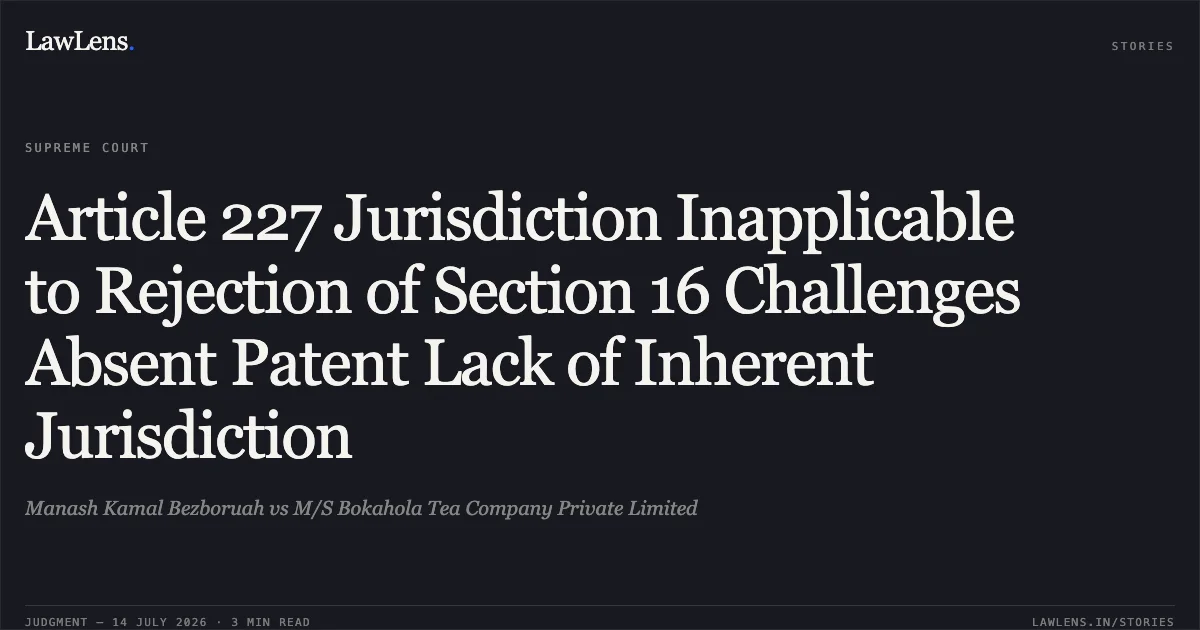
Source reference: para. 10Respondents 1-3 challenged this via a Revision Petition under Article 227 of the Constitution. The Gauhati High Court stayed the arbitral notices and held the Revision Petition maintainable, citing a "patent lack of inherent jurisdiction" in the Tribunal's order
Source reference: para. 11-12Issues
1. Whether the High Court was justified in entertaining a Revision Petition under Article 227 of the Constitution against an interim order of the Arbitral Tribunal
Source reference: para. 212. Whether an Arbitral Tribunal possesses the competence to decide the joinder of non-signatory parties under the doctrine of kompetenz-kompetenz
Source reference: para. 31Law Applied
The court applied Section 5 of the Arbitration and Conciliation Act, 1996, which mandates minimal judicial intervention
Source reference: para. 22It relied on the doctrine of kompetenz-kompetenz under Section 16, empowering the Tribunal to rule on its own jurisdiction
Source reference: para. 22The court cited SBP Co. v. Patel Engineering Ltd., which disapproved of High Courts correcting arbitral orders under Article 227 during the pendency of proceedings
Source reference: para. 26It further applied the "narrow band of perversity" and "patent lack of inherent jurisdiction" tests from Deep Industries Ltd. v. ONGC and Punjab State Power Corpn. Ltd. v. Emta Coal Ltd.
Source reference: para. 27-28Finally, it referenced Cox and Kings Ltd. v. SAP India Pvt. Ltd. regarding the joinder of non-signatories under the "Group of Companies" doctrine
Source reference: para. 31Reasoning
The Court reasoned that the Act is a self-contained code designed for expeditious dispute resolution with minimal interference
Source reference: para. 22It found that while Article 227 is a part of the basic structure, its exercise in arbitral matters must be "extremely circumspect" and restricted to cases of "patent lack of inherent jurisdiction" that "stare one in the face"
Source reference: para. 27-28The Court observed that the High Court failed to record any specific finding of perversity or inherent lack of jurisdiction in the Tribunal's order
Source reference: para. 24Furthermore, the Court held that determining whether non-signatories are "veritable parties" is a complex factual inquiry that falling squarely within the Tribunal’s domain under Section 16
Source reference: para. 31The Court criticised Respondents 1-3 for not seeking a review of the original Supreme Court referral order despite being parties to that appeal
Source reference: para. 32Holding
The Supreme Court allowed the appeals and set aside the High Court's orders dated 02.09.2025 and 28.01.2026. It held that a challenge to an order rejecting a Section 16 application lies only under Section 34 of the Act after the final award is passed
The Revision Petition was dismissed. The Court directed the Arbitral Tribunal to independently decide the status of Respondents 1-3 regarding the arbitration proceedings, uninfluenced by this judgment, and to complete the proceedings expeditiously
Source reference: para. 33-35Acts & Sections Cited
11 provisions across 3 statutes referred to in this judgment. Each provision opens on LawLens.
Arbitration and Conciliation Act, 19967
Code of Civil Procedure, 19083
Indian Partnership Act, 19321
Original Court PDF
Manash Kamal BezboruahvsM/S Bokahola Tea Company Private Limited
Click to open original judgment
Original judgment, available to read, download and summarize on LawLens.in