Facts
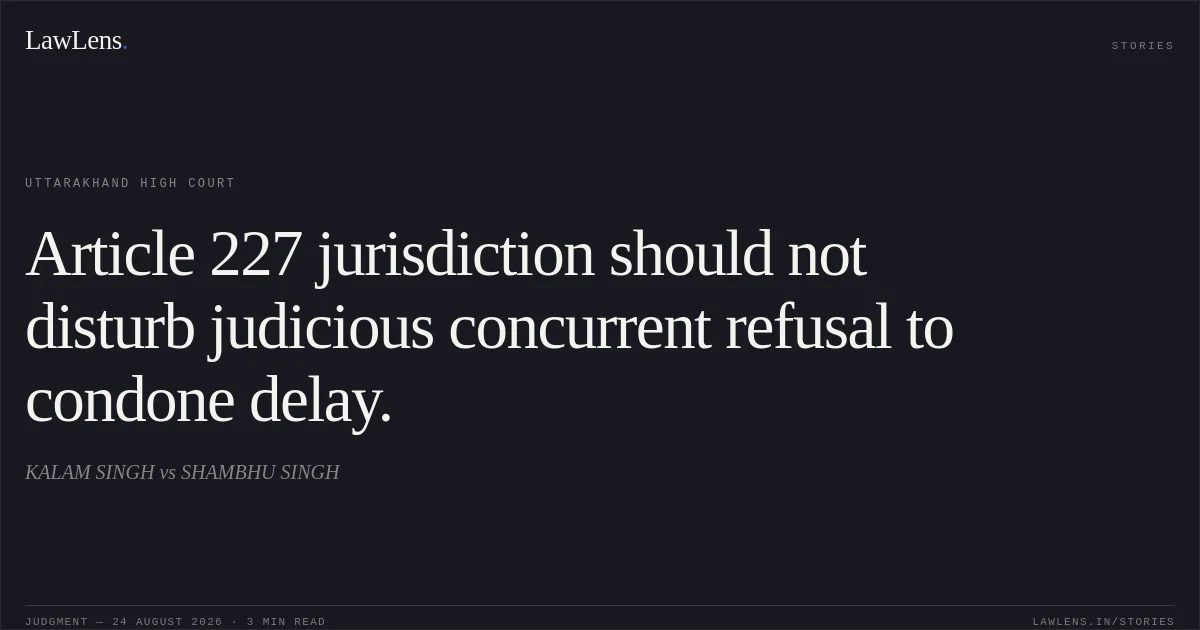
The petitioner’s civil suit was dismissed for default under Order IX Rule 8 CPC on 3 June 2015. He thereafter sought restoration of the suit along with an application under Section 5 of the Limitation Act for condonation of delay.
Source reference: paras. 1–2; pp. 1–2The Trial Court rejected the delay-condonation application on 8 March 2016, finding that the cause shown was insufficient. The petitioner’s revision was dismissed by the District Judge, Uttarkashi, on 4 July 2016. The petitioner consequently invoked the High Court’s supervisory jurisdiction under Article 227 of the Constitution.
Source reference: paras. 1–2; pp. 1–2The courts below found that the petitioner’s son and power-of-attorney holder, who was pursuing the suit, was present in the court complex on the date of dismissal in connection with another case, and that the plea of the petitioner’s old age and illness was not credible. They concluded that the petitioner and his counsel had been negligent.
Source reference: paras. 1–2; pp. 1–2Issues
Whether the Trial Court was justified in rejecting the petitioner’s application for condonation of delay on the ground that no sufficient cause had been shown.
Source reference: paras. 1–2; pp. 1–2Whether the High Court ought to interfere under Article 227 with the Trial Court’s order as affirmed by the Revisional Court.
Source reference: para. 3; p. 2Law Applied
The Court applied Order IX Rule 8 CPC concerning dismissal of a suit for default and Section 5 of the Limitation Act, 1963, under which delay may be condoned only upon establishment of “sufficient cause.”
Source reference: para. 3; pp. 2–5Relying principally on Pathapati Subba Reddy v. Collector (LA), (2024) 12 SCC 336, the Court held that although Section 5 may receive a liberal, justice-oriented interpretation, condonation remains discretionary and cannot be granted where negligence, inaction, lack of bona fides, or want of due diligence is evident.
Source reference: para. 3; pp. 2–5The Court also relied on Collector (LA) v. Katiji, (1987) 2 SCC 107; Ramlal v. Rewa Coalfields Ltd.; Maqbul Ahmad v. Pratap Narain Singh; Lanka Venkateswarlu v. State of A.P.; State of Jharkhand v. Ashok Kumar Chokhani; and Basawaraj v. LAO, reiterating that substantial justice and equitable considerations cannot be used to defeat the law of limitation, and that merits of the underlying case are generally irrelevant while deciding condonation.
Source reference: paras. 3; pp. 2–5Interference under Article 227 is unwarranted where subordinate courts have exercised their discretion judiciously and passed reasoned orders.
Source reference: para. 3; p. 2Reasoning
The High Court found no error in the concurrent conclusion that the petitioner had failed to establish sufficient cause. The presence of the petitioner’s son and power-of-attorney holder in the court complex on the date of dismissal undermined the explanation based on the petitioner’s age and illness, particularly because the son was responsible for pursuing the suit.
Source reference: para. 2; p. 2The absence of both the petitioner and his counsel, coupled with the courts’ finding of negligence, demonstrated lack of due diligence and bona fides. Applying the principles governing Section 5 of the Limitation Act, the Court held that a liberal approach could not justify condoning delay where negligence and inaction were apparent.
Source reference: paras. 2–3; pp. 2–5Since the Trial Court and Revisional Court had exercised their discretion in a reasoned and judicious manner, there was no basis for supervisory interference under Article 227.
Source reference: paras. 2–3; pp. 2–5Holding
The Court answered the issues against the petitioner. It held that the Trial Court properly rejected the application for condonation of delay and that the Revisional Court correctly affirmed that decision.
Finding no jurisdictional or legal error warranting interference under Article 227, the High Court dismissed the writ petition and upheld the orders dated 8 March 2016 and 4 July 2016.
Source reference: para. 4; p. 5Acts & Sections Cited
2 provisions across 1 statute referred to in this judgment. Linked provisions open on LawLens.
Limitation Act, 19632
Original Court PDF
KALAM SINGHvsSHAMBHU SINGH
Click to open original judgment
Original judgment, available to read, download and summarize on LawLens.in