Facts
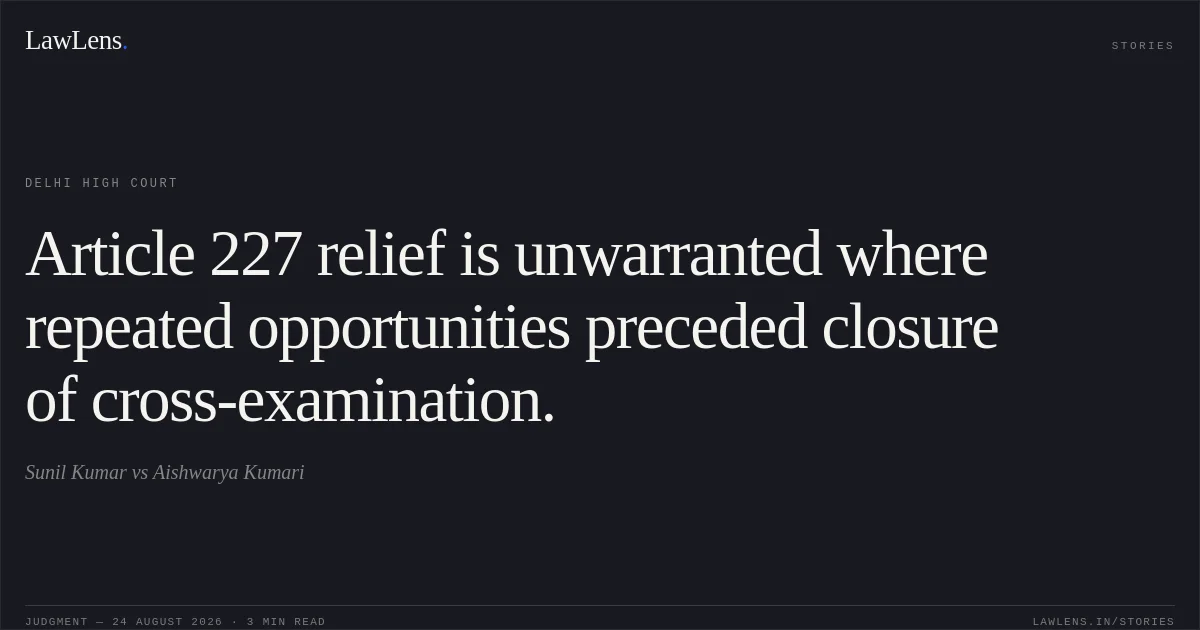
The Petitioner challenged, under Article 227 of the Constitution of India read with Section 151 of the Code of Civil Procedure, 1908, the order dated 01.11.2025 of the Principal Judge, Family Court, North-West District, Rohini, Delhi, in HMA No. 1214/2017.
Source reference: para. 1; pp. 1–2The Family Court had dismissed the Petitioner’s application under Order XVIII Rule 17 read with Section 151 CPC seeking recall of the order dated 13.10.2025, by which his right to further cross-examine RW-1 had been closed.
Source reference: para. 1; pp. 1–2RW-1 had been examined in chief on 09.12.2024; cross-examination commenced on 03.02.2025 but remained incomplete at the Petitioner’s instance.
Source reference: paras. 8–10; pp. 3–4On 19.05.2025, although RW-1 was present, the Petitioner’s counsel sought a pass-over, and the matter was adjourned.
Source reference: paras. 8–10; pp. 3–4On 13.10.2025, fixed as the last and final opportunity, neither the Petitioner nor his counsel appeared, resulting in closure of the right to cross-examine RW-1.
Source reference: paras. 8–10; pp. 3–4The Petitioner attributed the absence to his counsel’s heavy cause list and contended that one further opportunity, subject to costs, ought to be granted.
Source reference: paras. 2–7; pp. 2–3The Family Court also recorded repeated defaults by the Petitioner in leading his own evidence and the delay in prosecuting the proceedings.
Source reference: para. 8; pp. 3–4Issues
Whether the Family Court erred in refusing to recall the order closing the Petitioner’s right to further cross-examine RW-1, when the Petitioner’s counsel was absent on account of a heavy cause list.
Source reference: paras. 2–7, 9–14; pp. 2–5Whether the High Court ought to exercise its supervisory jurisdiction under Article 227 of the Constitution to grant the Petitioner one final opportunity to complete the cross-examination.
Source reference: paras. 13–16; pp. 5–6Whether the Petitioner’s delay in approaching the High Court and his previous conduct in the proceedings disentitled him to discretionary relief.
Source reference: paras. 11–16; pp. 5–6Law Applied
The Court applied Article 227 of the Constitution, which confers limited supervisory jurisdiction over subordinate courts and is exercised where there is perversity, material irregularity, or failure to exercise jurisdiction, rather than to reappreciate every discretionary procedural order.
Source reference: paras. 13–16; pp. 5–6It considered Order XVIII Rule 17 read with Section 151 CPC, under which a court may recall a witness or invoke its inherent procedural powers where necessary to secure the ends of justice; however, such relief is discretionary and cannot be claimed as an automatic right after repeated opportunities or deliberate/prolonged default.
Source reference: paras. 1, 8–14; pp. 1–5The Court further applied the principle that the right to cross-examine may be closed after sufficient opportunity has been granted, particularly where the matter was fixed as a last and final opportunity, and that a litigant’s conduct and unexplained delay are relevant to the grant of discretionary relief.
Source reference: paras. 9–16; pp. 4–6Reasoning
The High Court held that the Family Court had not rejected the recall application solely because of the Petitioner’s absence on 13.10.2025.
Source reference: paras. 9–12; pp. 4–5It had considered the entire procedural history, including the partial cross-examination of RW-1, the Petitioner’s requests for adjournments and pass-over, the prior opportunities granted, and the fact that 13.10.2025 was expressly fixed as the last and final opportunity.
Source reference: paras. 9–12; pp. 4–5The Court further relied on the Petitioner’s repeated defaults in leading his own evidence and his general delay in prosecuting the matrimonial proceedings.
Source reference: para. 11; p. 5In that context, the explanation that counsel was occupied by a heavy cause list did not constitute sufficient justification for recalling the closure order.
Source reference: paras. 13–16; pp. 5–6Since the Family Court had exercised its procedural discretion after granting adequate opportunities, and no perversity or material irregularity was demonstrated, Article 227 jurisdiction was not warranted.
Source reference: paras. 13–16; pp. 5–6The Petitioner’s considerable and inadequately explained delay in approaching the High Court reinforced the refusal of relief.
Source reference: paras. 13–16; pp. 5–6Holding
The High Court answered the issues against the Petitioner.
It found no perversity, material irregularity, or denial of sufficient opportunity in the Family Court’s refusal to recall the order closing the Petitioner’s right to further cross-examine RW-1.
Source reference: paras. 13–14; pp. 5–6The Petition under Article 227 was dismissed as devoid of merit, and the pending applications were disposed of accordingly.
Source reference: paras. 16–18; p. 6Acts & Sections Cited
1 provisions across 1 statute referred to in this judgment. Each provision opens on LawLens.
Code of Civil Procedure, 19081
Original Court PDF
Sunil KumarvsAishwarya Kumari
Click to open original judgment
Original judgment, available to read, download and summarize on LawLens.in