Facts
NDS Art World Pvt. Ltd. (“Corporate Debtor”) was admitted into the Corporate Insolvency Resolution Process (“CIRP”) under Section 7 of the Insolvency and Bankruptcy Code, 2016 (“IBC”), and a Resolution Professional (“RP”) was appointed.
Source reference: paras. 4, 8, 19The order commencing CIRP and imposing moratorium under Section 14 was uploaded on the NCLT website and publicly announced.
Source reference: paras. 4, 8, 19The RP subsequently discovered that approximately ₹1,01,04,908 had been transferred from the Corporate Debtor’s IDBI Bank account to various parties during the moratorium period, including ₹80 lakh allegedly received by Moving Pixels Pvt. Ltd. (“Appellant”) in connection with an event conducted before commencement of CIRP.
Source reference: paras. 9–10, 18After notices demanding repayment were not complied with, the RP filed I.A. No. 5303 of 2023 under Section 60(5), read with Section 14(1)(b), seeking restitution and 18% interest under Section 3 of the Interest Act, 1978.
Source reference: paras. 2–3, 11–15The NCLT allowed the application and directed repayment with interest. The Appellant challenged that order before the NCLAT.
Source reference: para. 16Issues
Whether transfer of the Corporate Debtor’s funds to the Appellant during the moratorium period, even where the underlying work or transaction arose before CIRP, violated Section 14(1)(b) of the IBC
Source reference: paras. 15–18Whether the RP could seek return of the transferred amount under Section 60(5), read with Section 14(1)(b), or was required to proceed under Section 74 of the IBC
Source reference: paras. 21–22Whether the Appellant could avoid repayment by pleading lack of knowledge of the CIRP or by asserting that the money was held by the Corporate Debtor in trust
Source reference: paras. 19–20Whether repayment could be ordered with interest at 18% under Section 3 of the Interest Act, 1978
Source reference: paras. 3, 16Law Applied
The Court applied Section 14(1)(b) of the IBC, which prohibits the Corporate Debtor from transferring, encumbering, alienating or disposing of its assets, legal rights or beneficial interests during the moratorium.
Source reference: paras. 15–18Section 60(5) confers jurisdiction upon the NCLT to entertain and decide questions arising out of or in relation to the insolvency resolution process.
Source reference: para. 2Sections 13(1)(b) and 15 of the IBC, read with Regulation 6 of the CIRP Regulations, require public announcement of commencement of CIRP, supporting a presumption that the moratorium is in the public domain.
Source reference: para. 19, 24Section 3 of the Interest Act, 1978 was relied upon to award interest on the amount directed to be refunded.
Source reference: paras. 3, 16The Court further held that the Appellant could not rely on Section 74 of the IBC, observing that the provision had been omitted with effect from 6 April 2026; it distinguished Writer Business Services Pvt. Ltd. v. Ashutosh Agrawala, RP for Cox & Kings Ltd., Company Appeal (AT) (Ins.) No. 956 of 2021, because that decision was rendered when Section 74 was in force.
Source reference: paras. 21–23Reasoning
The NCLAT held that the decisive factor was not when the underlying work was performed or when pro forma invoices were raised, but when the Corporate Debtor’s funds were credited and transferred.
Source reference: para. 18The bank records established that the relevant amounts, including ₹80 lakh, moved through the Corporate Debtor’s account after commencement of CIRP and during the subsistence of the moratorium.
Source reference: para. 18Such transfer constituted disposal of, or dealing with, the Corporate Debtor’s assets within the meaning of Section 14(1)(b), irrespective of the pre-CIRP origin of the transaction.
Source reference: para. 18The Appellant’s plea of ignorance was rejected because the CIRP order had been uploaded on the NCLT website and publicly announced, creating a deemed basis for knowledge.
Source reference: para. 19The proposed trust argument also failed because the Appellant produced no evidence establishing a trust relationship or showing that the ₹80 lakh was held in trust by the Corporate Debtor.
Source reference: para. 20The Court additionally held that the Section 74 argument could not displace the RP’s remedy under Sections 60(5) and 14(1)(b), particularly in view of the stated omission of Section 74.
Source reference: paras. 21–22Holding
The appeal was dismissed.
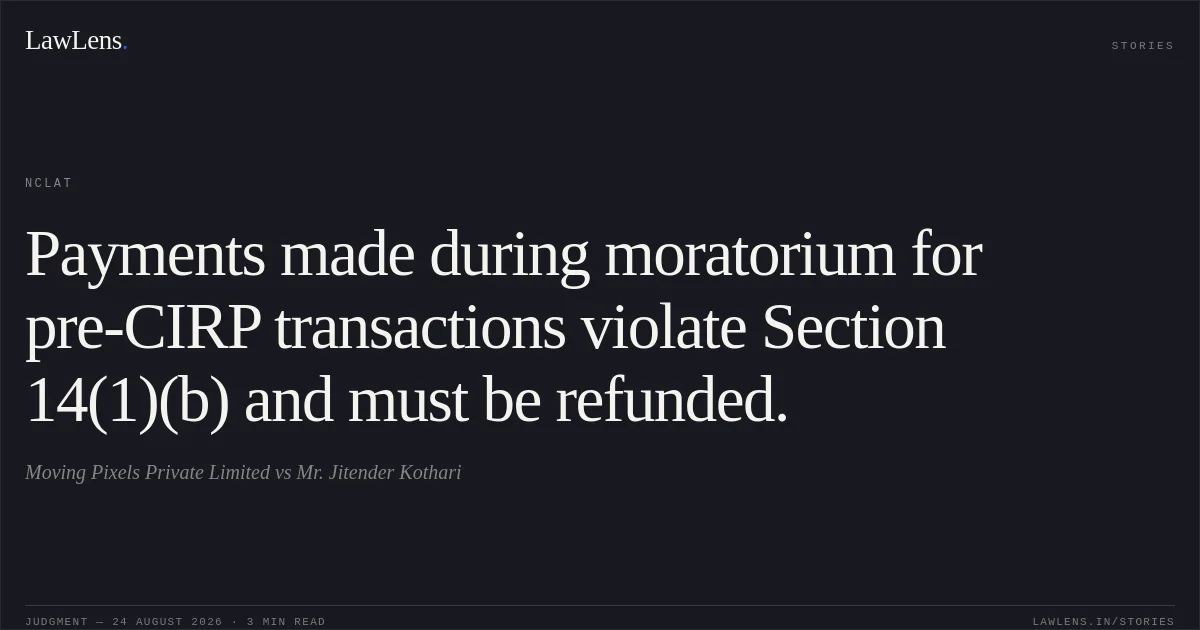
The NCLAT upheld the NCLT’s finding that the transfer of the Corporate Debtor’s funds during the moratorium violated Section 14(1)(b) of the IBC.
Source reference: paras. 16, 24–25The Appellant was consequently required to remit the amount received, together with interest at 18% under Section 3 of the Interest Act, 1978.
Source reference: paras. 16, 24–25Acts & Sections Cited
7 provisions across 2 statutes referred to in this judgment. Each provision opens on LawLens.
Insolvency and Bankruptcy Code, 2016.6
Interest Act, 19781
Original Court PDF
Moving Pixels Private LimitedvsMr. Jitender Kothari
Click to open original judgment
Original judgment, available to read, download and summarize on LawLens.in