Facts
The suit properties were ancestral properties. After Sakharam Ghule’s death, his daughter, Krushnabai, was recorded as one of his legal heirs in the revenue records. The defendants later claimed that the properties had been partitioned before 20 December 2004 under Section 85 of the Maharashtra Land Revenue Code, 1966, without including Krushnabai. She sued for partition and separate possession and obtained an interim injunction restraining the defendants from creating third-party interests or carrying out construction on the properties.
Source reference: p.4, paras. 4–6Defendant No. 14’s appeal against the injunction was dismissed; he then challenged that decision under Article 227 of the Constitution.
Source reference: p.5, paras. 7–8The High Court noted that the injunction had operated since 2016 and that portions of the properties had nevertheless been transferred.
Source reference: p.8, para. 13; p.9, para. 15Issues
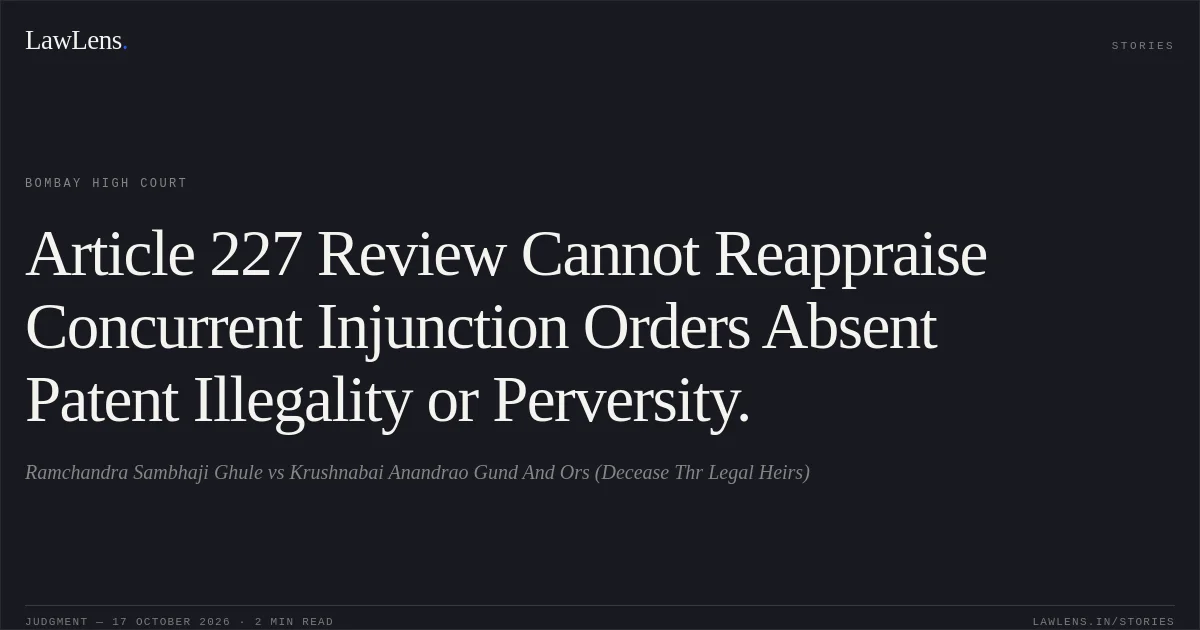
Whether the concurrent orders granting and maintaining the temporary injunction disclosed a patent illegality, jurisdictional error, or perversity warranting interference under Article 227.
Source reference: pp. 8–9, paras. 14–16Whether the defendants’ claim of a pre-20 December 2004 partition, allegedly supported by public documents, displaced Krushnabai’s prima facie claim to a share and justified interfering with the injunction.
Source reference: pp. 6–7, paras. 11–13; p.9, para. 16Law Applied
Article 227 supervisory jurisdiction does not permit the High Court to reappreciate evidence or substitute its view for that of the courts below; interference with discretionary orders is warranted only where they disclose patent illegality, jurisdictional error, or perversity, applying Rajendra Diwan v. Pradeep Kumar Ranibala (2019 SCC OnLine SC 1586).
Source reference: p.8, para. 14Section 6 of the Hindu Succession Act, 1956, as amended in 2005, recognises a daughter’s coparcenary rights; under Section 6(5), a partition before 20 December 2004 may be recognised, with the explanation addressing the form in which such partition must be evidenced. Vineeta Sharma v. Rakesh Sharma ((2020) 9 SCC 1) recognises that, exceptionally, an oral partition supported by public documents and finally evidenced as if effected by a court decree may satisfy that requirement.
Source reference: p.6, para. 11; pp. 6–7, para. 12Reasoning
The High Court found no basis to interfere with the concurrent discretionary orders under the limited Article 227 standard.
Source reference: p.8, para. 14Krushnabai’s recorded status as Sakharam’s legal heir, coupled with the allegation that her name was omitted from the proceedings before the Tahsildar, supported a strong prima facie challenge to the alleged partition; Vineeta Sharma did not advance the petitioner’s case at the interim stage.
Source reference: p.9, para. 16The injunction had remained in force for nearly a decade, and the defendants’ transfers of portions of the properties despite the restraint order further weighed against granting equitable relief and favoured preserving the injunction.
Source reference: pp. 8–9, paras. 15–17Holding
The Court declined to interfere with the concurrent orders maintaining the temporary injunction.
It dismissed the writ petition with costs and discharged the Rule.
Source reference: p.10, paras. 18–19Acts & Sections Cited
2 provisions across 2 statutes referred to in this judgment. Each provision opens on LawLens.
Maharashtra Land Revenue Code, 19661
Hindu Succession Act, 19561
Original Court PDF
Ramchandra Sambhaji GhulevsKrushnabai Anandrao Gund And Ors (Decease Thr Legal Heirs)
Click to open original judgment
Original judgment, available to read, download and summarize on LawLens.in