01Facts
The petitioner (Tippanna, defendant No.1 in the suit) challenged an interlocutory injunction granted against him in O.S. No. 584/2022 on the Original Side of the II Additional Civil Judge and JMFC-II, Dharwad.
¶ 1The suit property is Plot No. 9 in R.S. No. 46/1B+2/1+2+2A/1+1A/2/2, Doddanayakana Koppa, Dharwad, measuring 04 guntas.
¶ 3The property was acquired by the common father under a registered sale deed dated 27.09.1981.
¶ 4The plaintiffs (respondents 1 and 2, the petitioner's brothers) claimed exclusive title under a registered Will dated 23.06.1989 and were entered in revenue records vide M.E. No. 76/2005-06 dated 06.10.2005.
¶ 4The plaintiffs alleged that the petitioner had commenced construction without any right, title or interest.
¶ 5The plaintiffs sought a temporary injunction under Order XXXIX Rules 1 and 2 CPC restraining further construction.
¶ 6The petitioner objected, denying the Will and asserting that he was a co-owner, so the suit for injunction was not maintainable.
¶ 7The Trial Court allowed the application on 08.09.2022.
¶ 8The Appellate Court (III Additional Senior Civil Judge and CJM, Dharwad) dismissed M.A. No. 53/2022 on 05.12.2023 and confirmed the injunction.
¶ 8The petitioner then filed this writ petition under Articles 226 and 227 of the Constitution.
¶ 1, 902Issues
i.1. Whether an order of temporary injunction restraining a co-owner from constructing on the joint property is sustainable in law, given the settled principle that such relief ordinarily cannot be granted against a co-owner.
¶ 10ii.2. Whether the concurrent findings of the Trial Court and Appellate Court, that the plaintiffs established a prima facie case and balance of convenience based on the alleged Will, warrant interference in exercise of supervisory jurisdiction under Article 227.
¶ 13, 1403Law Applied
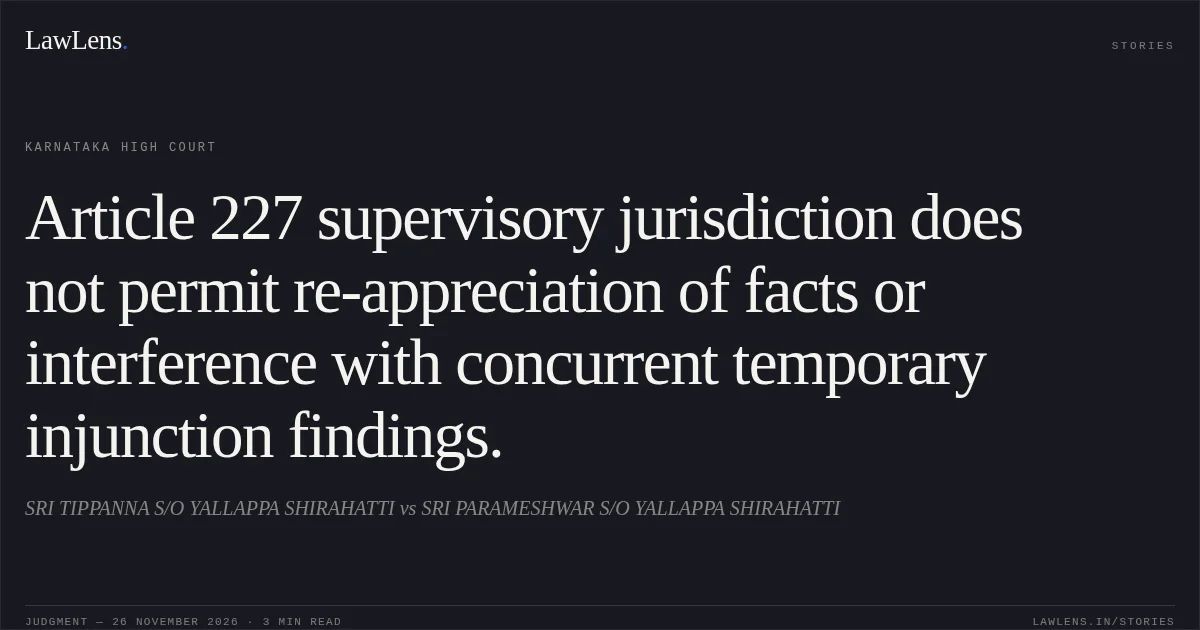
The limited scope of supervisory jurisdiction under Article 227 of the Constitution, under which the High Court does not sit in appeal to re-appreciate facts, and may interfere only to correct jurisdictional or patent errors of law, not merely because another view is possible.
¶ 14The grant of temporary injunction under Order XXXIX Rules 1 and 2 of the CPC, which requires a prima facie case, balance of convenience and irreparable injury.
¶ 6, 13The principle that an injunction cannot ordinarily be granted against a co-owner, noted as the governing principle of law on the petitioner's submission, though the Court did not expressly pronounce upon or apply it.
¶ 10The concurrent findings of the lower courts are treated as binding on the writ court absent perversity.
¶ 13, 1404Reasoning
The Trial Court and Appellate Court concurrently held that the plaintiffs' claim rested on the Will and that the Will, together with the revenue entries, established a prima facie case and favoured the balance of convenience.
¶ 13The petitioner's co-ownership objection was therefore met on the basis of the plaintiffs' asserted exclusive title, which the lower courts accepted at the interlocutory stage.
¶ 7, 11, 13The High Court found that the impugned orders were reasoned concurrent findings on facts and not perverse, and that the petitioner's contention invited a re-appreciation of evidence, which is beyond Article 227.
¶ 10, 14Because the question whether a co-owner may be injuncted depends on the validity and effect of the Will, which is a disputed fact, the Court did not decide the co-owner proposition in the abstract.
¶ 11, 14Recognising that the suit was pending since 2022, the Court directed expeditious disposal without being influenced by its observations on the interlocutory order.
¶ 1405Holding
The Court answered the first issue implicitly by declining to interfere: the injunction was upheld on the basis of the plaintiffs' prima facie case founded on the Will, and the co-owner objection did not displace the concurrent findings.
¶ 13, 14On the second issue, the Court held that concurrent findings on prima facie case and balance of convenience do not warrant interference under Article 227 absent perversity or jurisdictional error.
¶ 14The writ petition was dismissed.
¶ 15(i)The Trial Court was directed to dispose of O.S. No. 584/2022 expeditiously, and in any event within six months from receipt of a certified copy, without being influenced by observations on the temporary injunction.
¶ 15(ii)Original Court PDF
SRI TIPPANNA S/O YALLAPPA SHIRAHATTIvsSRI PARAMESHWAR S/O YALLAPPA SHIRAHATTI
Click to open original judgment
Original judgment, available to read, download and summarize on LawLens.in