01Facts
The respondent, A.S. Navalgund, was a Branch Manager of Union Bank of India at SS Front Road Branch, Vijayapura. Under a bank scheme, he sanctioned loans to farmers for tractors and allied implements. Several borrowers defaulted.
¶ 2 · pp. 2–3An internal enquiry concluded that he had committed irregularities in sanctioning the loans, and the bank initiated both departmental and criminal proceedings.
¶ 2 · pp. 2–3In the departmental proceedings he was found guilty and dismissed from service.
¶ 3 · p. 3He challenged the dismissal in W.P. No. 70887/2012.
¶ 3 · p. 3In Special CBI C.C. No. 10/2013, the Special Judge, Dharwad, acquitted him, along with co-accused, honourably.
¶ 4 · pp. 3–4The learned Single Judge relied on this acquittal, quashed the dismissal order dated 09.08.2007, and directed 50% back wages for 2007–2013 and terminal benefits as if no dismissal existed.
¶ 4 · p. 4The bank appealed.
¶ 4 · p. 4 · ¶ 5 · p. 402Issues
i.1. Whether the Single Judge erred in setting aside the findings of the domestic enquiry and the dismissal order, having regard to the differing standards of proof in criminal and disciplinary proceedings.
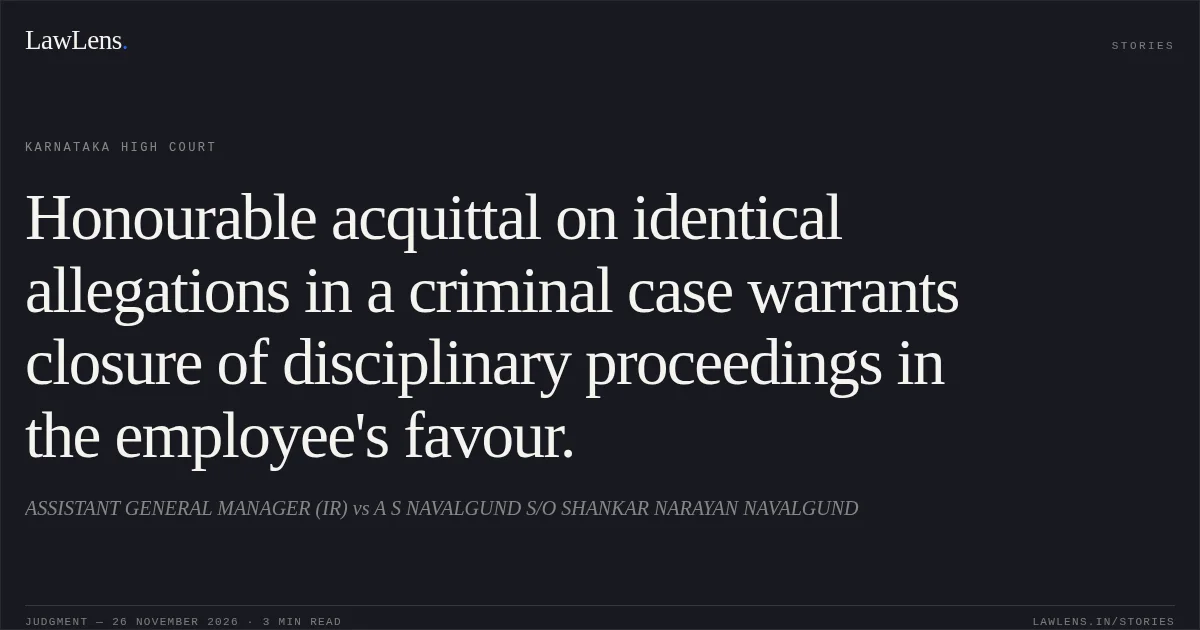
¶ 5 · pp. 4–5ii.2. Whether an honourable acquittal in a criminal case on the same allegations warrants closure of disciplinary proceedings in favour of the employee.
¶ 7 · p. 6iii.3. Whether the bank established the respondent's specific role or error in sanctioning the loans.
¶ 10 · pp. 7–803Law Applied
The prosecution's burden in a criminal case is proof beyond reasonable doubt, whereas the employer's burden in disciplinary proceedings is preponderance of probability.
¶ 7 · p. 6Where an employee is honourably acquitted in a criminal case on the same allegations, the disciplinary proceedings may be closed in his favour.
¶ 7 · p. 6An acquittal founded on a finding that the prosecution failed to prove the accused's involvement is to be treated as an honourable acquittal.
¶ 9 · p. 7Jurisdiction in the writ appeal rests on Section 4 of the Karnataka High Court Act, 1961.
p. 2Provisions in the judgment · 1 · Linked ones open on LawLens
KARNATAKA HIGH COURT ACT, 1961 Section 4
04Reasoning
The Trial Court found that loans were sanctioned after necessary verification, inspection, and collection of documents; that loans were disbursed to tractor suppliers; and that defaults were committed by farmers, after which the bank seized and auctioned the tractors.
¶ 8 · pp. 6–7The Trial Court concluded that the bank had "failed miserably" to prove the involvement of any accused in the alleged crimes or any irregularity in sanctioning the loans.
¶ 8 · pp. 6–7The Court treated this as an honourable acquittal of the respondent.
¶ 9 · p. 7When asked to identify the respondent's role in sanctioning or disbursing the loans and the specific error he committed, the bank's counsel could not answer.
¶ 10 · p. 7The Court found that the bank's position rested only on loan defaults by borrowers, and that initiating proceedings on that basis made the respondent a scapegoat for a commercial decision that caused loss to the bank.
¶ 10 · pp. 7–8The Court therefore found no infirmity in the Single Judge's reasoning.
¶ 11 · p. 805Holding
The respondent's honourable acquittal on the same allegations, combined with the bank's failure to establish any individual role or error, justified upholding the Single Judge's order.
¶ 9–11 · pp. 7–8The writ appeal is dismissed. The Single Judge's order quashing the dismissal dated 09.08.2007, granting 50% back wages for 2007–2013, and directing payment of terminal benefits computed from the date of superannuation is affirmed. The appellants are granted three months from the date of judgment to implement the Single Judge's order.
¶ 4 · p. 4 · ¶ 11 · p. 8 · ¶ 12 · p. 8Original Court PDF
ASSISTANT GENERAL MANAGER (IR)vsA S NAVALGUND S/O SHANKAR NARAYAN NAVALGUND
Click to open original judgment
Original judgment, available to read, download and summarize on LawLens.in