01Facts
The petitioner, an ex-conductor of the NEKRTC Yelburga Depot, was charged with unauthorised absence from duty from 06.08.2009 to 12.09.2009, a period of 38 days.
¶ 2 · ¶ 10A domestic enquiry followed and he was dismissed from service.
¶ 2He challenged the dismissal before the Labour Court, Gulbarga, in K.I.D. No. 110/2010.
¶ 3The Labour Court held, by order dated 14.01.2011, that the domestic enquiry was neither fair nor proper.
¶ 6 · ¶ 7The Corporation alleged a past disciplinary history, which it failed to prove; the petitioner, however, failed to prove that he had sought extension of leave.
¶ 8 · ¶ 9By award dated 23.03.2011, the Labour Court held the 38-day absence to be misconduct but found dismissal disproportionate.
¶ 10The Labour Court set aside the dismissal and directed reinstatement with continuity of service, without back wages from the date of dismissal to reinstatement, and with stoppage of one future annual increment.
¶ 10The petitioner challenged only the denial of back wages, contending that combining that denial with increment stoppage amounted to double jeopardy.
¶ 1 · ¶ 1102Issues
i.1. Whether denial of back wages, combined with stoppage of one future annual increment for the same misconduct, amounts to double punishment (double jeopardy).
¶ 11 · ¶ 14ii.2. Whether the Labour Court's denial of back wages was supported by any reasons.
¶ 1303Law Applied
The petition was filed under Articles 226 and 227 of the Constitution of India.
p. 1A single misconduct may not attract two punitive consequences, so denial of back wages combined with stoppage of an increment constitutes double jeopardy.
¶ 14An award denying relief must give reasons for the denial, and the absence of any reasoning on what weighed with the tribunal is a defect.
¶ 13The finding that the domestic enquiry was unfair is relevant to the propriety of the penalty imposed on that foundation.
¶ 1204Reasoning
The Labour Court accepted that the petitioner was guilty of misconduct but found dismissal disproportionate and substituted reinstatement.
¶ 10The Court observed that the Labour Court had itself found the enquiry unfair, and that the dismissal, a major penalty, was imposed on that flawed enquiry.
¶ 12The Labour Court nonetheless imposed two consequences for the same 38-day absence: loss of back wages for the entire period between dismissal and reinstatement, and stoppage of one future increment.
¶ 10 · ¶ 11Applying its reasoning in para. 14, the Court held this cumulative penalty to be double jeopardy.
¶ 14The Court found that the Labour Court gave no reason for denying back wages or for the cumulative penalty.
¶ 13The petitioner's relief was limited to back wages: the Court did not revisit the finding of misconduct, the disproportionality finding, or the reinstatement with continuity.
¶ 1505Holding
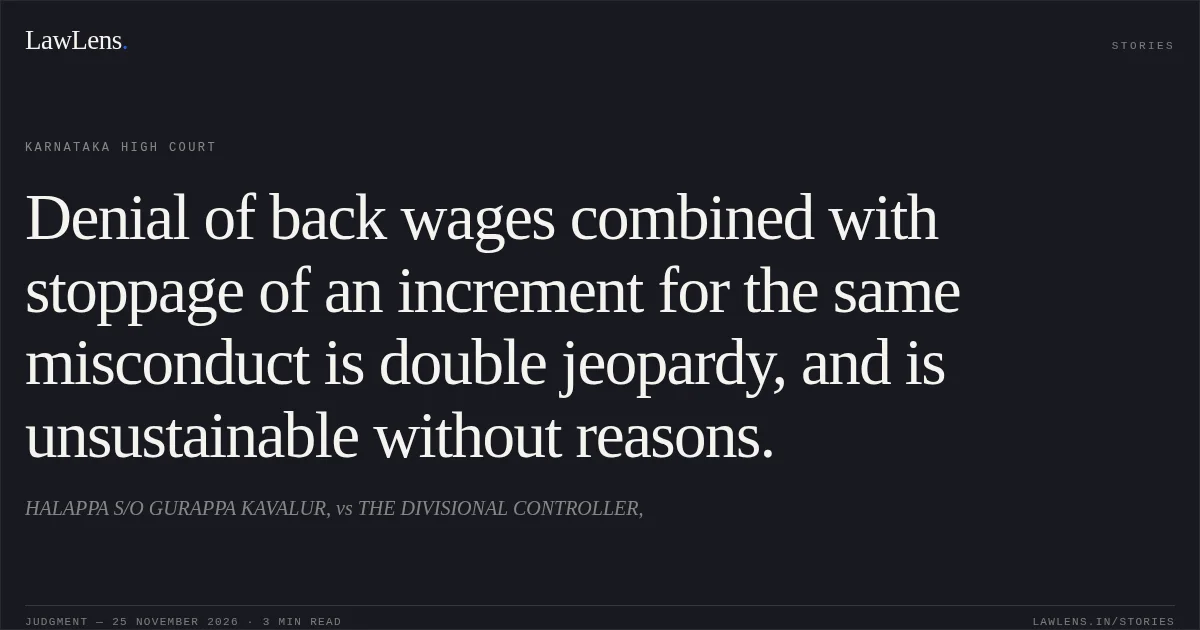
Denying back wages alongside stoppage of one future increment for the same misconduct amounts to double jeopardy, and the Labour Court's denial of back wages was unreasoned.
¶ 13 · ¶ 14The writ petition was allowed to the extent that the Labour Court's direction denying back wages from the date of dismissal to the date of reinstatement was set aside, and the Corporation was directed to pay back wages for that period. No order as to costs.
¶ 15 · ¶ 16(i) · ¶ 16(ii) · ¶ 16(iii)Note: The operative order does not expressly quash the stoppage of one future increment, although para. 14 treats the combination as impermissible. Practitioners should verify whether the increment stoppage stands as originally directed or must be separately challenged or clarified.
¶ 14 · ¶ 16Original Court PDF
HALAPPA S/O GURAPPA KAVALUR,vsTHE DIVISIONAL CONTROLLER,
Click to open original judgment
Original judgment, available to read, download and summarize on LawLens.in