01Facts
On 08.09.2015, at about 3:00 p.m., the appellant was a pillion rider on a motorcycle near Nagaj Village, Sangli District, when a Bolero vehicle (MH-50-A-1689), allegedly driven rashly and negligently, dashed against it
¶ 3 · p. 3The appellant sustained grievous injuries, namely a fracture of the tibia and fibula of the right leg
¶ 13 · p. 7He was an inpatient from 08.09.2015 to 30.09.2015, a period of 23 days
¶ 13 · p. 7He filed MVC No. 357/2016 before the Additional MACT, Chikodi.
p. 3Respondent No. 1 (owner) was placed ex parte
¶ 4 · p. 3Respondent No. 2 (insurer) admitted the policy but denied negligence, the appellant's age and occupation, and liability, contending that the driver lacked a valid licence
¶ 4 · p. 3Before the Tribunal, the appellant examined himself (P.W.1) and a doctor (P.W.2) and marked Exs. P1–P16. The respondents led no evidence
¶ 6 · pp. 4–5The Tribunal awarded ₹2,57,643/-
¶ 7 · pp. 5–6The appellant sought enhancement, contending that the income and disability assessment were incorrect and that the awards under pain and suffering, conveyance, loss of income during treatment, and loss of amenities were inadequate
¶ 9 · pp. 5–6Respondent No. 2 supported the Tribunal's award
¶ 10 · p. 602Issues
i.1. Whether the appellant is entitled to enhancement of the compensation awarded by the Tribunal and, if so, to what extent.
¶ 11 · p. 6ii.2. Whether any consequential order, including the mode of payment, interest, and costs, is warranted on the enhanced amount.
¶ 11(ii) · p. 6 · ¶ 20 · pp. 9–1003Law Applied
The judgment rests on the appellate jurisdiction conferred by Section 173(1) of the Motor Vehicles Act, 1988, under which the appeal was filed
p. 1The judgment does not expressly cite any statutory provision on quantum or any judicial precedent
Compensation for personal injury must be just and reasonable, assessed under distinct heads (pain and suffering, medical expenses, incidental and conveyance charges, loss of earnings during the laid-up period, future loss of income, future medical expenses, and loss of amenities) on the basis of the nature of injury, duration of treatment, recovery period, and permanent disability
¶ 13–15 · pp. 7–8The award under each head is subject to reassessment on the evidence, and the impugned award is modifiable in appeal
¶ 20 · p. 9Provisions in the judgment · 1 · Linked ones open on LawLens
Motor Vehicles Act, 1988 Section 173
04Reasoning
The Court accepted the medical evidence of fractures of both the tibia and fibula, the 23-day inpatient stay, and the 9% permanent disability as established
¶ 13, 15 · pp. 7–8Applying the just-and-reasonable standard, the Court enhanced pain and suffering from ₹30,000 to ₹40,000
¶ 13 · p. 7 · ¶ 17The Court awarded ₹10,000 under the head of conveyance (described in the text as "convenience") and enhanced incidental charges from ₹9,600 to ₹20,000
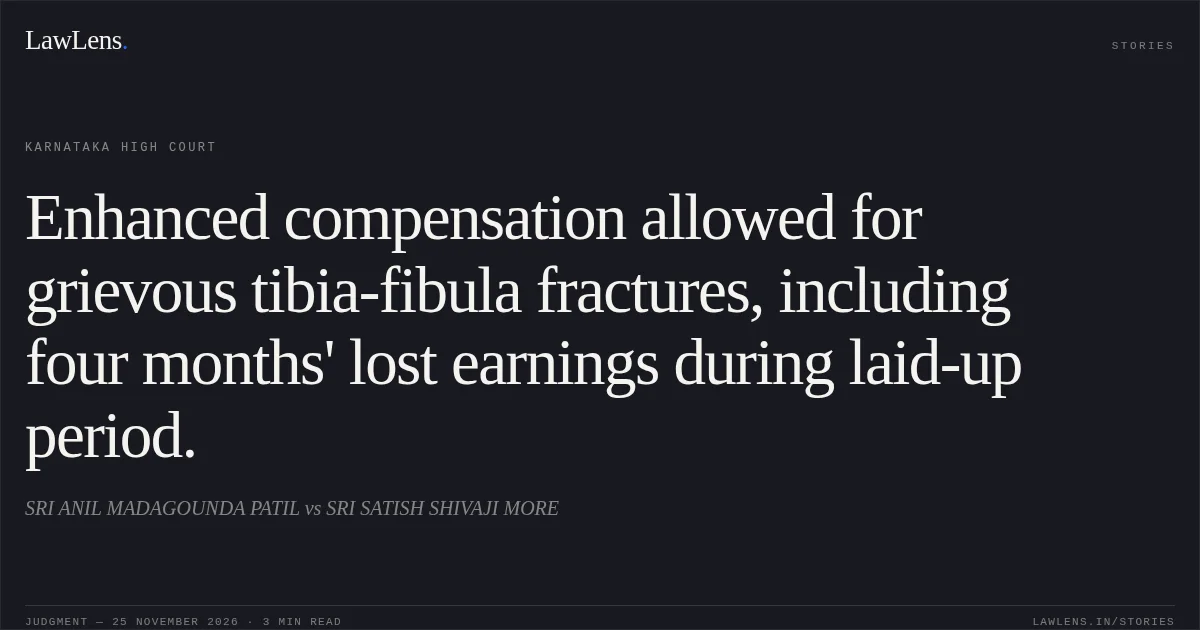
¶ 13, 17Because the injuries required about four months of recovery during which the appellant could not work, the Court awarded ₹32,000 for loss of earnings during the laid-up period, replacing the Tribunal's ₹22,133
¶ 14 · p. 8The two fractures and 9% disability justified enhancing loss of amenities from ₹5,000 to ₹25,000
¶ 15 · p. 8The Court found the Tribunal's awards for medical expenses (₹88,150), future medical expenses (₹20,000), and future loss of income due to disability (₹77,760) adequate and declined to interfere
¶ 16 · p. 8The judgment does not record a separate reasoned finding on the appellant's specific challenge to the assessed income and disability percentage, beyond affirming the future loss of income award
¶ 9, 16The enhanced total of ₹3,12,910/- (an increase of ₹55,267/-) was computed by summing the revised heads
¶ 17–18 · pp. 8–905Holding
The appellant is entitled to enhancement, and the Court answers Issue 1 in the affirmative
¶ 19 · p. 9The appeal is partly allowed. The Tribunal's award is modified to ₹3,12,910/- (against ₹2,57,643/-), carrying interest at 6% per annum
¶ 20(i)–(ii) · p. 9The appellant is not entitled to interest on the enhanced amount for the delayed period
¶ 20(iii) · p. 10The insurer (Respondent No. 2) must deposit the compensation with accrued interest before the Tribunal within eight weeks of receipt of the certified copy
¶ 20(iv) · p. 10A modified decree is to be drawn, no order as to costs is made, pending interlocutory applications stand disposed of, and the TCR is to be transmitted to the Tribunal
¶ 20(v)–(viii) · p. 10Original Court PDF
SRI ANIL MADAGOUNDA PATILvsSRI SATISH SHIVAJI MORE
Click to open original judgment
Original judgment, available to read, download and summarize on LawLens.in