01Facts
The claimant's son, Venkatesh, died in a road traffic accident on 24.02.2014 involving a luggage goods auto-rickshaw (KA-06/C-4172) owned by Respondent No. 1, insured by Respondent No. 2 (United India Insurance).
¶ 3The claimant alleged that the deceased was working as a loader-cum-unloader, that the driver drove rashly and the vehicle overturned into a ditch, and that the deceased fell and was fatally injured.
¶ 4The records state he died on 26.10.2024; this date appears inconsistent with the 2014 accident and the 2022 award and should be verified.
¶ 4Both respondents denied the claim; the insurer admitted a valid policy but pleaded policy conditions.
¶ 5During pendency, the original claimant (mother) died and her elder sister was brought on record as LR.
¶ 6The Tribunal awarded Rs. 8,68,000 (medical Rs. 32,000; consortium Rs. 40,000; estate Rs. 15,000; transport/funeral Rs. 25,000; dependency Rs. 7,56,000).
¶ 7The LR appealed for enhancement and the insurer appealed on liability and quantum.
¶ 8The insurer contended that the deceased was a gratuitous passenger, that the policy did not cover employees (the Rs. 50 premium covering only the driver), that the LR was not dependent on the deceased, and sought remand on IA No. 2/2023 (MLC extract, PW-1's criminal-case deposition, and judgment in CC No. 56/2015).
¶ 10–12The claimant contended that the Rs. 50 premium covers one employee, that the insurer led no evidence rebutting the employment, and that income should be Rs. 8,500 per month per the KSLSA chart.
¶ 1302Issues
i.1. Whether the LR of the claimant can be considered a dependant of the deceased.
¶ 15ii.2. Whether the insurance policy covered the risk of the deceased.
¶ 15iii.3. Whether the deceased was travelling in the offending vehicle as a gratuitous passenger or as a loader-cum-unloader (employee).
¶ 1503Law Applied
The Motor Vehicles Act, 1988 (ss. 166, 168, 173) provides the framework of compensation and appeals.
¶ 3, 15Gujarat SRTC v. Ramanbhai Prabhatbhai (1987) 3 SCC 234: every LR suffering loss from a motor accident death has a remedy, and a brother may claim as LR.
¶ 28National Insurance Co. v. Birender (2020) 11 SCC 356: major married and earning children, as LRs, may claim irrespective of full dependence, but the claim is not confined to conventional heads.
¶ 28, 30Seema Rani and Deep Shikha (2025): a married daughter is not a dependant for loss of dependency unless she proves financial dependence on the deceased.
¶ 30–31Shriram General Insurance v. Meena Rajmal Kataria and Manjuri Bera v. Oriental Insurance: no-fault liability under s. 140 does not depend on dependency.
¶ 32–34A. Manavalagan v. A. Krishnamurthy (2005 ACJ 992): where claimants are non-dependent siblings, savings are taken at 15% of income for loss of estate.
¶ 28, 35B.V. Gopala and George Menezes: estate-loss principles.
¶ 28National Insurance v. Pranay Sethi (2017) 16 SCC 680: 40% future prospects for age below 40; Sarla Verma: multiplier 18 for ages 16–20; Magma General v. Nanu Ram (2018 ACJ 2782): consortium and funeral heads, with 10% escalation.
¶ 40–41The KSLSA chart is applied as a basis for notional income where documentary proof is absent.
¶ 39Provisions in the judgment · 8 · Linked ones open on LawLens
Motor Vehicles Act, 1988 Section 173Section 166Section 168Section 140Section 165Section 163Section 2
Code of Civil Procedure, 1908 Section 151
04Reasoning
The LR (elder sister) may file as an LR, but she is not a dependant. The claim petition was filed by the mother, and the sister came on record only as LR without amending the petition or pleading dependence on the deceased.
¶ 26–27, 37Her oral evidence on dependence could not be considered in the absence of pleading, and she was therefore denied loss of dependency and awarded only loss of estate.
¶ 38The Court relied on the Rs. 50 premium collected for one employee and the Rs. 100 owner-driver premium, reasoning that the deceased was travelling as an employee rather than a passenger, so the risk was covered.
¶ 24The Court found the MLC register entry ("history of fall from moving auto rickshaw") consistent with the charge-sheet's account of rash driving and the vehicle overturning into a ditch, so the accident was established.
¶ 21–22The complaint and PW-1/PW-2 evidence did not describe the deceased as a loader-cum-unloader, but nothing was elicited in cross-examination to dispute it, and respondents led no evidence (including from the owner) to rebut employment.
¶ 18, 23The insurer's remand request was not separately adjudicated in the reasons; the Court dealt with the material on record.
¶ 12, 20–23On quantum, the Court substituted notional income of Rs. 8,500 per month for Rs. 5,000, applied 40% future prospects and multiplier 18, and reduced the estate-loss fraction to one-fourth of income (not 50%), yielding Rs. 6,42,600 for loss of estate.
¶ 39–40Consortium (Rs. 40,000) and funeral (Rs. 15,000) were enhanced by 10% and a further 10% escalation. No loss of dependency was awarded.
¶ 41–4205Holding
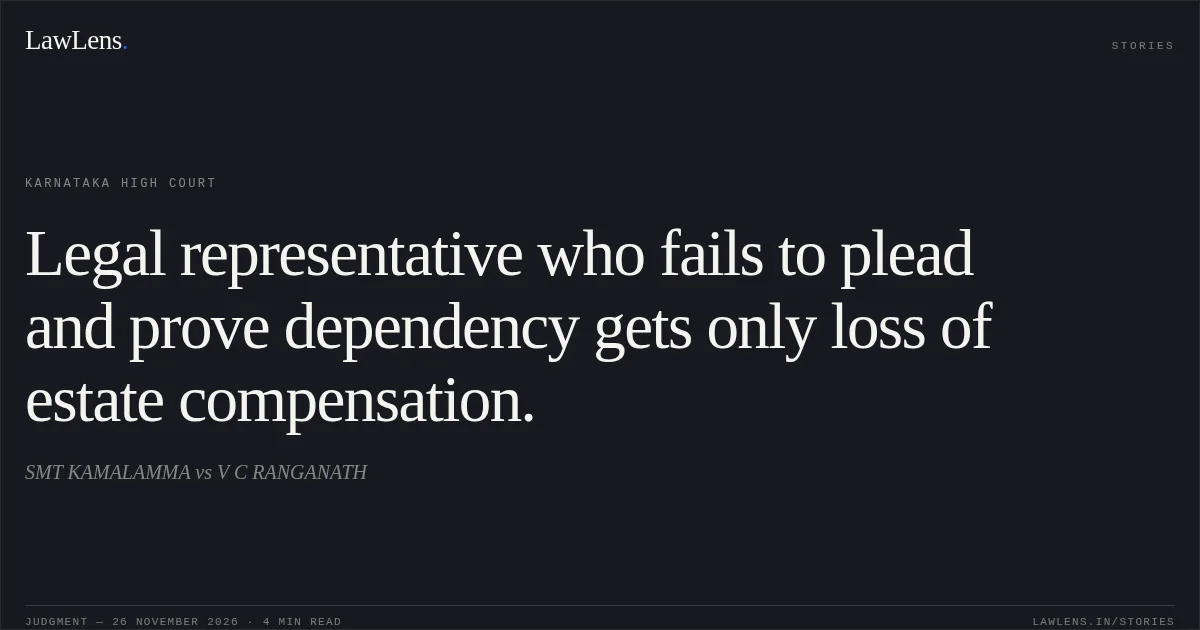
The LR is not a dependant and is entitled only to loss of estate, not loss of dependency.
¶ 37–38The policy covered the deceased, as he was an employee and not a gratuitous passenger; the deceased was a loader-cum-unloader.
¶ 19, 23, 24Both appeals were allowed in part. The compensation was modified to Rs. 7,41,150 (medical Rs. 32,000; consortium Rs. 48,400; estate Rs. 6,42,600; funeral Rs. 18,150; dependency nil) instead of Rs. 8,68,000.
¶ 42, 43(i), 43(ii)Interest at 6% p.a. is payable. The insurer must deposit the amount with accrued interest before the Tribunal within eight weeks of receiving the certified copy. Disbursement is per the Tribunal's award, with no costs; the modified award is to be drawn and the TCR transmitted to the Tribunal.
¶ 43(iii), 43(iv), 43(v)–(viii)Original Court PDF
SMT KAMALAMMAvsV C RANGANATH
Click to open original judgment
Original judgment, available to read, download and summarize on LawLens.in